Abstract:Institutional APIs and chart terminals both send orders to the same broker and liquidity providers, but the number of hands involved, the location of the pre-trade check and the way errors are reported all differ. A hypothetical EUR/USD walkthrough shows why a faster route is not the same thing as a better trade.

 Contents
What an order routing path really means
Every forex order travels a route, from the moment you give an instruction to the moment you learn which price you received. That journey is the order routing path. Two front ends can start it: an API, short for application programming interface, which is a set of rules that lets one computer program send instructions to another without a person clicking, and a graphical terminal, the screen with charts and buttons where a human does the clicking.
Both end up at the same destination: a broker and, usually, one or more liquidity providers. A liquidity provider is a party that quotes prices and takes the other side of your trade. Routing describes how an instruction travels, not whether the trade itself makes sense.
The stages an order passes through
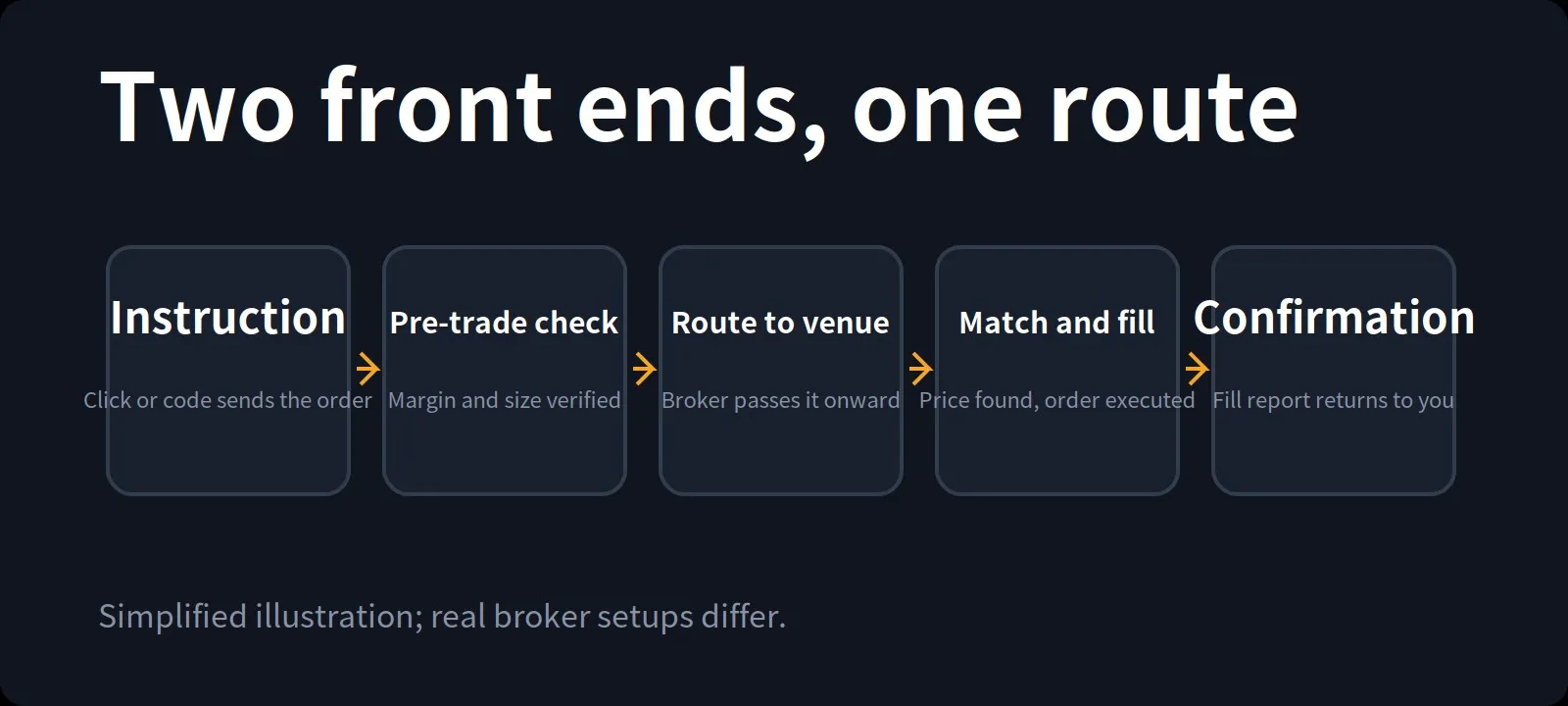
Most retail forex orders move through a similar sequence, whichever front end starts them:
- Instruction: you choose a market order, which means trading now at the best available price, and the terminal or your own code sends it onward.
- Pre-trade check: the broker's system confirms the order size, your available margin (the funds set aside as collateral), and whether the instrument is open for trading.
- Routing to a venue: the broker passes the order to a liquidity provider or a matching engine, the system that pairs buyers with sellers.
- Matching and fill: a price is found and the order is filled, meaning executed. A partial fill means only part of the size is executed.
- Confirmation: a fill report travels back so your platform can show the open position.
Read that list backwards too. A confirmation that never arrives is as much a part of routing as the click that started everything.
How an instruction becomes a confirmed fill
A hypothetical walk through both routes
Assume, purely for illustration, that a trader wants to buy one standard lot of EUR/USD, meaning 100,000 units of the euro. The assumed quote in this made-up scenario is 1.1215, a placeholder chosen for the walkthrough and not a live market level. Nothing here is an instruction to trade.
On a chart terminal, the trader sees the quote, clicks buy, and the platform runs the pre-trade check before sending the order onward. On an API, a small program has already checked the account balance, so the request leaves as a formatted message carrying instrument, size, direction and order type. The screen is replaced by a fixed template.
Now suppose the assumed price drifts from 1.1215 to 1.1216 while the order is in transit, a change of one pip, where a pip is the standard smallest quoted step for the pair (0.0001 here). The terminal route may return a fill at 1.1216, so the trader enters slightly worse than the screen showed a moment earlier. The API route carries exactly the same exposure to that change; an API does not conjure a better price.
On one standard lot, that single pip equals about 10 US dollars of difference, a small mechanical detail that turns into a visible number. What the API can change is how quickly the request is acknowledged, how errors are reported, and whether a partial fill is handled automatically. A person watching a screen can cancel a working order by hand, while a program needs an explicit rule for every outcome it might receive.
That contrast between judgement and pre-written rules outlasts the speed question.
Where beginners misread the difference
- Faster routing is not better trading. Latency, the delay between sending a message and receiving a reply, affects the mechanics of execution, not the quality of the idea behind a trade.
- An API does not bypass the broker. Your order still meets the same counterparties, spreads and slippage, which is the gap between the price you expected and the price you actually got.
- A chart terminal is not the amateur option. Many professional desks keep a person in front of a screen precisely because a human can judge an unusual error message.
- Automation moves risk rather than removing it. Coding mistakes, dropped connections and duplicate messages become operational risks you now carry.
- Neither route says anything about direction. One is plumbing, the other is plumbing with a different set of pipes.
An order routing path decides how an instruction travels and how its result is reported to you. It says nothing about whether a trade is a sound idea, and no routing choice removes market risk.
Finally, WikiFX would like to remind everyone that before using any US stock, futures, or forex brokers, remember to check the platform's regulatory information, trading environment, field inspection reports, user reviews, and overall rating on the WikiFX App. This will help you effectively avoid problematic scam platforms and rogue brokers, safeguarding your capital.