Abstract:Spreads widen between the New York close and the Sydney open because far fewer participants are quoting, so each dealer needs more room to take the other side. This guide defines bid, ask and pip, explains why depth drains in that window, and works through a hypothetical EURUSD example showing how the same position can cost five times more to enter.

 Contents
The spread is a quote gap, not a fee
A forex quote always has two sides. The bid is the highest price at which a dealer will buy the base currency from you, and the ask is the lowest price at which that dealer will sell it to you. The spread is the distance between the best bid and the best ask among all dealers quoting at that moment, which is why it changes from second to second.
Retail platforms usually label the ask as the buy button and the bid as the sell button, so the gap appears against you the instant you open a position. That is precisely what it is: a cost of crossing from one side of the quote to the other. It carries no information about where price will go next.
Spreads are normally quoted in pips. A pip is the standard unit of price change for a pair, most often the fourth decimal place, so one pip on EURUSD is 0.0001. A spread of 0.4 pips therefore means the ask sits 0.00004 above the bid.
Why the gap between sessions is thin
Liquidity is the number of orders resting near the current price, ready to trade at short notice. When many participants compete, quotes crowd together and the gap between best bid and best ask stays narrow. When few are present, each dealer needs more room before committing capital, because finding someone to take the other side becomes harder.
This is where the trading day matters. Banks and funds supply most of the depth, and they work local hours. The London and New York overlap is the busiest window; once New York desks wind down and Sydney has not yet reached full staffing, the book thins quickly and quotes spread apart.
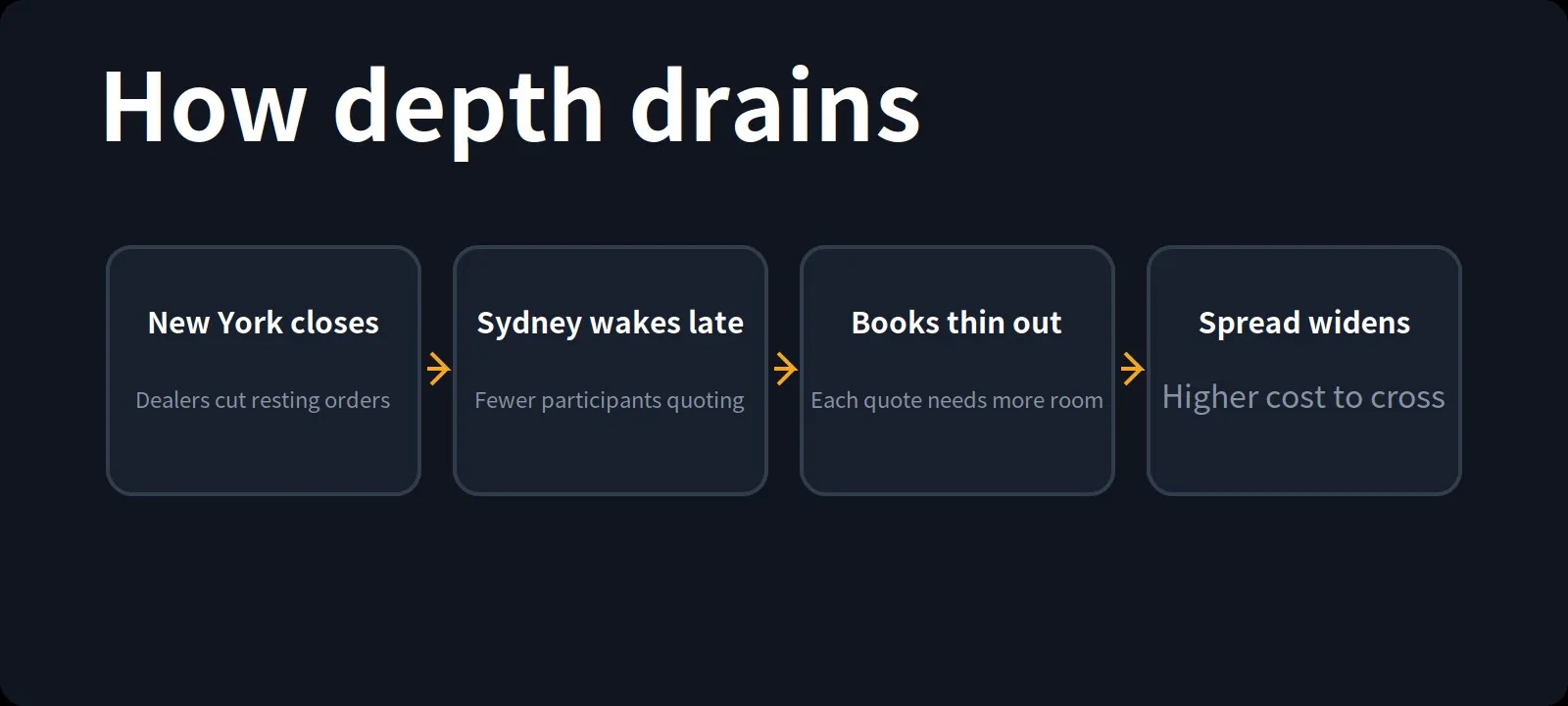
A sequence that repeats each trading day
The daily rollover sits in the same window. Positions still open when the trading day rolls get a financing adjustment that can be a credit or a charge, depending on the pair and the direction held. Some participants close or avoid opening around that point, which removes more resting orders just as depth is already falling.
Doing the arithmetic on a wider spread
The cost of crossing the spread has a short formula: spread cost = (ask - bid) × units traded.
- Measure the gap in price terms by subtracting the bid from the ask.
- Convert it to pips by dividing by the pip size, which is 0.0001 for EURUSD.
- Multiply the price gap by the number of units transacted, because the gap is charged on every unit.
- Convert the result into your account currency if the pair's quote currency differs from it.
Now a hypothetical example, using invented quotes built around a EURUSD level of 1.1215. These numbers exist only for teaching and are not live prices.
During the London and New York overlap, suppose the quote reads bid 1.12148 and ask 1.12152. The gap is 0.00004, or 0.4 pips. Later, after New York has closed and before Sydney is fully active, suppose the quote reads bid 1.12130 and ask 1.12150. The gap is now 0.00020, or 2.0 pips.
For a hypothetical 100,000-unit transaction, the entry cost is 0.00004 × 100,000 = 4 USD in the busy window and 0.00020 × 100,000 = 20 USD in the quiet one. Five times the cost for the same pair and the same size. That figure assumes the account is denominated in US dollars; an account held in another currency would need a conversion at the going rate, which brings its own uncertainty.
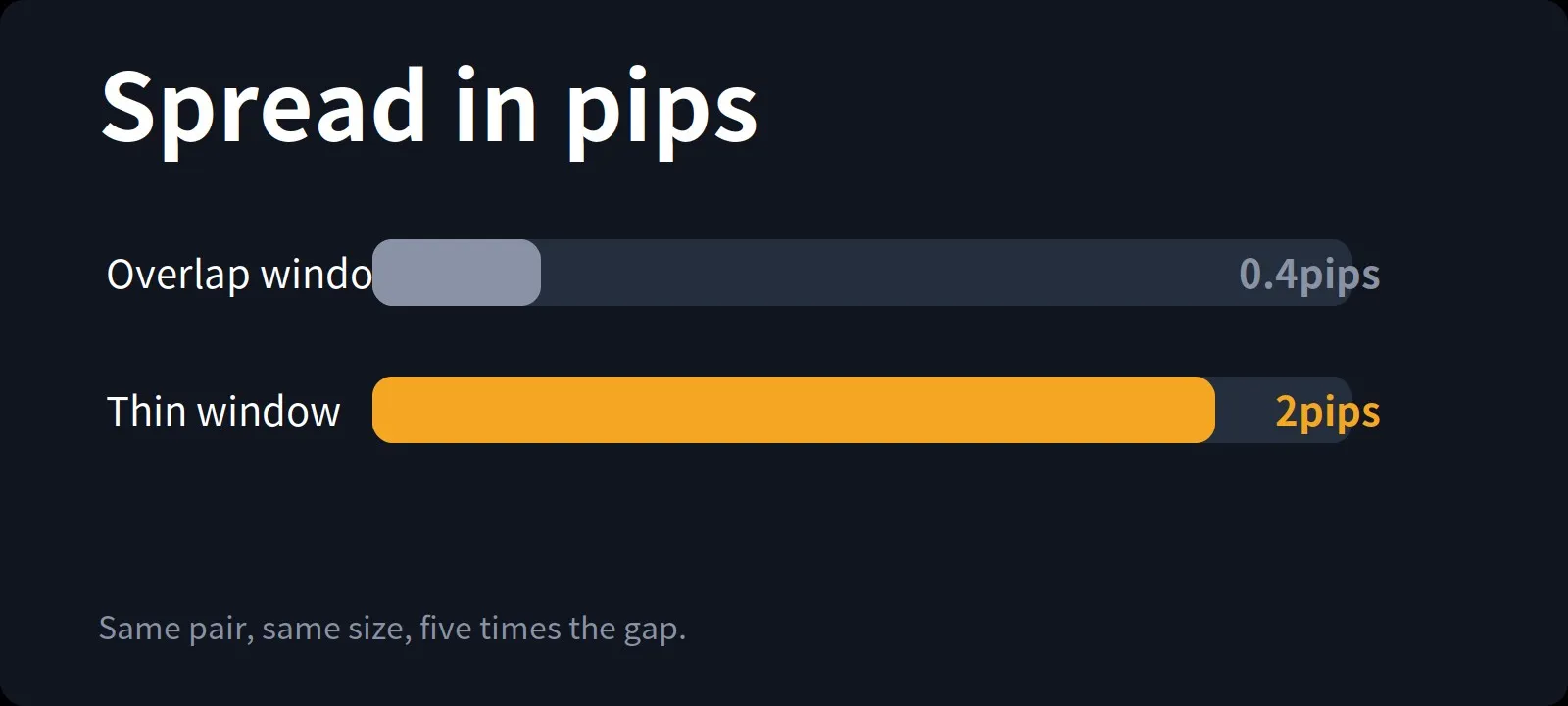
Hypothetical EURUSD quotes
Where beginners misread the picture
- Treating the spread as a fixed property of a pair. It is quoted live and shifts with order flow, scheduled data releases and the time of day.
- Comparing pip spreads across different pairs as if the numbers were equivalent money. One pip is worth different amounts per unit depending on the pair and the exchange rate.
- Reading a wide spread as a forecast. A thin book describes how many people are willing to trade, not which way price will move.
- Assuming a displayed quote is available in any size. With fewer resting orders, larger tickets may fill at prices different from the one on screen.
- Confusing quiet with closed. The forex market runs through the week, but depth varies hour by hour; the weekend shutdown is the extreme case where quoting stops altogether.
What this explains, and what it does not
The session clock explains one part of trading cost very clearly: fewer participants means wider quotes, and wider quotes mean a larger gap to cross. It does not say that one hour is better than another for you, and it says nothing about direction.
A spread is a live measurement of how many people are willing to meet you at a given price. Reading it that way keeps the number in its proper place, as a cost to be understood rather than a signal to be followed.
Finally, WikiFX would like to remind everyone that before using any US stock, futures, or forex brokers, remember to check the platform's regulatory information, trading environment, field inspection reports, user reviews, and overall rating on the WikiFX App. This will help you effectively avoid problematic scam platforms and rogue brokers, safeguarding your capital.