Abstract:Slippage is the difference between an expected forex price and the actual fill. It can be positive or negative, and it appears when quotes move, liquidity is thin, order size is large, or a stop becomes a market order. A hypothetical EUR/USD example shows how to measure the gap in pips without treating it as a trading signal.

 Contents
What slippage means in forex
Slippage is the difference between the price a trader expected for an order and the price actually received. It is not a fee, a spread, or a forecast. It is an execution result, and it can move either way.
A simple boundary helps: slippage describes how an order was filled, not where the market will go next. A fill can be better than expected, which is positive slippage, or worse, which is negative slippage. Both are normal parts of a market where prices change continuously.
The term appears most often with market orders. A market order is an instruction to trade now at the best price available. It does not reserve a price in advance. That single feature explains most slippage.
The price you see is not a promise
A quote on a screen is a snapshot. It tells you what someone was willing to pay or accept at that moment, not what will be available when your order reaches the market. Prices update as orders are added, changed, and removed.
A market order does not reserve a price. It asks to trade now at the best available price. Between the moment the order leaves your platform and the moment it is matched, the quote can change. If the best price is no longer there, the next available price is used.
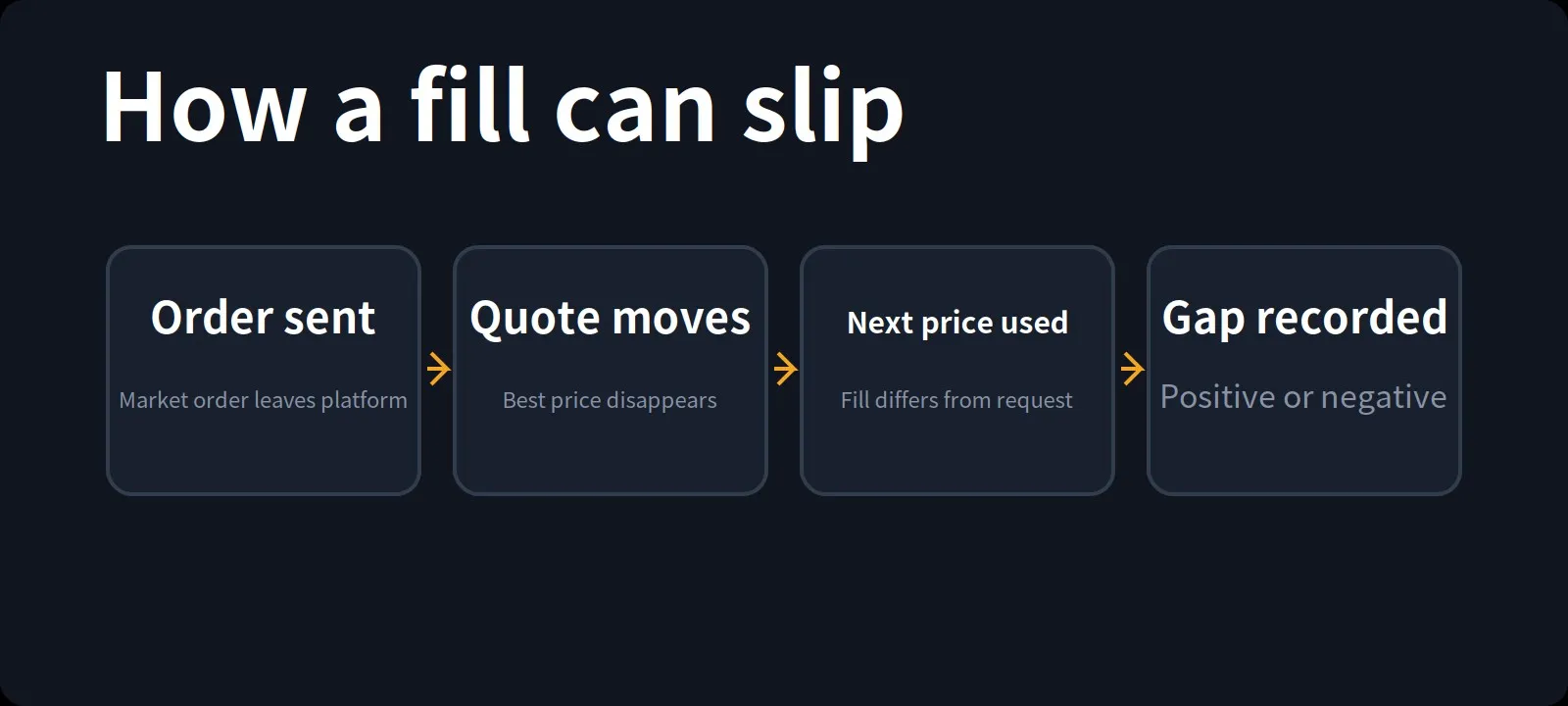
A market order follows available prices, not the first quote seen.
Liquidity is the next piece. Liquidity means how easily an asset can be traded near the current price without moving that price. When liquidity is thin, there are fewer orders at each price level. A trade that is small in a deep market can become large in a thin one.
Conditions that often widen the gap include major data releases, the first moments after a market opens, and quiet periods when few participants are active. Weekend or holiday gaps can also matter. When trading resumes, the first available price may be far from the last quote before the break.
Order size is another factor. A small order may be filled at one price. A larger order may use several prices in the order book, so the average fill is different from the first quote seen. This is not a special penalty. It is the market absorbing the size.
How to measure slippage
Measure slippage in the direction that matters for the order. For a buy, slippage equals the executed price minus the expected price. For a sell, slippage equals the expected price minus the executed price. A negative result is negative slippage; a positive result is positive slippage.
To express the gap in pips, divide the price difference by one pip. For most major pairs quoted to four decimal places, one pip is 0.0001. A pip is a standard unit of price movement in forex. It makes small price changes easier to compare.
Hypothetical teaching example, not a trade instruction. Assume a platform shows EUR/USD at 1.1215 and a trader submits a buy market order expecting that price. The order fills at 1.1219. The difference is 0.0004, or 4 pips. Because the buy filled higher than expected, this is 4 pips of negative slippage.
On a standard lot, which is 100,000 units of the first currency in the pair, one pip of EUR/USD is usually worth about USD 10 when the account currency is US dollars. A gap of 4 pips would be about USD 40 worse than expected. If the same buy had filled at 1.1212 instead, the result would be 3 pips of positive slippage, or about USD 30 better. The example is arithmetic, not a suggestion to buy or sell.
Where beginners get slippage wrong
- Slippage is always a loss. Positive slippage exists. A buy can fill lower than expected, or a sell higher, when the market moves in the trader's favour between order and execution.
- Slippage and spread are the same thing. The spread is the normal gap between the bid (sell) quote and the ask (buy) quote at a given moment. Slippage is the gap between expected and actual execution. They can appear together, but they are separate ideas.
- A stop-loss guarantees a price. A stop-loss is an order that triggers at a chosen level, but the trigger is not always the fill. Once triggered, it can become a market order, so negative slippage is possible in fast markets.
- Every bad fill is unfair dealing. Price movement can explain many gaps, especially around news. Execution quality and market conditions still matter, and a trader can keep records of expected and actual fills to see patterns. That is observation, not proof of misconduct.
- Order size has no effect. Large orders can consume several price levels, so the average fill may differ from the quote first seen. This is one reason the same market can feel different to different participants.
What slippage is and is not
Slippage is an execution outcome. It is not a fixed cost, not a trading signal, and not a promise of profit or loss. A positive fill does not make a strategy sound, and a negative fill does not by itself prove that a broker acted badly.
The useful part is narrower: conditions such as thin liquidity, fast price changes, large order size, and stop orders that turn into market orders make fills less predictable. The order type also matters. A limit order sets a maximum buy price or minimum sell price, so it may avoid negative slippage, but it can also stay unfilled. That trade-off belongs to order handling, not to a recommendation.
Slippage is best understood as the price of immediacy when the market cannot stand still. It can help or hurt. Knowing why it happens makes the fill report easier to read, without turning one result into a rule about the next.
Finally, WikiFX would like to remind everyone that before using any US stock, futures, or forex brokers, remember to check the platform's regulatory information, trading environment, field inspection reports, user reviews, and overall rating on the WikiFX App. This will help you effectively avoid problematic scam platforms and rogue brokers, safeguarding your capital.