Abstract:Copy trading does not copy prices, it copies instructions, and instructions take time to travel. This guide defines latency, signal, slippage, spread and liquidity, walks through the four stages a copied order typically follows, and works through a clearly hypothetical EUR/USD example where a 6 pip gap appears during a data release. It closes with the misreadings beginners make most often and a clear boundary: timing explains the difference between two fill prices, not the quality of a strategy.

 Contents
Why the copy can arrive at a different price
Many new copy-trading users picture the arrangement as a mirror: the moment the trader they follow opens a position, an identical position should appear in their own account at the same price. In calm conditions that picture is close enough to be useful. During a burst of volatility it breaks down, and the copied order may arrive late, smaller, or a few pips away from the price that was quoted when the signal was sent.
Four terms carry most of the explanation. Latency is the total time between an event and the system's reaction to it. A signal is the platform's message that the source account has opened, closed, or adjusted a position. Slippage is the gap between the price a trader expected and the price actually received. The spread is the difference between the buy quote and the sell quote, and it is the most visible cost of any trade.
One more term matters later: liquidity, meaning the amount of opposite interest available to fill an order at or near the quoted price. When liquidity thins, an order has to travel further to find a match, and the price it finally gets reflects that search.
The route a copied signal travels
In most retail social-copy setups, a copied order passes through four stages, and each stage adds time.
- The signal is created. Software watching the source account notices the change and stamps it with a time.
- The signal crosses the network. It travels from the source platform's server to the copy server, a hop measured in milliseconds, meaning thousandths of a second.
- The order is sized and routed. The copy engine scales the trade to your chosen ratio, the setting that decides what fraction of the source trade's size your account repeats, then sends it to your broker, where it is quoted at the current spread.
- The fill returns. Your broker matches the order against available liquidity and reports the price that was genuinely available.
Platforms differ in how they route and execute, so the stages above are a general map rather than a description of every system. What holds across most of them is that in quiet hours the four stages finish so fast that the difference rarely matters, while in a spike several stages slow at once: more accounts copy the same signal, servers queue, spreads widen, and liquidity thins exactly when demand for it rises. Delay tends to grow with the number of followers and with market conditions, and in some setups it also depends on whether your own device stays connected.
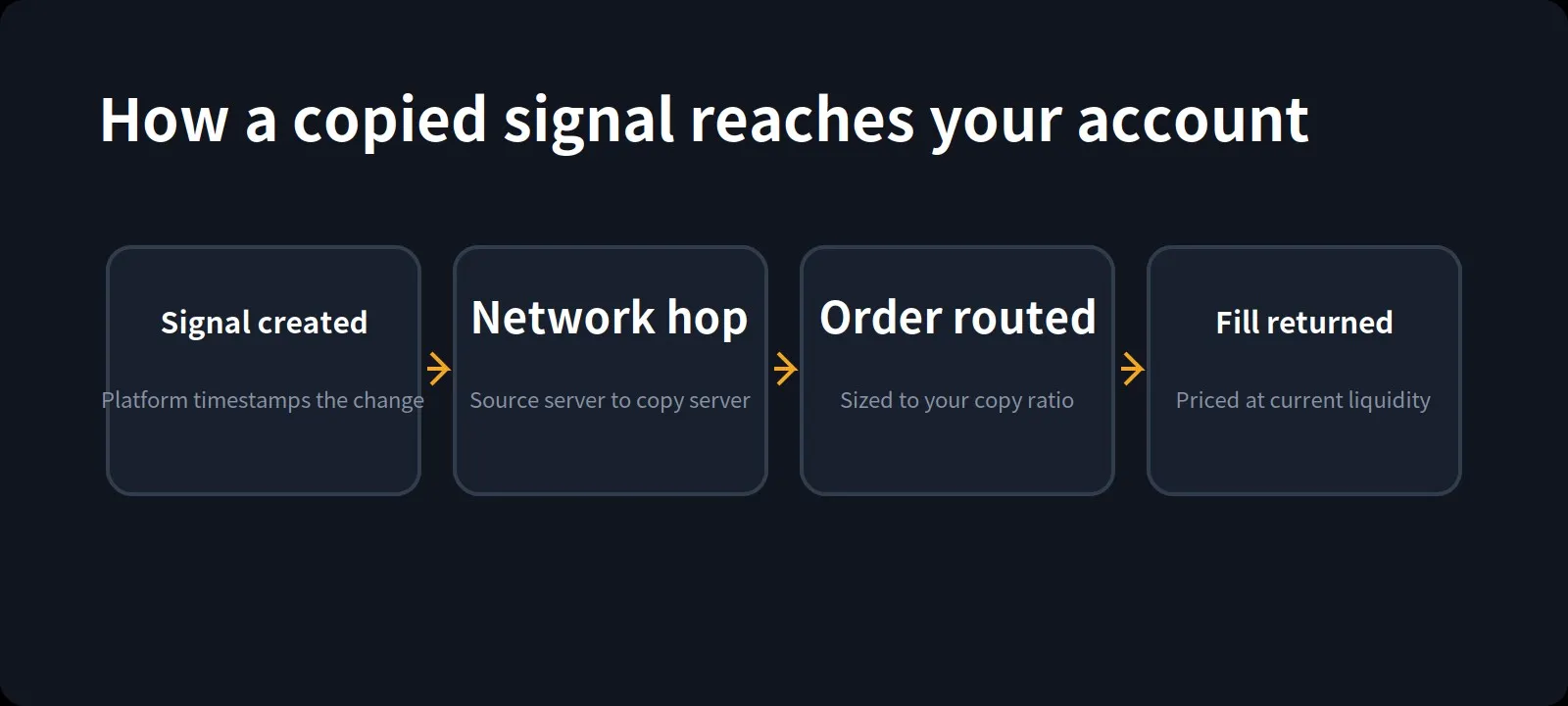
Each stage adds time, and several slow down together during a volatility spike.
A hypothetical example of a late fill
Everything in this section is a made-up illustration, not a real trade and not a suggestion to take one.
Assume the followed trader opens a long position in EUR/USD, meaning a position that gains if the pair rises, while the platform's reference quote is 1.1215. Your copy account is set to a ratio that produces 0.10 lots, meaning 10,000 euros, where one pip, the fourth decimal place for this pair, is worth roughly one US dollar.
In a calm session, assume the whole trip from signal to fill takes about 80 milliseconds. When a scheduled data release lands, the same trip might stretch to 400 milliseconds, because the copy engine is handling many accounts at once, the broker is repricing, and the spread may widen from 1 pip to 4.
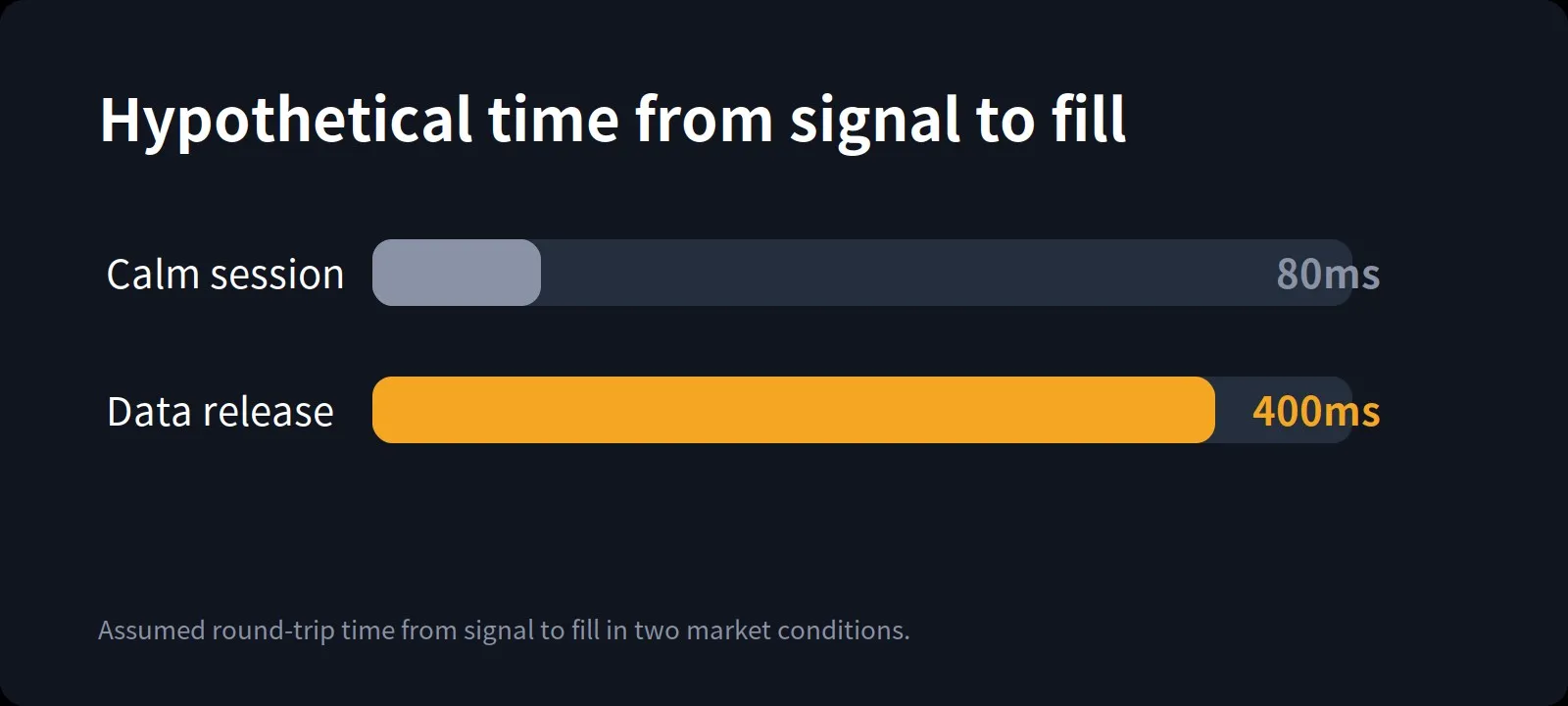
Illustrative figures only, not measured platform performance.
Now assume the price jumps 6 pips before your order is filled, so the fill lands at 1.1221 rather than 1.1215. Six pips on 0.10 lots is about 6 dollars of extra cost, before counting the wider spread. The amount looks modest, yet it is a cost that does not appear in the quoted signal price, and it can repeat on every signal during the same session.
Where beginners misread the numbers
- A fixed delay. Latency is a range, not a constant, and the range stretches under stress.
- Bad faith as the first explanation. A gap between signal and fill can come from the structure of the route before any question of intent arises.
- Confusing size with speed. Raising the copy ratio multiplies the money attached to each pip, but it does not move the order any faster.
- Comparing your statement to the source account's published record without asking which price that record used. A signal price and a fill price are two different things.
That last point is the boundary worth keeping in view. Latency explains why one decision can produce two different fill prices on two accounts at the same moment. It measures timing and cost, not skill, and no millisecond figure can tell you whether an approach will hold up over months. When reading any performance summary, the useful questions are not only what was earned, but which price was recorded and how long the gap was between the signal and the execution it stood for.
Finally, WikiFX would like to remind everyone that before using any US stock, futures, or forex brokers, remember to check the platform's regulatory information, trading environment, field inspection reports, user reviews, and overall rating on the WikiFX App. This will help you effectively avoid problematic scam platforms and rogue brokers, safeguarding your capital.