Abstract:VPS redundancy lowers the risk that a single server fault stops an automated trading system. This beginner guide walks through primary and standby servers, heartbeats, failover, a hypothetical uptime calculation, and the limits redundancy cannot remove.

 Contents
What VPS redundancy actually means
A VPS, short for virtual private server, is a rented slice of a physical computer that runs software continuously inside a data centre. Beginners often assume that because the machine sits in a professional facility, it is already protected. Redundancy means something narrower: a spare working path for a critical function, so that one failure does not stop the whole service. Its opposite is a single point of failure, any component whose breakdown brings the entire chain to a halt.
For an automated trading system, meaning software that places and manages orders without a human clicking each trade, the server can become exactly that weak link. Redundancy lowers the risk that a machine fault interrupts the process. It does not lower market risk, improve a strategy, or make losses less likely.
So the honest description is an availability design. Availability is the share of time a service is actually working. A highly available setup can still be unprofitable, and redundancy gives no protection against a broker outage, corrupted data, or a strategy that loses money in ordinary market conditions.
The failure chain behind a single server
An automated setup is a chain, not a single box. The server depends on power, network access, storage, the operating system, the trading terminal and the link to the broker. Each of those is a single point of failure when it has no backup. A common beginner mistake is to copy the terminal settings onto a second machine and call that redundancy, while the power supply or the network route stays unique.
Real redundancy separates the layers. The simplest design is active-passive: one server does the work while the other waits. A standby server may sit in a different data centre or use a different network provider, and its configuration and order state are copied across at regular intervals in a process called replication.
A heartbeat is a small signal the primary server sends out at fixed intervals. When the standby misses several beats in a row, it begins a failover, the controlled switch from primary to standby. Each step depends on the one before it, which is why an untested chain is worth very little.
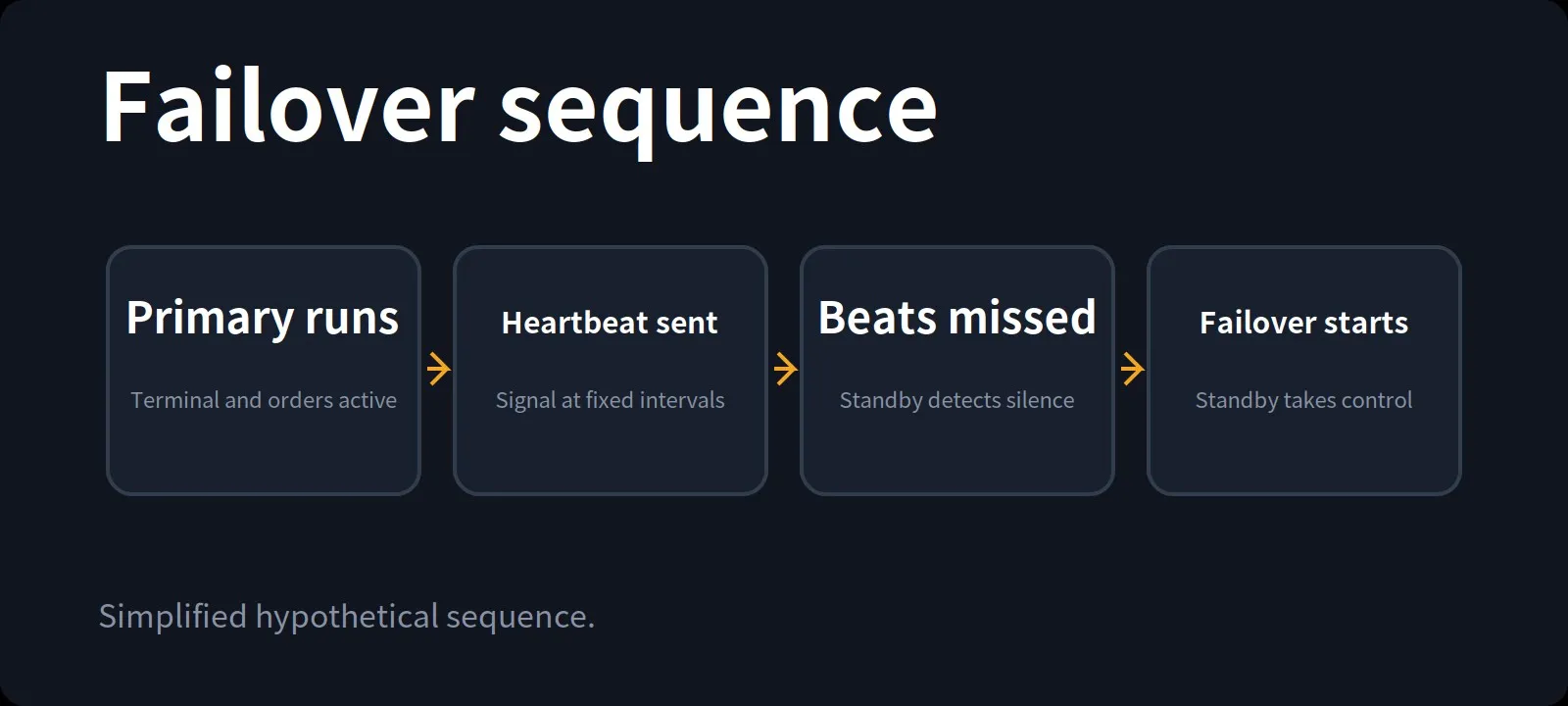
A standby server only helps if it can detect failure and take control.
That sounds simple, but the handover needs rules. The standby must know which orders are open, which positions are closed, and whether the primary is genuinely dead or merely slow. Without those rules, two servers can act at once, a condition called split-brain. The result can be duplicate orders or conflicting position management, which is often worse than a clean outage.
A hypothetical failover calculation
Availability is normally written as a percentage of time a service works. A 99% figure sounds impressive until it is converted into minutes. The formula is short: expected downtime = total minutes × (1 - availability).
Hypothetical example, used only to demonstrate the arithmetic and never as a forecast: assume a 30-day month and two servers that fail independently.
- Convert the month to minutes: 30 × 24 × 60 = 43,200 minutes.
- Apply one server's failure rate: 43,200 × 0.01 = 432 minutes, about 7.2 hours.
- Apply both failure rates together: 43,200 × (0.01 × 0.01) = 4.32 minutes of simultaneous downtime.
That result is a simplified model, not a promise. Real outages are often correlated: a shared power fault, a common network provider, or a bad software update can hit both machines at once. Failover also takes time, usually seconds to minutes, and that gap belongs in the downtime estimate. The calculation shows why independence matters, not why two servers are always enough.
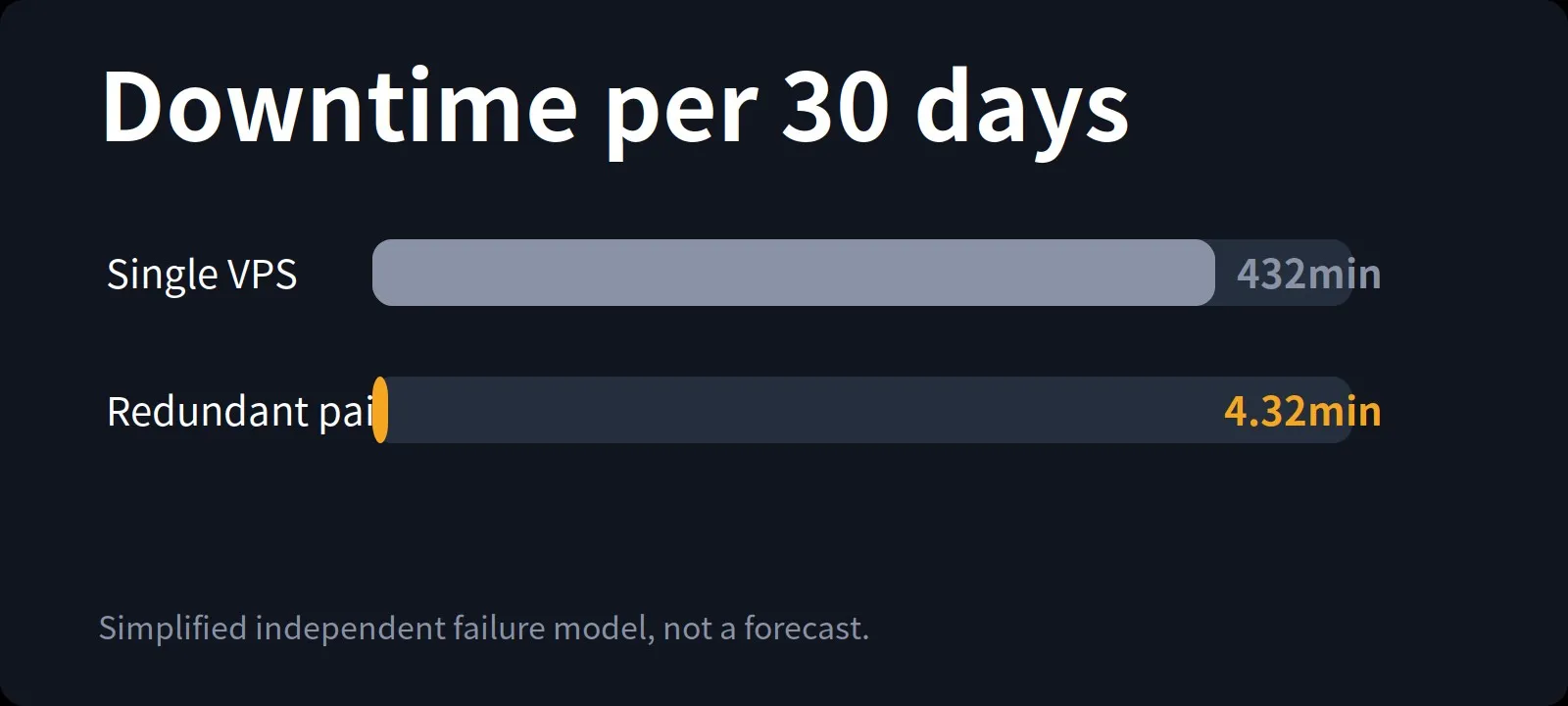
The gap comes from the arithmetic, not from a better trading strategy.
Where redundancy disappoints
Redundancy is often sold as a cure-all, and that is where beginners misread it. Two machines in the same rack may share a power feed and a network switch, so they are not truly independent. A standby that is never tested is only a diagram. Failover can also fail silently when monitoring is weak, when replication lag is long, or when the standby holds an outdated copy of the order state.
- Shared location: both servers fail together when the data centre loses power or connectivity.
- Split-brain: both servers believe they are primary and send conflicting orders.
- Latency, the delay before a response arrives, measured in milliseconds: a distant standby may get slower replies from the broker, so the switch quietly changes execution conditions.
- Complexity: more moving parts mean more components to monitor, patch and test.
None of these problems makes redundancy useless. They make the design details matter more than the label. A redundant system is judged by how it behaves when something breaks, not by how impressive its diagram looks.
Think of it as a spare tyre, not a better engine. The spare keeps a vehicle moving after a puncture; it does not make the journey safer in every other way. In forex education this belongs to operational risk management, the work of keeping a process running, rather than to market prediction. A server can be highly available while the trading result is still poor.
Finally, WikiFX would like to remind everyone that before using any US stock, futures, or forex brokers, remember to check the platform's regulatory information, trading environment, field inspection reports, user reviews, and overall rating on the WikiFX App. This will help you effectively avoid problematic scam platforms and rogue brokers, safeguarding your capital.