Abstract:Prop firm drawdown rules become clearer once balance, equity and the reference point are kept apart. This guide separates static, daily and trailing limits, works through a hypothetical account with open positions and trading costs, and corrects the misreadings that quietly use up buffer.

 Contents
What the drawdown rule actually caps
A proprietary trading firm, usually shortened to prop firm, gives a trader access to the firm's capital under a written rulebook. The drawdown limit is one line in that rulebook: the largest fall in account value, measured from a defined reference point, before the arrangement is paused, reset or closed. The reference point is the starting level the firm measures that fall from, and it is the detail most readers skip.
The firm is capping its own exposure, and the trader gets a boundary that does not move with opinion. Drawdown also appears in chart work, where maximum drawdown describes the biggest past fall in a chart of account value over time. In a prop agreement it is a contractual threshold instead. A rule tells you how much room the account has left; it says nothing about whether the next idea will work.
Balance, equity and the reference point
Most confusion starts with two account figures that are not the same thing.
- Balance is the cash on the books after closed trades, deposits and withdrawals. Open positions have not touched it yet.
- Equity is balance plus the floating profit or loss on open positions, meaning the gain or loss that exists on paper and is not yet realised.
- Peak equity is the highest equity level the account has reached so far.
- A static drawdown is measured from a fixed reference, usually the starting balance. The floor, meaning the equity level that must not be crossed, stays put even after a new high.
- A trailing drawdown is measured from a moving reference, usually peak equity. The floor climbs as the account climbs.
- A daily drawdown covers one trading day, counted from that day's opening balance or opening equity, whichever the agreement names.
Two accounts can hold the same equity and face very different amounts of room left, simply because their reference points differ. The room left before a limit is reached is often called the buffer. A useful test of any rulebook is three questions: what is the reference, when does it reset, and do open positions and trading costs count.
A hypothetical walk through the arithmetic
The simple version is: drawdown equals reference equity minus current equity. As a percentage, divide that result by the reference equity and multiply by 100.
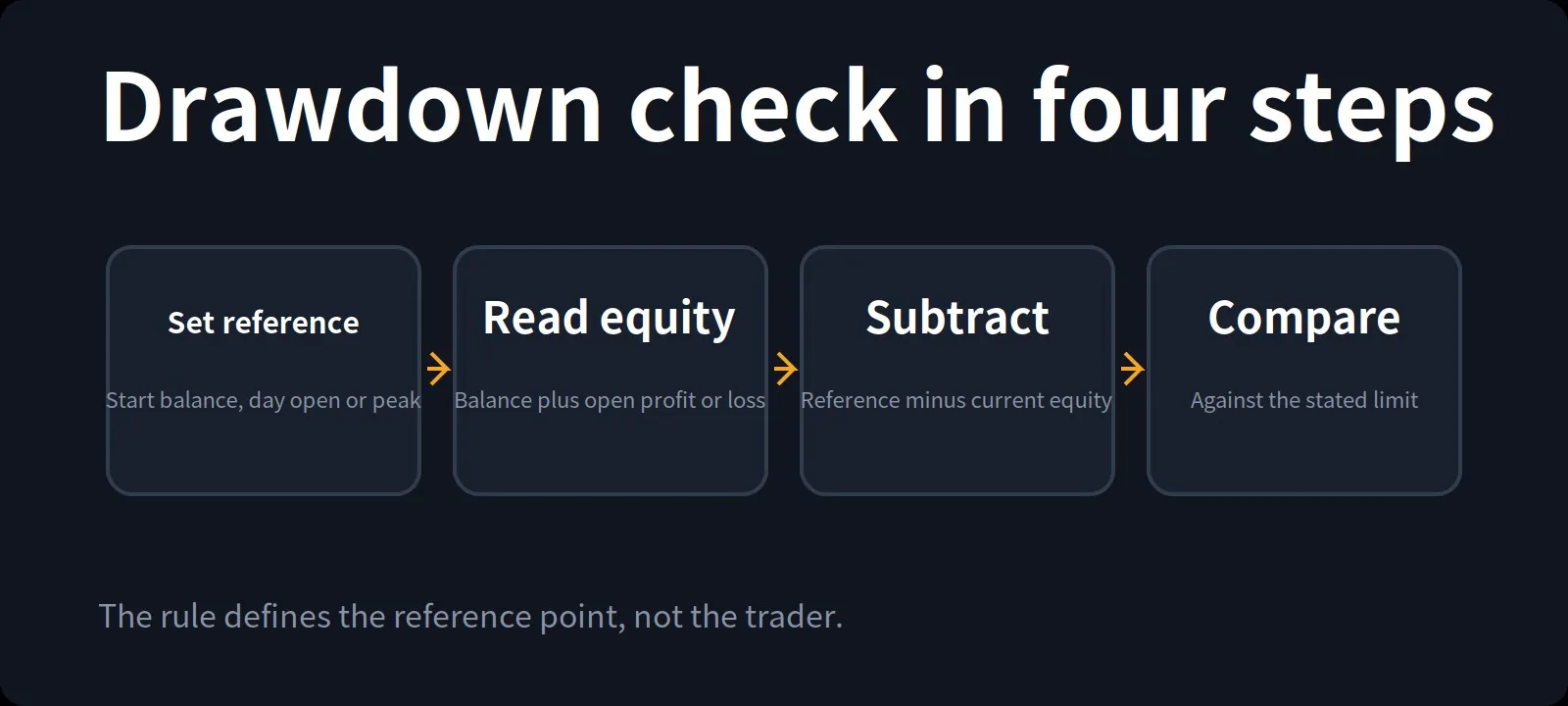
A drawdown rule is only as clear as its reference point.
Assume a practice account of USD 10,000 with a daily limit of 5%, which is USD 500, and a maximum trailing limit of USD 1,000, equal to 10% of the starting balance and trailing from peak equity. The day opens at USD 10,000. A position moves equity up to USD 10,300, then price turns and equity falls to USD 9,700. None of this is a trading instruction; it is bookkeeping.
Walk it in order.
- The daily reference is the opening equity of USD 10,000 and current equity is USD 9,700, so the daily drawdown is USD 300, which leaves USD 200 of the USD 500 allowance.
- The trailing reference is the peak equity of USD 10,300 and the floor sits USD 1,000 below it at USD 9,300, so current equity of USD 9,700 leaves USD 400 of room.
- The daily rule is the tighter of the two, so it is the one that shapes the day.
Now add position size to the picture. Suppose an illustrative position of 100,000 units, the size usually called one standard lot, in a pair where the US dollar is the second currency, the one the price is quoted in. A pip is the standard unit used to measure a price move in a currency pair; for most pairs it is the fourth decimal place, that is 0.0001, even though many platforms show a fifth decimal for finer quoting. At 100,000 units, one pip of movement is worth about USD 10.
A stop-loss order, meaning a standing instruction to close the position at a chosen price so the loss stops there, set 20 pips away would cap the loss near USD 200. That matches the remaining daily buffer of USD 200 before spread and commission are counted; those costs would push the real loss a little higher. At the current equity of USD 9,700, the maximum limit still has USD 400 of room, so it is not the binding constraint. The arithmetic shows why the daily figure, not the headline maximum, often decides how the day ends.
Where beginners misread the rule
- Treating the two limits as separate safety nets. The tighter one binds first, and a daily breach can end the arrangement long before the maximum is reached.
- Watching balance instead of equity. A floating loss can push equity through a limit while the closed-trade balance still looks untouched.
- Leaving out costs. Spread, the gap between the buy and sell price, and commission, the fee charged per trade, both eat into the buffer. So does swap, the interest charged or credited for holding a position past the daily rollover point, when positions are carried into the next trading day.
- Assuming the reset is at midnight in your own time zone. Many firms reset on a server clock or a rolling 24-hour window, meaning a window that moves with the clock rather than resetting at a fixed hour. The exact method belongs in your reading of the rulebook, not in guesswork.
- Confusing the limit with a stop-loss order. The drawdown limit is an account threshold held by the firm, not an order sitting in the market.
The link between the rule and risk per idea is direct arithmetic. Risking 2% of the account on each trade, meaning the amount you accept losing if the idea fails, against a 5% daily limit means three losses in a row would pass the limit before costs are counted. That is not an argument for any particular risk size. It is a reason to compare what one idea can cost with the buffer actually left, instead of reading the headline percentage as the whole story.
Finally, WikiFX would like to remind everyone that before using any US stock, futures, or forex brokers, remember to check the platform's regulatory information, trading environment, field inspection reports, user reviews, and overall rating on the WikiFX App. This will help you effectively avoid problematic scam platforms and rogue brokers, safeguarding your capital.