Abstract:Swap points are the difference between the near and far rates in an FX swap, and they are built from two short-term interest rates plus the time to the far date. A worked hypothetical example shows how EUR/USD spot at 1.1215 with a 2.00% euro rate and a 4.00% dollar rate produces roughly 56 points over 90 days, which annualises to about 2.0%. The article also separates this implied financing cost from common misreadings, such as treating a rollover charge as a platform fee or as a signal about direction.
 Contents
What an FX swap is really pricing
An FX swap is one agreement with two legs. On the near date, one currency is exchanged for another at an agreed rate; on the far date, the same amounts are exchanged back at a second agreed rate. Both rates are fixed at the start, so neither side has to guess where the market will be later.
The near rate is normally the spot rate, meaning the price for exchanging currencies at standard settlement in a couple of business days. The far rate applies to a later date. Swap points are the difference between the two rates, quoted as a small number rather than as a full exchange rate. When the far date is a standard future value date, the same figure is often called the forward points.
The instrument answers a funding need rather than a market view. A bank or a business holds one currency today and expects the other later, and wants the exchange rate locked while it bridges the gap. The points are what the market charges or pays for that bridge. They say nothing about where spot will trade next month.
Two interest rates sit inside the price
Every currency has a short-term interest rate, which is what a deposit in that currency earns over a set period. When one currency's rate is higher than the other's, a temptation appears. Borrow in the low-rate currency, convert at spot, deposit in the high-rate currency, and convert back later.
If the forward rate stayed exactly at spot, that sequence would lock in a gain with no market risk. Banks competing for the same trade remove it. The far rate is pushed away from spot by roughly the interest gap, so the apparent profit disappears once the return leg is priced. This idea is covered interest parity: once currency risk is hedged, no free extra return should remain.
A few conventions matter when reading the number:
- Points are quoted in the fourth decimal for most pairs, so one point is 0.0001; for yen pairs they are quoted in the second decimal, where one point is 0.01.
- The sign depends on which currency has the higher rate. The forward can sit above spot, a premium for the base currency, or below it, a discount. In a pair such as EUR/USD, the euro is the base currency and the dollar is the quote currency.
- Day count changes the answer slightly. Many pairs use a 360-day year in the calculation and some currencies use 365, so mixing them shifts the points.
How the points are calculated
The relationship is usually written with the base currency on the left of the pair and the quote currency on the right:
Forward rate = Spot rate x (1 + quote currency rate x days / 360) / (1 + base currency rate x days / 360)
In steps:
- Note the two short-term rates for the tenor you need, meaning the length of time until the far date, plus the number of days.
- Convert each annual rate into a rate for that period by multiplying it by days / 360.
- Divide the quote currency factor by the base currency factor, then multiply by spot.
Hypothetical teaching example. The figures below are chosen for illustration and are not live quotes. Assume EUR/USD spot at 1.1215, a euro short-term rate of 2.00%, a dollar short-term rate of 4.00%, and 90 days.
- Dollar factor: 1 + 0.04 x 90 / 360 = 1.01
- Euro factor: 1 + 0.02 x 90 / 360 = 1.005
- Forward: 1.1215 x 1.01 / 1.005 = about 1.1271
- Swap points: 1.1271 - 1.1215 = 0.0056, or 56 points
Annualise the points and the implied financing cost appears: 0.0056 / 1.1215 x (360 / 90) = about 2.0%, close to the two percentage point gap between the deposit rates. That is what implied financing cost means here. The forward price carries roughly the cost of funding one currency against the other for 90 days, packed into a single exchange rate.
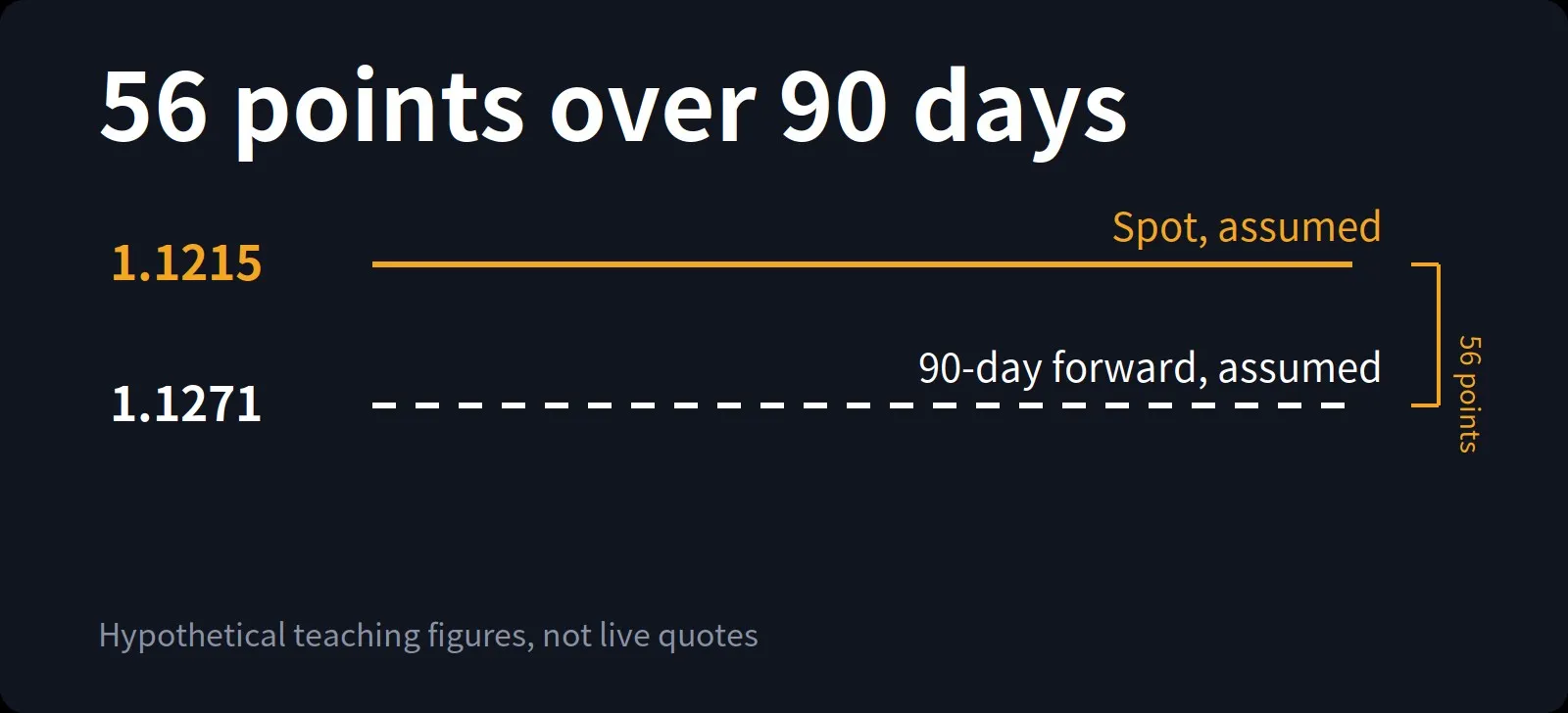
Hypothetical EUR/USD calculation over 90 days
Why the number gets misread
- A swap or rollover debit on a statement is not a commission invented by the platform. A rollover is the process of extending a position to a new value date, and the debit reflects the forward points for that extension. It becomes a credit when the rate gap runs the other way.
- A larger positive figure does not mean the base currency is strong or about to rise. It means the interest gap or the time to the far date is larger.
- Raw points cannot be compared across pairs. Fifty-six points on EUR/USD and fifty-six points on USD/JPY are different sums of money, so convert them into an annual percentage before comparing.
- The headline policy rate is not the rate that belongs in the formula. What matters is the interbank rate, meaning the rate banks charge each other for short-term deposits, for the specific period.
- The clean formula is a reference, not a market quote. Real forward prices also reflect differences in funding rates for the same currency across markets, credit and liquidity conditions, and holiday adjustments to value dates.
Swap points are the price of time in a currency pair. They are built from two short-term interest rates, a day count and a period, and they express the financing cost implied by moving an exchange rate from one date to another. They are not a forecast of spot, and they are not free income.
Seen as a cost of carry, meaning the cost of holding one currency against another over time, the figure explains much of what looks puzzling on a first statement. It stops being mysterious once the two deposit rates behind it are visible.
Finally, WikiFX would like to remind everyone that before using any US stock, futures, or forex brokers, remember to check the platform's regulatory information, trading environment, field inspection reports, user reviews, and overall rating on the WikiFX App. This will help you effectively avoid problematic scam platforms and rogue brokers, safeguarding your capital.