

Global Broker Regulation Inquiry App
About WikiFX


Stop Limit and Iceberg Orders: Why Fills Can Fail

WikiFX
|


Abstract:A stop limit order can trigger and still stay unfilled, while an iceberg order can hide size yet leave a visible footprint. This guide walks through both mechanisms using a clearly labelled hypothetical example.

A beginner often treats an order as a simple yes or no: it fills, or it does not. Stop limit orders and iceberg orders break that assumption, but in two different places. One buys price control and gives up the certainty of a fill. The other hides size, yet it cannot make that size vanish from the market.
 Contents
Two tools, two different problems
A stop limit order carries two prices. The stop price is the trigger that wakes the order up. The limit price is the worst price the trader will accept once the order is awake. The design targets slippage, which is the gap between the price expected and the price actually received.
An iceberg order splits a large order into a small visible part and a larger hidden reserve. The visible part is the tip; the reserve is released as the tip fills. The design targets market impact, which is the price movement that can happen when other participants notice a large order.
Both tools rest on the same foundation: the order book, the list of resting buy and sell orders that a venue matches. Displayed liquidity is what that book shows publicly. Hidden liquidity is size that exists but is not visible. An iceberg belongs to the second group, and that is where both its usefulness and its limits come from.
The order mechanics you need first
Four basic order behaviours sit underneath both products.
- Market order. It seeks immediate execution at the best available price. Speed is high and price certainty is low, especially when liquidity is thin.
- Limit order. It sets a maximum buying price or a minimum selling price. Price is controlled, execution is not promised.
- Stop order. It stays dormant, meaning inactive, until a trigger price trades, then becomes a market order. It usually executes, but the fill can be worse than the trigger.
- Stop limit order. It also waits for a trigger, then becomes a limit order rather than a market order. The trader gains price control and loses execution certainty.
A fill is simply an execution, the moment the order trades. A partial fill means only part of the size traded, which leaves a remainder still working in the market.
A hypothetical walk through both mechanisms
Hypothetical example, not a recommendation. Assume EURUSD is quoted at 1.1215 and a trader holds a long position, meaning a position that gains when the price rises.
The trader enters a sell stop limit with the stop at 1.1180 and the limit at 1.1170. A bid is the price a buyer is showing. Because the stop sits below the market, the order waits until price falls to it.
If the market trades down to 1.1180, the stop triggers and a sell limit at 1.1170 becomes active. A sell limit can fill only at 1.1170 or higher. Suppose the next bid jumps to 1.1165, so the limit sits above the market and stays unfilled while price keeps falling. The stop did its job; the limit did not promise an exit.
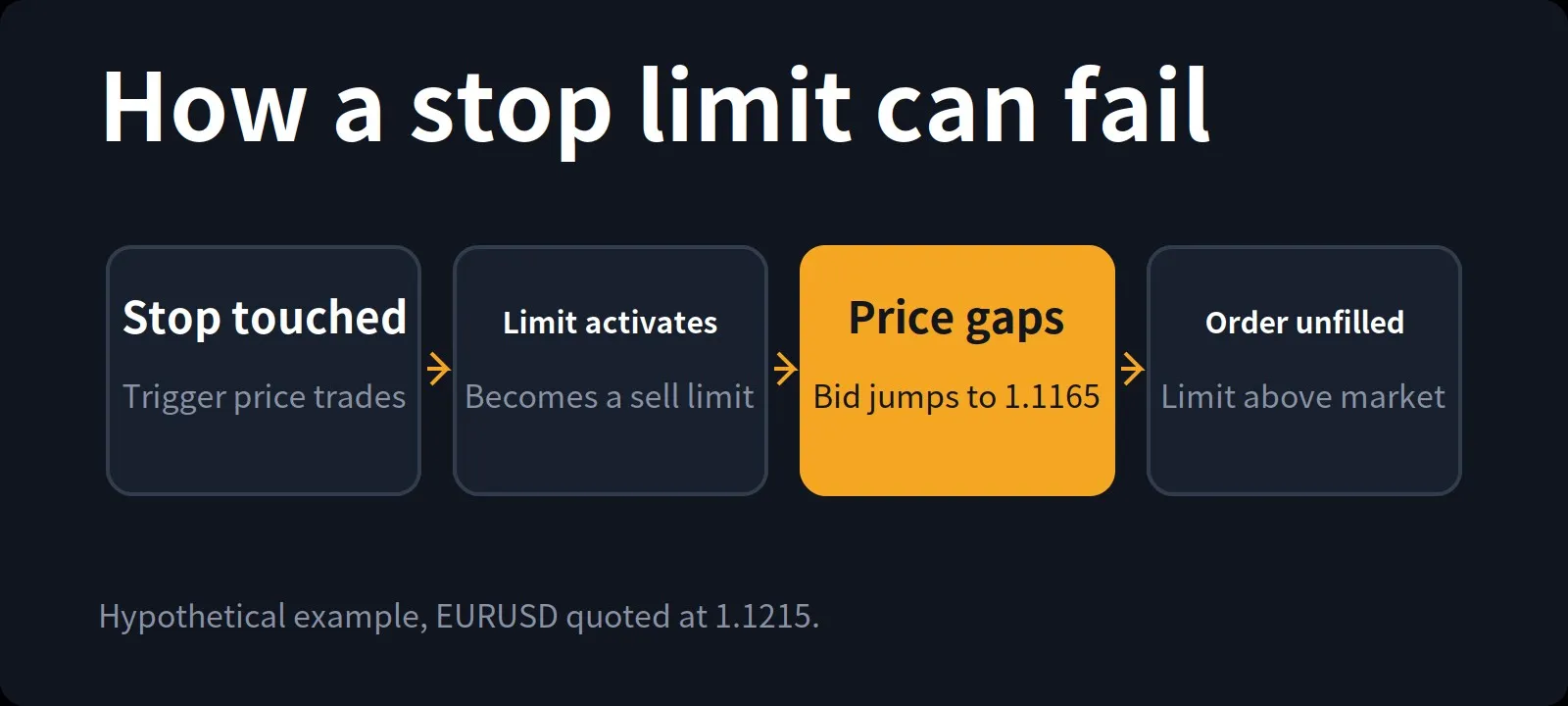
Hypothetical sequence, not trading advice.
Now a separate hypothetical scenario. Another participant wants to sell 10 lots, where a lot is a standard unit of trade size, and uses an iceberg showing 1 lot at 1.1215 while 9 lots sit in reserve. Each time the 1 lot tip fills, another 1 lot appears at the same price. Other participants see a small offer, where an offer is a resting sell order. If buying interest dries up before the reserve is filled, the remainder may stay open or be cancelled, depending on the venue's rules.
Where the limits appear, and what these orders are not
The most common beginner error is to read stop as guaranteed and iceberg as invisible. Neither word carries that meaning.
- Gaps. A gap is a jump in price with little or no trading in between. A trigger can fire and the market can leap past the limit, leaving a live order at a price nobody is trading.
- Partial fills. In a fast market, a limit order may fill in pieces. The unfilled remainder stays open or is cancelled under the broker's order rules.
- A visible footprint. An iceberg's tip is not a secret for long. Repeated refills at the same price can signal hidden supply or demand to attentive participants.
- Queue priority. Queue priority is the order in which resting orders at the same price are filled. A new visible slice often joins the back of the queue, so the full reserve is not assured of execution.
- Venue support. Some trading venues offer native iceberg orders; others simulate them, and behaviour around partial fills can differ.
Both tools are also exposed to liquidity conditions. Around major data releases, or when a market is thin, the distance between quoted prices can widen and the assumptions behind either order weaken.
A stop limit order is a price control tool, not a guaranteed exit. An iceberg order is a visibility tool, not guaranteed concealment and not guaranteed full execution. Neither changes the direction of the market; both change how an order behaves after a trigger or a partial fill.
The useful question is not which order is better in general. It is which uncertainty the order accepts: an unfilled stop limit in a gap, or a visible footprint from an iceberg. Reading the order ticket and the venue's execution rules is part of understanding the tool, not a separate detail.
Finally, WikiFX would like to remind everyone that before using any US stock, futures, or forex brokers, remember to check the platform's regulatory information, trading environment, field inspection reports, user reviews, and overall rating on the WikiFX App. This will help you effectively avoid problematic scam platforms and rogue brokers, safeguarding your capital.

Disclaimer:
The views in this article only represent the author's personal views, and do not constitute investment advice on this platform. This platform does not guarantee the accuracy, completeness and timeliness of the information in the article, and will not be liable for any loss caused by the use of or reliance on the information in the article.
WikiFX Broker
Latest News
Oil Prices Retreat as Fed and ECB Decisions Loom
WikiFXSBI Chief Expects 50 bps RBI Rate Hike in December, Sees Consumer Credit Cooling
WikiFXMAS Brings Malaysia and Thailand Central Banks Into Bloom Digital Money Push
WikiFXSeven Detained in an Investment Scam Call Centre Raid
WikiFXEMAR MARKETS Review: What Traders Should Know Before Depositing
WikiFXIndia's Forex Reserves Slip to $721 Billion as Gold Holdings Rise $706 Million
WikiFXU.S. Dollar Gains Ground As Traders Focus On Middle East Tensions: Analysis For EUR/USD, GBP/USD, USD/CAD, USD/JPY
WikiFXUSD/CAD: Can the Bank of Canada and Fed Trigger a Breakout?
WikiFXFirst Light News: AI Trade Boosted on Anthropic IPO Filing as Brazil Slumps
WikiFXGold Fights Back. Silver Breaks Lower. Same Dollar, Different Stories.
WikiFX