Global Broker Regulation Inquiry App
About WikiFX


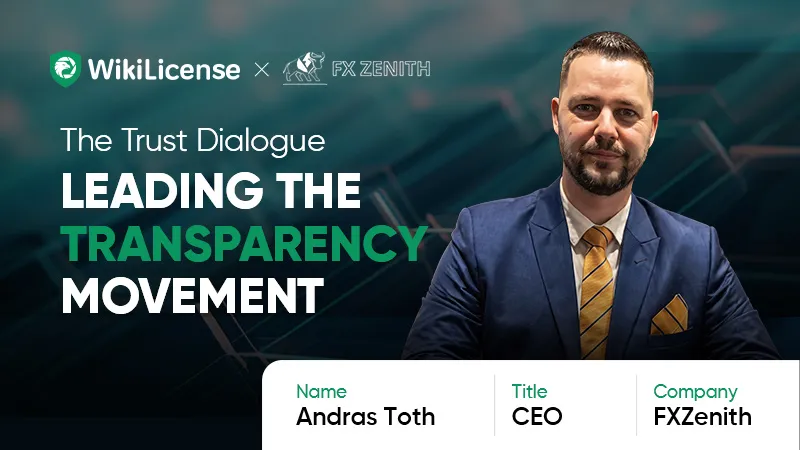
Leading the Transparency Movement, The Trust Dialogue with Andras Toth from FXZENITH
WikiFX
|


Abstract:In this edition of WikiLicense’s corporate interview series, we speak with Andras Toth, the Founder & CEO of FXZENITH, one of the early adopters of the WikiLicense dynamic certification badge, to discuss how transparent practices, independent verification, and visible accountability are shaping the future of the forex industry.
Trust in financial markets is built on transparency, verification, and accountability. To address the growing need for reliable license information and greater industry visibility, WikiLicense provides a dynamic certification solution that enables brokers to showcase verified licensing details and allows investors to access clearer, more trustworthy information.
In this edition of WikiLicenses corporate interview series, we speak with Andras Toth, the Founder & CEO of FXZENITH, one of the early adopters of the WikiLicense dynamic certification badge, to discuss how transparent practices, independent verification, and visible accountability are shaping the future of the forex industry.
Q1: In an industry as fast-paced and complex as forex trading, what does “let trust be seen” mean for your daily operations and long-term strategy?
Andras Toth: For me, “let trust be seen” means making transparency a measurable, visible, and continuously verifiable standard. In daily operations, this translates into clear communication of trading conditions, real-time disclosure of execution quality. From a long-term strategic perspective, I believe trust must be personal and accessible. As Founder & CEO, I make myself directly available to clients and partners across multiple channels, including LinkedIn, WhatsApp, and WeChat, because leadership visibility reinforces institutional credibility. Our expansion is built on the principle that brokers who demonstrate verifiable integrity will be the ones shaping the next decade of the industry.
Q2: You recently became one of the key players to adopt the WikiLicense and display its dynamic certification badge on your own website. What was the primary strategic driver behind this decision?
Andras Toth: The primary driver was institutional-grade credibility. WikiFX is a widely visited and trusted platform within the global trading community, and visibility on such a channel is strategically important for us. It allows us to reach more clients and partners with our core message: You deserve to trade, or have your investments managed, at a brokerage where the broker is not against you, but with you. The WikiLicense badge provides an independent, real-time verification layer that strengthens our public trust architecture.
Q3: In recent years, the market has seen cases of cloned licenses, impersonated identities, and misleading information. What impact do these issues have on investors and legitimate brokers?
Andras Toth: These practices erode confidence at a systemic level. For investors, cloned licenses and impersonated entities create confusion, financial risk, and emotional distress, often discouraging them from participating in the market altogether. For legitimate brokers, the impact is equally damaging.
This is why I, as the CEO, remain personally visible and accessible. I put my name and face behind our operations, attend industry expos, and make myself available for direct meetings.
Q4: How important is transparency of financial license information in building user trust and promoting the healthy development of the industry?
Andras Toth: Transparency of license information is foundational. When clients can independently verify a brokers regulatory status, operational legitimacy, and compliance footprint, trust becomes data-driven rather than assumption-based. At the same time, I personally believe that transparency is ultimately strengthened through human presence. This is why I place significant emphasis on my own visibility as CEO, because transparent data and transparent leadership together create a stronger, more resilient trust environment.
Q5: In your opinion, what areas should the financial industry continue to improve to enhance transparency and investor protection in the future?
Andras Toth: Every industry has room for improvement, and finance is no exception. Several areas require continued enhancement. At FXZENITH, we go beyond standard disclosure practices. When I say we are transparent, I mean genuine operational transparency: We regularly share detailed reports with our traders that most market participants rarely publish, such as execution reports and slippage reports, which provide deep insight into order handling quality and market interaction. These reports demonstrate how orders are filled, how liquidity behaves, and how execution conditions evolve in real time. When we say we are transparent, we mean that we provide visibility into the very mechanics of trade execution, not just the surface-level information.
Q6: How do you see the importance of a more transparent license verification mechanism for the financial industry today?
Andras Toth: A transparent license verification mechanism is a structural requirement for modern financial markets. As digital onboarding accelerates and cross-border trading becomes the norm, investors need instant, reliable confirmation of a brokers legitimacy. Mechanisms like WikiLicense help transform trust from a subjective perception into an objective, verifiable standard. This shift is essential for protecting investors, elevating compliant brokers, and ensuring long-term industry stability.
A More Transparent Future Starts with Verification
As the financial industry continues to evolve, transparency and independent verification will play an increasingly important role in building lasting trust. WikiLicense is committed to helping financial institutions make their regulatory credentials more visible while giving investors easier access to verified license information.
Financial institutions are invited to verify and showcase their licenses through WikiLicense, helping clients see trust for themselves.
The WikiLicense corporate interview series is ongoing. We will continue speaking with industry leaders and financial institutions to explore how transparency, verification, and accountability are shaping a more trustworthy and sustainable financial industry.
Disclaimer:
The views in this article only represent the author's personal views, and do not constitute investment advice on this platform. This platform does not guarantee the accuracy, completeness and timeliness of the information in the article, and will not be liable for any loss caused by the use of or reliance on the information in the article.
WikiFX Broker
Latest News
Forex Automation Has One Weak Link. Can You Spot It?
WikiFXWhat Does It Mean When A Regulator Flags A Broker? What Traders Must Know?
WikiFXSlippage: why your forex order fills at a price you did not see
WikiFXASIC Warns 7,639 Super Switch Clients Moved $678 Million Through Lead Generators
WikiFXGlobal Markets Outlook: Oil Retreat Fuels Pre-CPI Recovery
WikiFXU.S. Dollar Rallies As CPI Exceeds Estimates: Analysis For EUR/USD, GBP/USD, USD/CAD, USD/JPY
WikiFXGBP/USD | Current targets
WikiFXA key report for where inflation stood in October comes out Tuesday. Here's what to expect
WikiFXEURUSD Attempts a Bounce — Can Buyers Reclaim 1.1170?
WikiFX5 Ways PrimeXBT Helps Traders Reduce Trading Costs
WikiFX