Abstract:India's crude import bill reached $15.4 billion in September, demonstrating a significant 47% rise in shipments to the country, as the Indian basket averaged $116 per barrel. This report is published on X with the user account being @ayusshsanghi. According to the post, the rupee crumbled to a record low of near ₹97 against the dollar before recovering to range around ₹94.5, a 2.5 rupee round trip in USD/INR that came with an excise duty cut, RBI dollar sales, and a pump-price freeze.
However, these numbers are yet to be confirmed by an official news release. These are all user claims. The chain of events it describes is the standard one: a costlier basket lifts the dollar bill, refiners bid for dollars, the currency weakens, the central bank supplies dollars. What needs checking is the size of each step.
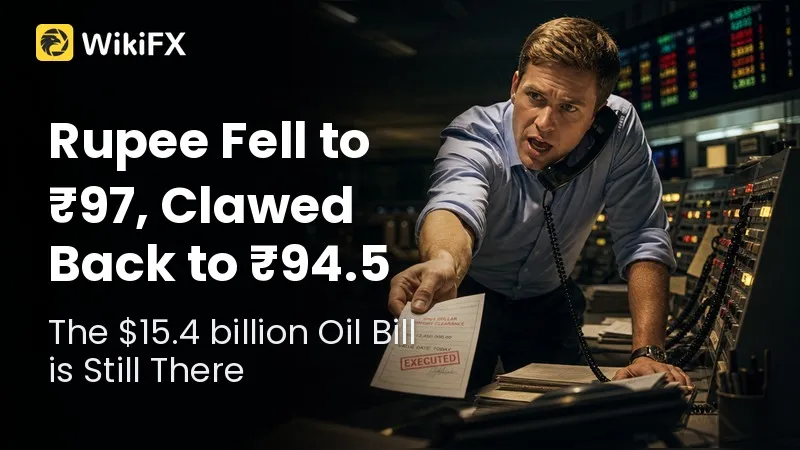
India's crude import bill reached $15.4 billion in September, demonstrating a significant 47% rise in shipments to the country, as the Indian basket averaged $116 per barrel. This report is published on X with the user account being @ayusshsanghi. According to the post, the rupee crumbled to a record low of near ₹97 against the dollar before recovering to range around ₹94.5, a 2.5 rupee round trip in USD/INR that came with an excise duty cut, RBI dollar sales, and a pump-price freeze.
However, these numbers are yet to be confirmed by an official news release. These are all user claims. The chain of events it describes is the standard one: a costlier basket lifts the dollar bill, refiners bid for dollars, the currency weakens, the central bank supplies dollars. What needs checking is the size of each step.
 Contents
The Bill, The Barrel, and 4.6 million Barrels a Day
The post's arithmetic runs like this. India meets 85% of its crude requirements from overseas. These include shipments from Russia, Iraw, UAE and Saudi Arabia I As the basket avraged $116 per barrel in September, the import bill galloped 47% to $15.4 billion.
The volumes are the parts that can be checked. Reuters vessel-tracking data, reported by Oilprice.com, Business Standard and The Economic Times, put India's Middle East crude imports at 2.8 million barrels a day in September — up 32% on August, the highest since February, and 54% of all purchases. Russian inflows fell 14% to 1.8 million bpd, cutting Russia's share to 33.5% from 46.6% a month earlier.
Those two suppliers alone add up to 4.6 million bpd. Priced at the $116 basket the post cites, 30 days of that is roughly $16 billion. Back-of-envelope, using numbers from two different sources, but the same order of magnitude as the $15.4 billion bill.
Why the shift back to the Gulf? Price. Urals loaded at Baltic ports now cost nearly as much as Middle Eastern grades, and Gulf availability improved as flows through the Strait of Hormuz recovered. Shorter voyages from the Gulf of Oman to Indian ports do the rest. That is a sourcing story, not a currency story — but it explains why the import bill tracks the $116 basket rather than the discount Russian barrels used to carry.
Four Things New Delhi Did
The post lists three fiscal moves and one central bank action.
Excise duty on petrol and diesel was cut by ₹10 a litre, to cushion oil marketing companies against the rise in crude costs. Regular petrol and diesel prices at public sector outlets were held unchanged. Fuel export levies were adjusted to keep more products at home.
That trio shifts the cost rather than removing it. If the pump price does not move, the higher import bill lands on the oil marketing companies' margins and on the exchequer, not on the retail fuel line of the CPI. The current account still takes the hit, because the dollars leave either way.
Then the RBI. The post says the central bank stepped in to curb dollar demand and support the rupee. No quantum is given — no dollar figure, no duration, no date for the intervention. Another post in the same conversation, from CNBC-TV18, raises exactly that question (more on it below).
How the Oil Bill Reaches Your USD/INR Position
Refiners pay for cargoes in dollars. That demand hits the spot market, and it is persistent rather than lumpy, because cargoes arrive every month.
When the RBI sells dollars from reserves to meet that demand, it does two things at once. It caps the spot movement. And it drains dollar liquidity out of the domestic market. Thinner dollar liquidity tends to show up in forward points and swap premiums — which is the line item that decides what holding a USD/INR position costs you overnight, or pays you.
This is the part retail traders feel and rarely see prices on the screen. Spot gets the attention. The carry does damage.
There is a second channel, slower. A frozen pump price delays the inflation pass-through instead of cancelling it. If crude stays where the post says it is, the pressure resurfaces when the freeze or the excise relief is unwound — and by then the RBI has both a weaker currency and a fiscal cost to deal with. That is the post's own conclusion, in its words: the measures “bought some breathing room,” and high oil prices “remain a serious challenge.”
What Traders on X are Arguing About
Seven posts reviewed on the same topic agree on the basics: the rupee is weak, the RBI is in the market, and the cost of money is climbing. They disagree with almost everything else.
Import dependence is the first split. The main post says nearly 85% of crude is imported. @nilishamantri_ puts it at roughly 90% and adds that Brent is trading above $110 — a different benchmark from the $116 Indian basket, so the two are not directly comparable.
The intervention itself is contested. CNBC-TV18 quoted SBI economist Soumya Kanti Ghosh questioning whether the RBI actually deployed $80 billion to defend the rupee, with the post's preview cutting off before his alternative estimate. @PlusPointIndia cited an IMF official urging India to let the rupee adjust to global shocks rather than lean on RBI intervention. Neither claim is verified here; Both are being circulated as arguments, not data.
The cost-of-carry side shows up in two more posts. @manoj_216 flags inflation at 5.54% and rising, and ties a weak rupee to costlier borrowing and higher EMIs. @LuckyGoliyan points to the 10-year government bond yield nearing 7.45%. If those levels hold, the interest-rate gap that drives USD/INR forward points is moving, not static.
@CSEP_Org asked the question none of the others answer: why is the rupee weakening despite strong growth? That is a discussion prompt, not a finding.
What the Wires Actually Confirm — and What They Don't
Indian oil coverage over the past 72 hours is about sourcing, not currency. The Middle East import rebound to 2.8 million bpd is confirmed across Oilprice.com, Business Standard and The Economic Times. Separately, US Secretary of State Marco Rubio's Mumbai visit put US and Venezuelan crude and a Russian oil waiver on the agenda, per The Hindu and the Indian Express.
None of those reports mention a rupee level, an excise duty cut, a pump-price freeze, or RBI dollar sales. Searches for corroboration of the main post's central claims returned nothing.
That matters for how you read this. The oil-import volumes are sourced. The 47% bill increase, the $116 basket, the ₹97 low and the ₹94.5 recovery are not. They rest on a single X post with 26 likes and 2 retweets. The post also gives no date for either rupee level, so “after touching a record low” could mean this week or last quarter.
What to Watch, and What Nobody Has Dated
The source material contains no scheduled data release, no policy meeting date and no RBI calendar. So the markers are the two. The post itself hands you.
First, the basket price. The $15.4 billion bill is a function of $116 crude. Every move in that average feeds straight into the dollar demand that the RBI is currently absorbing. If the basket stays high, the RBI keeps selling, dollar liquidity stays tight, and the carry on a long USD/INR position keeps shifting on the swap leg rather than the spot leg.
Second, the distance from ₹97. The recovery to ₹94.5 is roughly 2.5 rupees of ground. How much of that was intervention and how much was positioning is exactly what the $80 billion argument on X is about — and it has not been settled.
Watch the weekly reserves picture when it is next published, and the monthly crude import bill. Those two tell you whether the RBI is still supplying dollars and whether the bill is still growing. The rupee's level tells you the result, not the cause.
This article reports on market structure and cost mechanics. It does not recommend any position in USD/INR or any other pair.
For more insightful financial updates, follow us on WikiFX. If you haven't yet, click here to join us.