Abstract:Sleep debt and unresolved stress can wear down the mental skill behind risk judgment. Losses may feel more urgent, gains may look closer, and a plan written while calm can start to feel unreasonable. A worked hypothetical example shows how doubling risk after a bad night changes the recovery arithmetic, with a note on broker lot sizes. A short pre-session note on sleep, body signals, stress and mood builds a written record you can review each week.
 Contents
A late-night trade that ignores the plan
Imagine a common evening. The house is quiet, a money problem at home is still unresolved, and you have slept badly for three nights. You open your phone to check one currency pair before bed. Twenty minutes later you have taken a position twice the size written in your plan, and the reason is not fully clear.
Beginners often explain that moment as a knowledge gap: not enough strategy, not enough screen time. A harder explanation is that risk judgment works like a mental skill, and mental skills are affected by sleep and calm. When these are in short supply, the skill does not disappear. It becomes less reliable in ways that are hard to feel from the inside.
What a short night changes
Risk judgment, as the phrase is used here, means the ability to weigh a possible loss against a possible gain before acting, and to keep the loss inside a limit set earlier while calm.
Researchers who study sleep and decision making describe two systems sharing the work. The prefrontal areas, near the front of the brain, handle planning, holding back an impulse and comparing options. The amygdala, a deeper structure, reacts fast to threat and reward. After restricted sleep the first system can become less dependable while the second reacts more strongly. The practical result can be a shorter fuse: a small loss feels urgent, and a gain can look nearer than the chart suggests.
Stress adds its own distortion. Under pressure, attention narrows onto the immediate problem, you notice fewer alternatives, and the mind starts finding patterns in noise. Researchers describe a hot-cold empathy gap: from a calm, or cold, state you cannot fully imagine your own thinking in an aroused, or hot, state, and the reverse is also true. That is why a plan written on a quiet Sunday can feel unreasonable late at night.
Caffeine complicates the picture. It can lift alertness, and the lift may feel like sharper judgment. Feeling awake is not the same as weighing options well. The tired decision may simply arrive in a steadier voice.
One setup, two states: a hypothetical calculation
The numbers below are only for showing arithmetic. They are not a view on any currency, and nothing here suggests that anyone should buy or sell anything. For this example, take EUR/USD at 1.1215. Treat that level as an arbitrary placeholder, not a market call.
Assume a hypothetical account with 5,000 units of the quote currency, the second currency in a pair. For EUR/USD that quote currency is the US dollar. The written plan risks 1 percent per decision. One percent of 5,000 is 50 units, and no conversion is needed in this setup.
Assume a stop 40 pips below the entry. A stop is a standing order that closes a trade at a set loss. A pip is a conventional unit of price movement, not the smallest price a broker can quote. For EUR/USD one pip is usually 0.0001, although many brokers display a smaller fractional step, 0.00001.
Forty pips is therefore a distance of 0.0040. Position size, meaning the size of the trade in base currency units, comes from dividing the risk by that distance: 50 divided by 0.0040 equals 12,500. That is 12,500 euros, because the base currency is the first currency in the pair. One unit means one euro, not one lot.
Brokers package orders in lots. A lot is a fixed bundle, such as 1,000, 10,000 or 100,000 units of the base currency. Minimum and step sizes differ by broker, so a calculated size like 12,500 units may not be available exactly. The result is a teaching figure, not an instruction.
Now the tired version, same pair, same stop. For simplicity, set each loss at 2 percent of the starting balance, not 2 percent of the reduced balance. Risk becomes 100 units, and 100 divided by 0.0040 equals 25,000 units. Each loss is 100 units, so two losses cost 200 units, which is 4 percent of the starting balance.
If each new risk were recalculated on the reduced balance, the second loss would be 98 units and the total would be 198 units. The example keeps the starting balance convention to make the next step easier to follow.
The account then holds 4,800. Recovering 200 needs a gain of 200 divided by 4,800, about 4.2 percent, not 4 percent. Losses and gains are not symmetrical, and one bad night can tilt that arithmetic.
Notice what did not change: the analysis, the pair, the stop distance. What changed was the person doing the deciding.
A three-minute check before you open a chart
Self-observation is more useful than self-criticism, and it takes less time than most people expect. Keep a small note, on paper or on the phone, and fill it in before any platform is open.
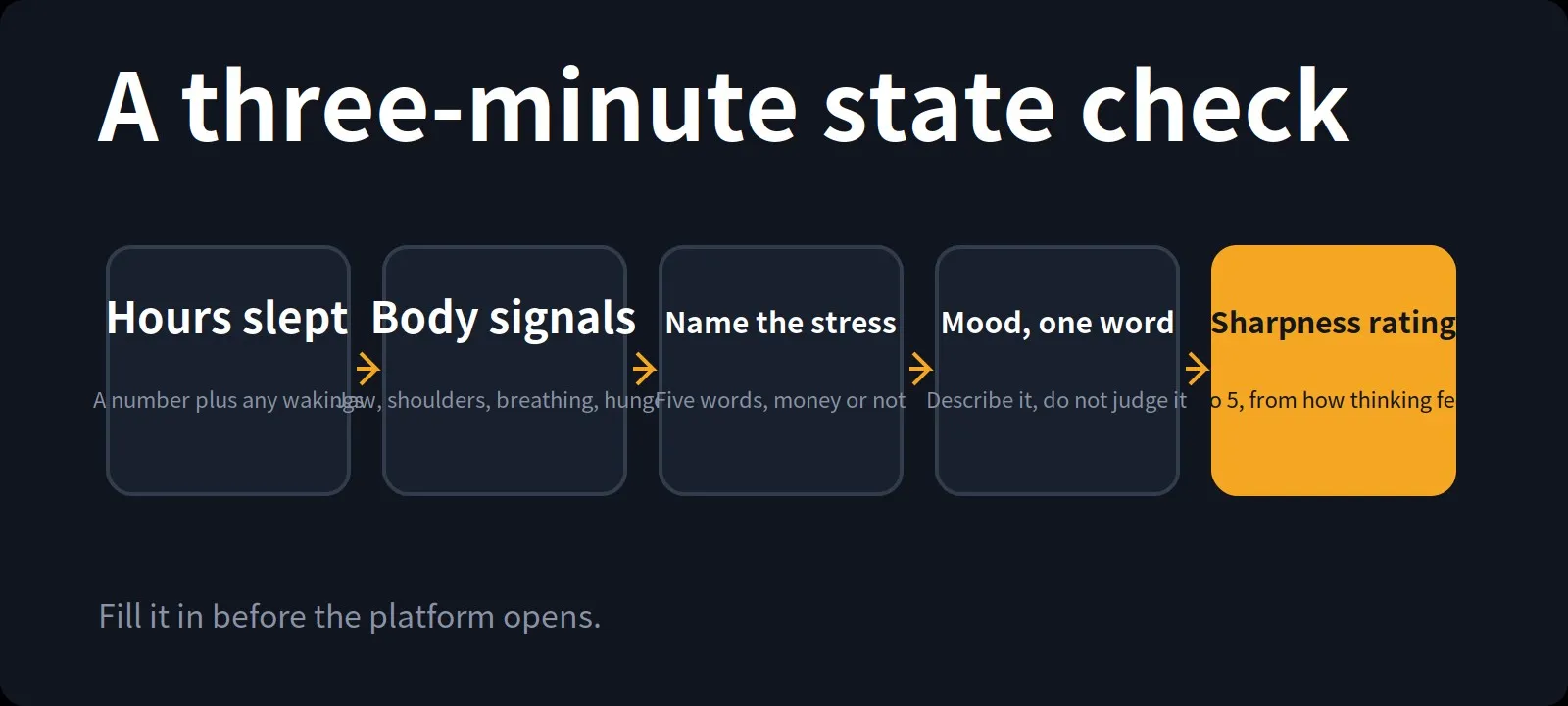
A short pre-session check for noticing your own state.
- Hours slept last night, as a number, plus any wakings.
- Body signals: tight jaw, raised shoulders, shallow breathing, hunger.
- The biggest stress of the past 24 hours, named in five words: school fees, a client, an argument, a debt reminder.
- One word for mood, written down without judging it.
- A rating from 1 to 5 for how sharp your thinking feels.
Review the notes every week or two and look for a relationship between low ratings and what happened to your written plan. You may notice the pattern in hindsight rather than in the moment: the days you doubled size, moved a stop or closed early may sit near short sleep and unresolved money stress.
Two misconceptions are worth naming. The first is that pressure sharpens you, when arousal can feel like focus simply because the body is awake and the heart is faster. The second is that sleep is a private luxury with no cost to your decisions. Its cost usually shows up in your choices long before it shows up on the chart.
The note will not make a tired night disappear. It does leave a record of what tiredness did, and that record is the part beginners forget first.