Abstract:Indian stock markets witnessed a sharp low in the early trading hours on Monday. While the Sensex fell by more than 600 points, Nifty slumped under 23,200. The fall in the stock market today is the investors’ reaction to the escalating tensions in the Middle East, a surge in crude oil prices and weakness across markets worldwide.
At around 9:30 a.m. on June 8, 2026, the BSE Sensex dropped by 627.47 points to 73,615.87, recording a fall of 0.85%. At the same time, the Nifty declined by 195.40 points to 23,171.30, registering a 0.84% fall.
The selloff was broad based, with most sectoral indices slipping into red. Nifty IT, Nifty Realty, Nifty Auto and Nifty Metal slipped by 1.61%, 1.68%, 1.21% and 1.31%, respectively. Even the Nifty Midcap 100 and Nifty Smallcap 100 declined by 0.73% and 0.63%, respectively.
As far as Sensex stocks are concerned, only State Bank of India, Axis Bank, Power Grid Corporation of India and Sun Pharmaceutical Industries were found to be green. Among the one
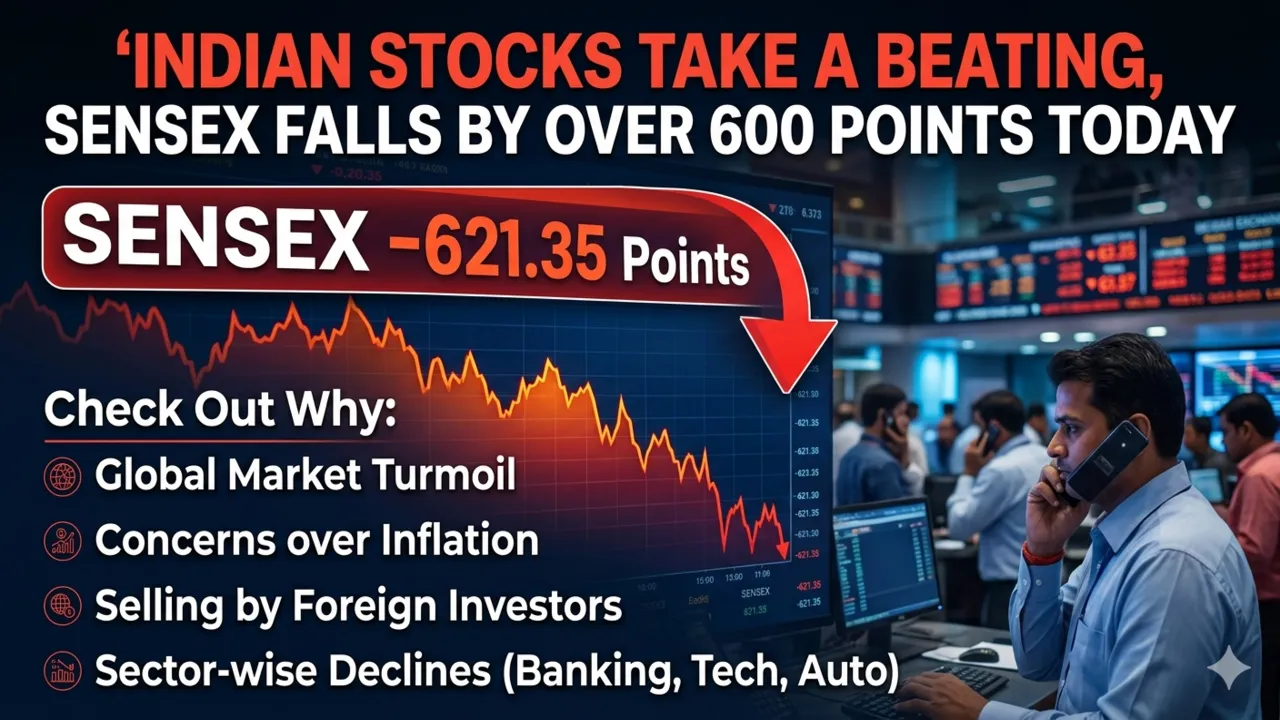
Indian stock markets witnessed a sharp low in the early trading hours on Monday. While the Sensex fell by more than 600 points, Nifty slumped under 23,200. The fall in the stock market today is the investors reaction to the escalating tensions in the Middle East, a surge in crude oil prices and weakness across markets worldwide.
At around 9:30 a.m. on June 8, 2026, the BSE Sensex dropped by 627.47 points to 73,615.87, recording a fall of 0.85%. At the same time, the Nifty declined by 195.40 points to 23,171.30, registering a 0.84% fall.
The selloff was broad based, with most sectoral indices slipping into red. Nifty IT, Nifty Realty, Nifty Auto and Nifty Metal slipped by 1.61%, 1.68%, 1.21% and 1.31%, respectively. Even the Nifty Midcap 100 and Nifty Smallcap 100 declined by 0.73% and 0.63%, respectively.
As far as Sensex stocks are concerned, only State Bank of India, Axis Bank, Power Grid Corporation of India and Sun Pharmaceutical Industries were found to be green. Among the ones taking most of the beating were Mahindra & Mahindra, Tata Consultancy Services, Tata Steel, HCL Technologies, Infosys, Eternal, InterGlobe Aviation and Trent.
Crude Oil Price Skyrockets After a Fresh Iran-Israel Conflict
What made stocks plummeting today was the fresh escalation in the Middle East. Responding to the Israeli strikes on Beirut, Iran hit Israel with missiles, making a peace agreement virtually difficult to attain in the near term. The renewed hostilities have raised concerns around global oil supply disruptions, pushing crude oil prices higher. While Brent crude surged 3.56% to $96.40 per barrel, WTI crude soared 3.32% to $93.55 per barrel.
Why Do Higher Crude Oil Prices Remain a Concern for India?
India imports most of its crude oil requirements, so a surge in oil prices will increase fuel costs, cause upside risks to inflation, widen the current account deficit, and potentially harm the countrys economic growth.
Global Market Selloff Did Not Help Indian Stock Indices Either
The sharp selloff in global markets also took a toll on the Indian stock market today. Bajaj Broking‘s Morning Bell report highlighted an intense and broad-based sell-off on Friday amid growing speculation that the US Federal Reserve would keep interest rates elevated for a longer period due to stronger-than-expected US job data. According to the report, Asian Markets also slipped into the red, with a nearly 3.7% fall in Japan’s Nikkei in early trade.
A stronger US economy often calls for maintaining higher interest rates, potentially reducing the scope for quick rate cuts and making investors more risk-averse in emerging markets such as India.
Conclusion
The sharp decline in Indian stock markets on Monday reflects growing investor anxiety over a combination of global and domestic risk factors. Escalating tensions between Iran and Israel have triggered a surge in crude oil prices, raising concerns for an oil-import-dependent economy like India. At the same time, fears that the US Federal Reserve may keep interest rates higher for longer have dampened risk sentiment across global markets. While the current selloff appears to be driven largely by external factors, investors will closely monitor developments in the Middle East, crude oil price movements, and upcoming central bank signals for further direction. Until greater clarity emerges, market volatility is likely to remain elevated.
Download the WikiFX App for the latest financial updates around the world.

More Insightful Articles for You
Review 2026: Massive Deposit & Withdrawal Complaints Against This Regulated Broker
The 6 Lowest-Commission Forex Brokers South Asian Traders Are Flocking To in 2026
If you trade forex from India, Pakistan, Bangladesh, Sri Lanka, or Nepal, you already know the quiet truth that eats into every trader's results: it is not just the market that decides whether you profit — it is the cost of getting in and out of each trade. Shave a couple of dollars off your commission on every lot, multiply it across hundreds of trades a year, and you are looking at the difference between a strategy that works and one that bleeds out slowly. South Asian traders are some of the most cost-conscious in the world, and rightly so. So we pulled the data on the brokers most often recommended for the region, cross-checked every name on WikiFX, and ranked them by the one number that matters most here: what they actually charge you to trade.
Before the list, one quick lesson that will make this whole ranking click.
News
2026-06-05
Further Reading
Disclaimer:
The views in this article only represent the author's personal views, and do not constitute investment advice on this platform. This platform does not guarantee the accuracy, completeness and timeliness of the information in the article, and will not be liable for any loss caused by the use of or reliance on the information in the article.