

Global Broker Regulation Inquiry App
About WikiFX
English
简体中文
繁體中文
English
Pусский
日本語
ภาษาไทย
Tiếng Việt
Bahasa Indonesia
Español
हिन्दी
Filippiiniläinen
Français
Deutsch
Português
Türkçe
한국어
العربية
اردو
Iran Rejects U.S. Proposal, Seeks Strategic Control Over Ceasefire Leverage
Abstract:[Figure 1: U.S.–Iran Geopolitical Illustration]The current situation marks a critical inflection point, shifting from military brinkmanship to strategic extraction. While publicly framed as ceasefire
The current situation marks a critical inflection point, shifting from military brinkmanship to strategic extraction. While publicly framed as ceasefire negotiations, the underlying reality reflects a rapid reconfiguration of power among the United States, Israel, and Iran within a compressed decision window.
Irans rejection of the U.S. 15-point proposal represents, in essence, a countermeasure to the “maximum pressure” strategy associated with Donald Trump.
Sovereignty and Transit Fees:
Iran‘s five key conditions, including the recognition of its sovereignty over strategic waterways, are closely tied to its reported imposition of a $2 million transit fee. This signals Tehran’s intent to transform the Strait of Hormuz from an আন্তর্জাতিক commons into a quasi-privatized strategic asset. Through selective access policies—granting passage to countries such as India—Iran is simultaneously weakening Western alliances while leveraging global energy chokepoints as instruments of economic coercion.
Negotiation vs. Messaging Strategy:
Irans foreign minister has deliberately framed the engagement as “information exchange” rather than formal negotiations. This semantic distinction reflects internal political balancing, particularly in managing pressure from hardline factions such as the Islamic Revolutionary Guard Corps, while preserving operational flexibility to recalibrate responses based on U.S. military movements.
Escalation Fallout and Strategic Miscalculations
The failure of U.S. and Israeli military actions to trigger internal destabilization within Iran has led to significant internal friction at the leadership level.
President Donald Trump has publicly criticized both the Secretary of Defense and the Chairman of the Joint Chiefs of Staff for prioritizing military escalation over diplomatic resolution. Meanwhile, Israels intelligence agency, Mossad, is reportedly facing internal scrutiny over intelligence misjudgments.
This instability has prompted Israeli leadership to issue a “48-hour maximum impact” directive, aiming to maximize military gains before any potential unilateral ceasefire by the U.S. Such internal fractures introduce substantial uncertainty into the prospects of a broader geopolitical settlement.
Energy Markets: From Supply Shock to Cost-Based Access
Global energy markets are undergoing structural recalibration. Irans implementation of a selective blockade mechanism effectively grants it de facto control over access to the Strait of Hormuz.
While Tehran denies imposing a fixed $2 million transit fee, the requirement for “coordination with Iran” has already become a functional geopolitical lever.
Although Saudi Arabia has doubled export volumes via the Yanbu port on the Red Sea, a daily supply gap of approximately 2 million barrels persists. This indicates a shift in the global oil market from total disruption risk to premium-priced access, where geopolitical risk premiums are increasingly embedded in shipping insurance costs and transit fees.
Gold Technical Analysis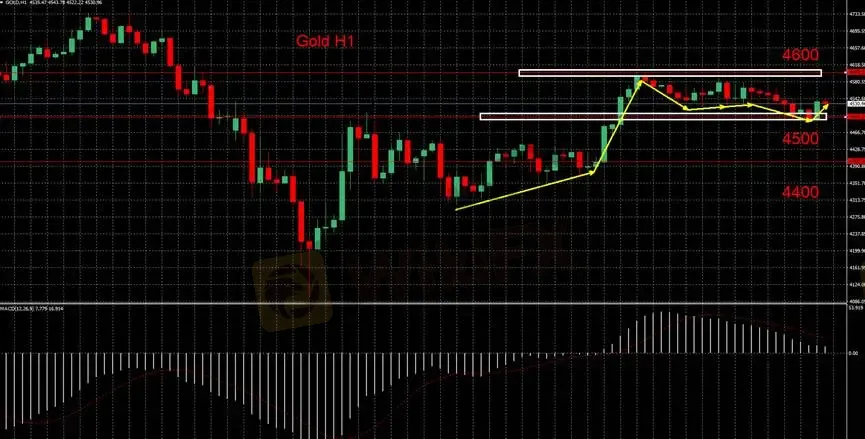
On the H1 timeframe, gold has transitioned from a sharp downward move into a range-bound consolidation with a bearish bias. After finding support near the 4,300 level, prices rebounded but remain capped by the 4,500–4,600 resistance zone. Multiple failed breakout attempts suggest persistent overhead supply and strong selling pressure.
The broader structure has shifted from a directional downtrend to horizontal consolidation, though still within a corrective phase dominated by sellers.
Momentum Indicators:
The MACD has moved above the zero line; however, the histogram is contracting, signaling waning bullish momentum. Concurrently, price action shows a failure to establish higher highs, forming a potential bearish divergence. This suggests that while short-term rebounds exist, upward momentum is fading, and the market is entering a tug-of-war phase between bulls and bears.
Key Trading Range:
The immediate range is defined between 4,400 and 4,600:
A rebound above 4,500 that fails to break 4,600 reinforces the resistance zone, favoring short positions.
A decisive breakout and sustained hold above 4,600 would indicate structural strengthening, opening the door for further upside.
On the downside, a break below 4,400 would signal the end of consolidation, with bears likely regaining control and retesting the 4,300 support level.
Disclaimer:
The views in this article only represent the author's personal views, and do not constitute investment advice on this platform. This platform does not guarantee the accuracy, completeness and timeliness of the information in the article, and will not be liable for any loss caused by the use of or reliance on the information in the article.
WikiFX Broker
Latest News
The Hidden Risks of Margin Calls and How to Trade Trends Safely
 WikiFX
T4Trade Review 2026: Official Warnings and Withdrawal Risks
WikiFXLONG ASIA Review 2026: Withdrawal Complaints and Unverified Regulation
WikiFXTotalFX Dangles 1:1000 Leverage and a $0 Minimum Deposit - But Is Its Regulation Strong?
WikiFXPay a 17% Tax First, Then You Can Withdraw" — How Nixse Allegedly Held One Trader's €25,000 Hostage
WikiFXHow to Read Market Reversals Through Price Action and Indicators
WikiFXA Single TikTok Ad Cost Him RM100,000
WikiFXLONG ASIA Review: Broker Complaints, Regulation Gaps, and Withdrawal Alarms
WikiFXHow Proprietary Trading and Artificial Volume Move Prices
WikiFXCrude Jumps Amid Structural FX Shifts
WikiFXCurrency Calculator
USD

CNY
Current Rate:0
Enter amount
USD
Redeemable Amount
CNY
Calculate 