Global Broker Regulation Inquiry App
About WikiFX


Funding your account with crypto? Three hidden boundaries

WikiFX
|


Abstract:Crypto funding feels instant and private, yet three separate boundaries decide what really happens to your money: who holds the key, who must verify you, and who converts the coins into local currency. A worked hypothetical withdrawal shows where fees, delays and losses can appear.

 Contents
What the three boundaries mean
A crypto deposit or withdrawal is a transfer where value travels as a digital token on a blockchain, a shared record of transactions maintained by many computers. Beginners often hear "crypto" and assume the transfer sits outside banking rules, so it must be faster, cheaper and more private. The speed can be real. The privacy usually is not.
Crypto rails change how value moves and how the record is kept; they do not remove identity checks, the custody question or counterparty risk. Hold those three in view and most surprises become predictable.
Custody, compliance and the payment channel
- Custody asks who controls the key. A private key is the string of characters that proves ownership of a crypto balance. When coins sit in an exchange or broker wallet, the firm controls that key and you hold a claim on the firm. That is counterparty exposure: you depend on the firm's solvency, security and withdrawal rules.
- Compliance asks who must verify you and what they record. A regulated intermediary normally runs identity checks, often called KYC or know your customer, checks the source of your funds, screens names against sanctions lists and keeps a trail. A blockchain record is permanent and visible in a way bank records are not, which makes the trail easier to audit, not easier to avoid.
- The payment channel asks who converts between crypto and local currency. That may be a peer-to-peer match, a local agent, a card processor or the platform itself. Each has its own settlement time and failure mode, such as a reversed bank transfer, a frozen agent account or a rate that differs from the one you first saw.
A hypothetical withdrawal, step by step
Assume a trader holds 800 US dollars in a trading account and funded it partly with a dollar-pegged stablecoin, a token designed to hold a value close to one US dollar. The trader requests a withdrawal of 500. This is a teaching example, not a live instruction or a fee schedule.
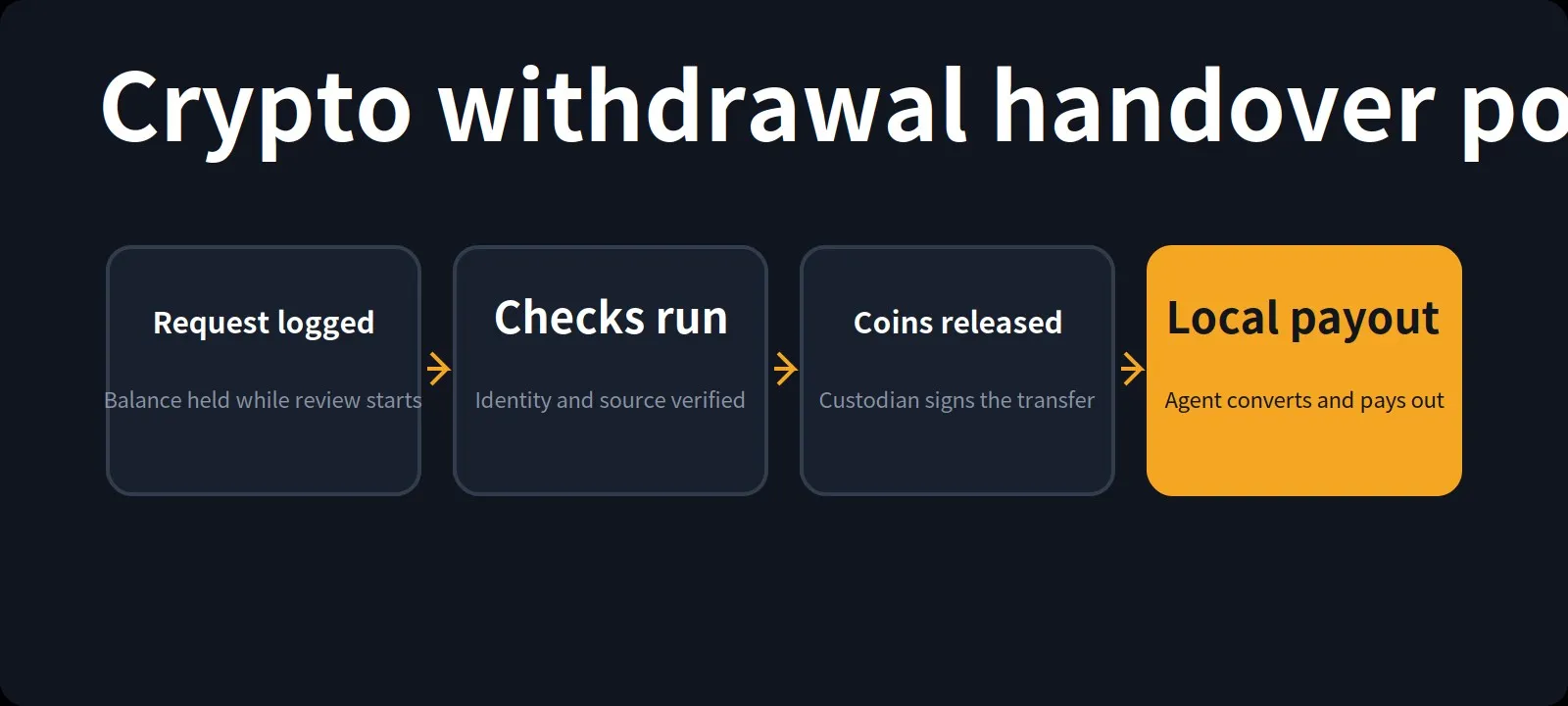
Four points where delays and costs can appear
- The request is logged, and the balance is usually held or reduced while checks run.
- Compliance reviews identity, source of funds and the destination address or bank account.
- The custodian, meaning the party holding the coins, signs the transfer and broadcasts it to the network.
- The payment channel converts the coins and pays out in local currency.
For the arithmetic, suppose the network fee is 2 dollars and the payment channel charges 1.5 percent of the requested amount. That fee is 7.50 dollars, so the amount before conversion is 500 minus 2 minus 7.50, which equals 490.50 dollars. If the channel also applies a rate 1 percent worse than the market mid rate, the local currency received falls again. A mid rate is the halfway point between the buy and sell quotes, and it is not a rate anyone actually gets.
Two timing points matter more than the fee table. Compliance review can pause a withdrawal for hours or days, and the token's market value can move between request and conversion. If the stablecoin slips below its peg during that window, the payout shrinks. Neither event is exotic; both are ordinary operational risk.
Where beginners misread the risk
- Treating crypto as anonymous. Most chains are pseudonymous and permanent, so a payment can be traced long after the trade is closed.
- Treating a confirmation screen as settlement. A network confirmation proves the transfer was recorded, not that the local agent has paid you.
- Treating a platform balance as coins in your pocket. The moment you hold a claim, the firm's solvency and terms become part of your risk.
- Treating a third-party receipt as the broker's receipt. Agents and peer-to-peer counterparties can fail after the coins have left.
None of this makes crypto funding unsafe by definition; it makes the handover points visible. The useful question is not whether crypto is private, but who holds the key, who checks you and who pays you out. Answer those three for any route and you can see where a delay, a cost or a loss would land.
Finally, WikiFX would like to remind everyone that before using any US stock, futures, or forex brokers, remember to check the platform's regulatory information, trading environment, field inspection reports, user reviews, and overall rating on the WikiFX App. This will help you effectively avoid problematic scam platforms and rogue brokers, safeguarding your capital.

Disclaimer:
The views in this article only represent the author's personal views, and do not constitute investment advice on this platform. This platform does not guarantee the accuracy, completeness and timeliness of the information in the article, and will not be liable for any loss caused by the use of or reliance on the information in the article.
WikiFX Broker
Latest News
EURUSD Attempts a Bounce — Can Buyers Reclaim 1.1170?
WikiFXGBP/USD | Current targets
WikiFXA key report for where inflation stood in October comes out Tuesday. Here's what to expect
WikiFXSEBI Proposes Mandatory AML/CFT Certification for Market Intermediaries’ Principal Officers
WikiFXGlobal Markets Outlook: Oil Retreat Fuels Pre-CPI Recovery
WikiFXIndia's Forex Reserves Slip to $717 Billion, Well Below September's $785.7 Billion Record
WikiFXForex Automation Has One Weak Link. Can You Spot It?
WikiFXIndia Forex Scam 2026: Top 5 SEBI Red Flags You Cannot Ignore!
WikiFXASIC Warns 7,639 Super Switch Clients Moved $678 Million Through Lead Generators
WikiFXLMAX Group Review: FCA-Regulated, Yet Clone Firms Are Targeting Its Clients
WikiFX