


FXGT Review of an Indian User's USD 1089.37 Profit Dispute
FXGT review of an India-labelled profit dispute, with complaint screenshots, a transaction-date mismatch, entity disclosures and evidence limits.
Original

简体中文
繁體中文
English
Pусский
日本語
ภาษาไทย
Tiếng Việt
Bahasa Indonesia
Español
हिन्दी
Filippiiniläinen
Français
Deutsch
Português
Türkçe
한국어
العربية
اردو




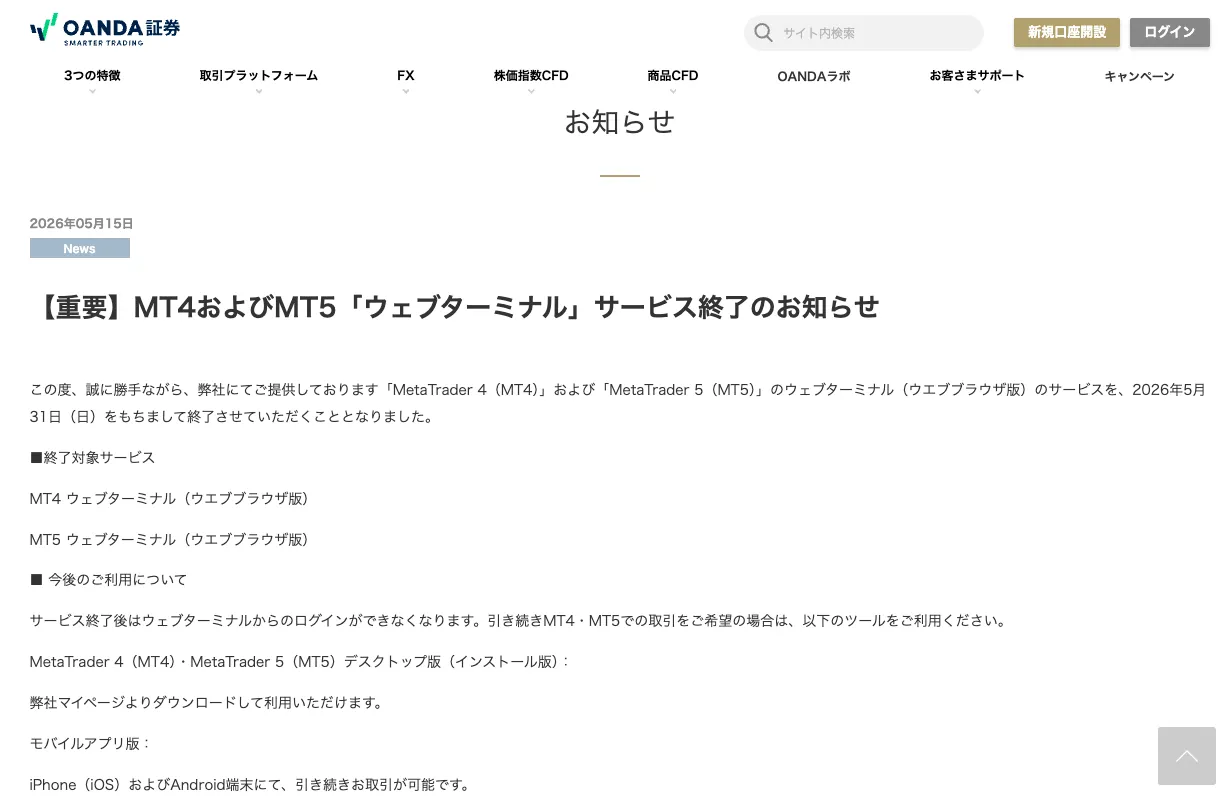
Abstract:OANDA Japan will shut down MT4 and MT5 web terminal access at the end of May, while desktop and mobile trading remain available as the broker continues its MT4 phase-out.

OANDA Japan has announced that it will stop offering web terminal access for MT4 and MT5 at the end of May, removing browser-based login for both platforms.
The change affects only the web versions. Clients will still be able to trade through installed desktop terminals and mobile apps.
 Contents
After the deadline, users will no longer be able to sign in through a browser for either MetaTrader platform.
OANDA Japan said clients should switch to the downloadable desktop versions of MT4 or MT5, or continue using the brokers mobile apps on iPhone and Android. The broker also noted that account balances, open positions, and pending orders will stay unchanged after the web terminal service ends.
One limitation remains: chart layouts and indicator settings created in the web terminal will not move automatically to desktop or mobile. Users who relied on browser-based chart setups will need to rebuild them manually on another device.
The web terminal closure is not an isolated move. It comes as OANDA Japan continues a broader withdrawal from MT4.
The broker had already announced earlier that it plans to end MT4 completely in November. That process has already started. New MT4 account openings have been stopped, and the next stages include restrictions on order placement before the platform is fully closed later in the year.
[Insert Image 2: OANDA Japan MT4 phase-out schedule]
In its earlier explanation, the company said MT4 no longer fits current security and maintenance requirements. It also pointed to the lack of ongoing support for the older platform as one of the reasons behind the transition.
OANDA Japan has been directing users toward MT5 and its own fxTrade platform as alternatives.
That shift has also appeared in other changes around the MT4 environment. Earlier this year, the broker tightened trading conditions on MT4 accounts hosted on its Tokyo server, raising margin requirements and effectively reducing leverage on that setup. The move was presented as part of risk control and operational management, but it also added pressure on remaining MT4 users to migrate.
The firm has also introduced account-transfer measures for some clients with low margin maintenance, moving positions and balances to MT5 where needed.
OANDA Japans latest step reflects a broader direction already visible among brokers still running older MetaTrader infrastructure.
Across the industry, support for older MT4 environments has been getting tighter as firms deal with security, maintenance, and system compatibility issues. In that context, ending browser access is a narrower technical step, but it fits the same larger pattern: keeping MT5 and newer systems active while gradually removing older access points.
For OANDA Japan, the immediate message is clear. Web access disappears first, but the broader MT4 exit is already in motion.
WikiFX is a global broker information platform that provides broker profiles, licence records, regulatory updates, and industry developments across multiple jurisdictions. It is widely used by traders to follow broker background information and market-related changes.

Disclaimer:
The views in this article only represent the author's personal views, and do not constitute investment advice on this platform. This platform does not guarantee the accuracy, completeness and timeliness of the information in the article, and will not be liable for any loss caused by the use of or reliance on the information in the article.

FXGT review of an India-labelled profit dispute, with complaint screenshots, a transaction-date mismatch, entity disclosures and evidence limits.

Gold and silver fell after the weekend's US-Iran escalation, and Indian markets opened lower on 28 September. The rupee opened 7 paise weaker at 95.88 against the dollar. Brent crude traded around $107 a barrel. US 10-year yields sat near 5.20%. Those figures come from trader posts on X, not from any media report in this material. None of them has been independently confirmed. Treat them as what traders saw on their screens at the open, not as settled fact. The counterintuitive part is the metals. War usually pushes gold up. This time it didn't. "Both precious metals had other plans after this weekend's US-Iran war escalation," wrote @YuvrajShah02, an account with 15,103 followers, roughly two hours after the open. The same post says Indian markets "have also taken a hit today." That post is the event this article is about. Everything below comes either from it or from other trader posts published the same morning.

SEBI's board on September 24 approved a sweeping overhaul of portfolio management rules, opening PMS to foreign securities, IPOs and a new mutual-fund-only route called PRIM. But one X user with 101,000 followers flagged a structural change that could reshape how PMS products are sold: a 'platform PMS' can now host independent fund managers (IFMs), each running their own strategy on the PMS's licence. Under the new SEBI (Portfolio Managers) Regulations, 2026, replacing the 2020 framework, existing PMS can invest in foreign securities under both discretionary and non-discretionary mandates, according to multiple media reports. The allowed list includes listed equity, debt, REITs, overseas mutual funds, ETFs, index funds and foreign government debt. All of it stays bound by FEMA and RBI's Liberalized Remittance Scheme — so you still can't buy foreign ETFs in rupees. The PMS just becomes a wrapper.

Most of what a BazaarFx review turns up online is opinion. Two records are not. The UK Financial Conduct Authority published a warning naming this brand on 13 August 2025, and Companies House holds a registration for a company using the name. Neither record settles the question of BazaarFx regulation in the way marketing pages usually imply, and the two are often mistaken for each other. This check was carried out on 22 September 2026; each record carries its own date.
WikiFXWikiFXWikiFXWikiFXWikiFXWikiFXWikiFXWikiFXWikiFXWikiFX