Abstract:NSE has cut the valuation of its initial public offering by roughly 15% and shrunk the deal to about ₹22,500–23,500 crore, down from an earlier plan of nearly ₹30,000 crore. The offer is entirely an offer for sale. Not a rupee of the proceeds goes to the exchange itself.
The revised plan puts 12.64 crore shares on the block, against the 14.89 crore proposed earlier. That works out to about 5.25% of NSE's paid-up capital, down from nearly 6%.
Two numbers moved. The float got smaller and the price got lower. Everything else in the revision follows from those two.
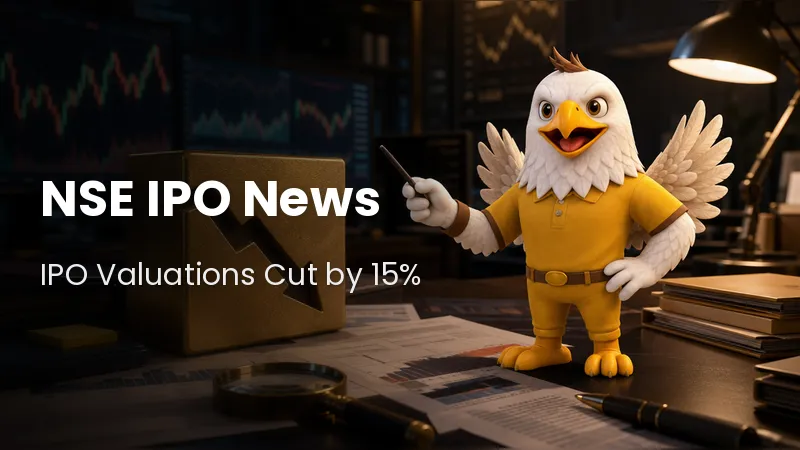
NSE has cut the valuation of its initial public offering by roughly 15% and shrunk the deal to about ₹22,500–23,500 crore, down from an earlier plan of nearly ₹30,000 crore. The offer is entirely an offer for sale. Not a rupee of the proceeds goes to the exchange itself.
The revised plan puts 12.64 crore shares on the block, against the 14.89 crore proposed earlier. That works out to about 5.25% of NSE's paid-up capital, down from nearly 6%.
Two numbers moved. The float got smaller and the price got lower. Everything else in the revision follows from those two.
 Contents
What Changed: Fewer Shares, Lower Price, Smaller Stake
The earlier plan was for an offer of up to 14.89 crore shares. The revised plan cuts that to around 12.64 crore. The total issue size falls from nearly ₹30,000 crore to ₹22,500–23,500 crore.
Public reports put the final figure at ₹22,561.57 crore. Groww, Upstox and Jagran Josh all use that number, and Upstox confirms the offer is an OFS of up to 12.64 crore shares.
The stake on offer drops from nearly 6% of paid-up capital to roughly 5.25%. That is a small change in percentage terms and a large one in rupees — the difference between the old and new plans is somewhere around ₹7,000 crore of stock that will not be sold.
Pricing is the other half. NSE shares have traded between ₹1,900 and ₹2,050 in the unlisted market over the past year. The IPO price is expected to come in below those levels. At a valuation of roughly 43 times FY26 earnings, the exchange would still carry a significant valuation — though comparisons with listed market-infrastructure peers such as BSE and MCX are part of how investors will judge it.
An all-OFS Deal Means NSE Gets Nothing
This is the part retail investors most often miss. A fresh issue raises money for the company. An offer for sale does not. NSE's IPO is entirely the second kind.
Existing shareholders sell part of their holdings to public investors. The exchange's balance sheet does not change. The cash goes to the selling shareholders.
One of them is Soach Global. The fund will sell 20% of its decade-old stake in the IPO and hold the remaining 80% as a long-term investment, according to TheWire.in, which carried the PTI release. The same report says the fund is set for nearly 25x gains on that partial exit.
That is the arithmetic of an OFS in one line: the company gets a listing, the selling shareholder gets the money. If you are buying the IPO, you are buying from an existing holder, not funding the exchange's next project.
The Unlisted Market Was Already Pricing NSE Higher
NSE shares have changed hands in the unlisted market at ₹1,900–₹2,050 over the past year. The revised IPO price is expected to sit below that range.
That gap is the reason the valuation cut drew attention. Investors who bought in the unlisted market at those levels are looking at an IPO that prices lower than what they paid.
The main post frames the revision as a balancing act: a very high valuation could hurt demand, while a lower one gives more comfort to investors entering through the IPO. Both statements describe the same trade-off — how much of the upside goes to the seller and how much is left for the buyer.
Derivatives Pay the Bills, and SEBI Writes the Rules
Around 60% of NSE's operating revenue comes from derivatives. That is the single most important number for anyone trying to value the exchange.
It is also the number most exposed to regulation. SEBI rules on retail participation, expiry structures, transaction charges and trading activity can all move derivatives volumes, and therefore NSE's revenue.
The main post flags this directly: the segment is an important source of earnings, and it is subject to regulatory and volume-related changes. Nothing in the material says a specific rule change is pending. The exposure is structural, not event-driven.
Where the Reported Numbers Disagree
The issue ran from September 17 to September 21, 2026, and closed on its third and final day of bidding. Reports on the final day do not agree on how much demand came in.
HDFC Sky recorded the issue at 1.46x on September 21, with retail at 0.88x, non-institutional at 2.32x and QIB at 1.83x. Upstox put it at 2.56x “so far” on the same day. Moneycontrol said the issue was subscribed over 2x with the retail portion fully subscribed. Rediff MoneyWiz reported nearly 4x on the final day and called it India's second-largest public issue.
These are snapshots taken at different points during a single day of bidding, which explains part of the spread. The retail line is the one that flips outright: HDFC Sky has retail below full subscription at 0.88x, while Moneycontrol describes the retail portion as fully subscribed.
On the gray market, The Times of India and Moneycontrol both put the premium at 3% on Day 3. Moneycontrol notes it declined to that level.
What Traders are Saying on X
The post that started this — from @itspixora, an account with 6,135 followers — asks why the issue is priced below unlisted-market levels and lays out the valuation cut, the OFS structure and the derivatives dependence.
A second post, from @Ashishkafunda, describes itself as an NSE mainboard IPO analysis sourced from the RHP and lists an IPO date of the 17th. It does not add figures beyond that.
A third post in the same pull, from @RealShreekaram, is about an Indore-based flour processor planning a capacity expansion and going public. It has nothing to do with NSE and should not be read as part of this story.
That is the full extent of the same-topic discussion available here. There is no meaningful disagreement between the posts on the facts of the valuation cut, and no post offers a figure that contradicts the others. The engagement counts on these posts are small and prove nothing about the claims in them.
What to Check Before You Act on Any of This
If you applied, your application status sits with your broker, not with NSE. Broker IPO sections show whether an application was received and, later, whether shares were allotted. None of the reports reviewed here state an allotment date.
If you are reading the subscription numbers to judge demand, read them from the exchange's own published data rather than from a single broker blog. The spread between 1.46x, 2.56x, over 2x and nearly 4x on the same day is wide enough that the source matters.
Treat the gray market premium as what it is: an unofficial, unregulated number. It stood at 3% on the final day, down from earlier levels, according to The Times of India and Moneycontrol.
And keep the structural point in view. Because the offer is entirely an OFS, the listing does not hand NSE new capital to deploy. What the market is pricing is the earnings power of an exchange that draws about 60% of its operating revenue from derivatives, in a segment where SEBI sets the rules on expiries, transaction charges and retail participation. That is the exposure that survives the listing.
Download the WIkiFX app for the latest financial news and updates.

Knowledge pays at WikiFX.Every time you share a WikiFX article, you'll receive 50 Reward Points. Grow your rewards with every share and unlock exclusive gifts in the WikiFX Points Mall. Start earning today!