

Global Broker Regulation Inquiry App
About WikiFX
English
简体中文
繁體中文
English
Pусский
日本語
ภาษาไทย
Tiếng Việt
Bahasa Indonesia
Español
हिन्दी
Filippiiniläinen
Français
Deutsch
Português
Türkçe
한국어
العربية
اردو


How AfCFTA Could Shift African Currency Demand

WikiFX
|


Abstract:The AfCFTA and related payment initiatives may give African businesses more ways to settle trade in local currencies, which could reduce the buffer demand for US dollars in routine transactions. This article explains the mechanism with a clearly hypothetical example and corrects common beginner misunderstandings.

 Contents
What the AfCFTA changes in cross-border money
The African Continental Free Trade Area (AfCFTA) is a trade agreement among many African countries that aims to lower tariffs, reduce border delays, and make it easier for goods and services to move within the continent. Cross-border settlement is the process of completing a payment between a buyer in one country and a seller in another. Currency demand means the amount of a particular currency that businesses, banks, and households need to hold for transactions, payments, or reserves.
When two African countries trade today, they often settle in a major international currency such as the US dollar or the euro. This happens because many African currencies are not directly exchangeable with each other in large amounts. A trader in Country A may not easily sell Country B's currency, so both sides agree to use a vehicle currency, a widely accepted third currency that acts as a middle step.
The AfCFTA framework has also encouraged a payment initiative, the Pan-African Payment and Settlement System (PAPSS), which aims to reduce the need for US dollars by settling many intra-African trades in local currencies. AfCFTA and PAPSS do not create new money or replace central banks. But they can change the settlement routes available, and that can change which currencies businesses need to hold for routine trade.
A simple hypothetical example of currency pressure
Consider a hypothetical furniture maker in Country A that sells goods to a retailer in Country B. The invoice is for 100,000 units of Country A's currency, which we will call LC-A. For this example, assume the exchange rate is 1 LC-A = 0.10 USD, so the invoice value is 10,000 USD. Country B's local currency is LC-B, and the retailer must pay from LC-B balances.
Under a USD settlement, the retailer buys USD with LC-B, sends the USD, and the furniture maker receives USD and converts it into LC-A. Both sides may hold a small USD buffer to cover timing gaps. If each side holds 3% of the invoice value in USD, the combined buffer is 600 USD. That is 3% of 10,000 USD from each side, so 300 plus 300.
Under a regional local-currency settlement, the retailer's bank could convert LC-B directly to LC-A, or a payment network could net offsetting flows. In that hypothetical case, neither the retailer nor the furniture maker needs to hold USD just to complete this trade. The specific USD buffer for this transaction falls close to zero. A small residual might remain for price uncertainty, but the direct USD demand created by this particular trade is much lower.
This example is intentionally simple and ignores banking fees, capital controls, and local market liquidity. It shows the mechanism: the choice of settlement currency changes which currencies businesses need to hold for routine trade.
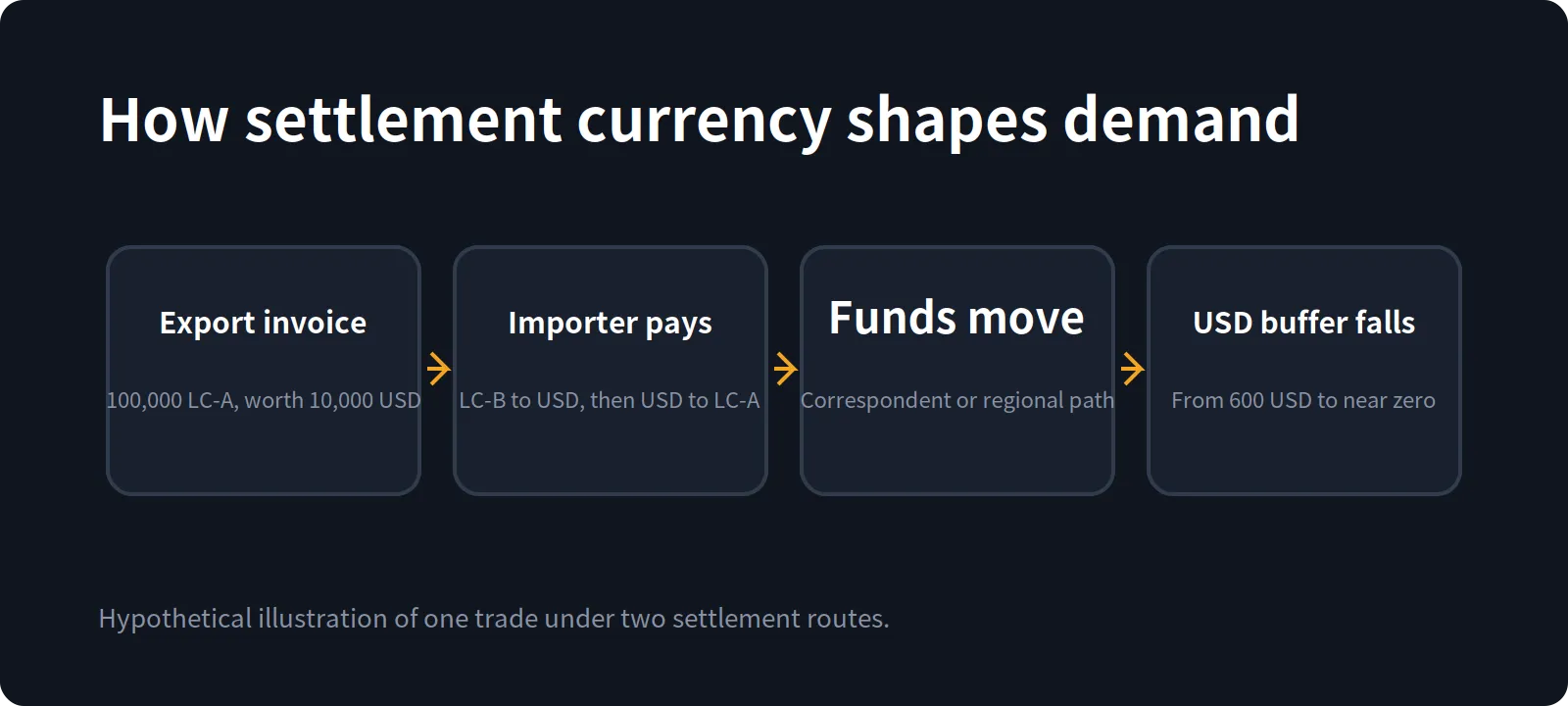
One trade can create very different currency demand depending on the settlement path.
Common misunderstandings about settlement and demand
- Misunderstanding: AfCFTA will immediately end the use of USD in African trade. In practice, vehicle currencies remain useful when local currency markets are shallow, illiquid, or unstable. A trade agreement can enable new settlement routes, but it cannot force a business to accept a currency it cannot easily use.
- Misunderstanding: Reduced USD demand means the USD will weaken against African currencies. Currency demand is only one of many factors. Inflation, interest rates, trade balances, and global capital flows also affect exchange rates. A fall in trade-related USD buffers does not mean an African currency will strengthen.
- Misunderstanding: Local-currency settlement removes exchange rate risk. It removes the USD middle step, but the buyer and seller still face the LC-A/LC-B exchange rate. The risk shifts to a direct pair that may have lower liquidity and wider price moves.
- Misunderstanding: AfCFTA guarantees faster or cheaper settlement. The agreement creates a framework, but adoption depends on banks, central banks, and companies. Some countries may join slowly, and technical or regulatory problems can delay the benefits.
AfCFTA is a trade integration framework, not a currency prediction engine. It can change which settlement options are available, but it cannot tell you which currency will strengthen or which payment route will be cheapest. Understanding the mechanism helps you follow future policy changes without mistaking them for trading signals.
Disclaimer:
The views in this article only represent the author's personal views, and do not constitute investment advice on this platform. This platform does not guarantee the accuracy, completeness and timeliness of the information in the article, and will not be liable for any loss caused by the use of or reliance on the information in the article.
WikiFX Broker
Latest News
Alpari Broker Exposed: What Are Other Traders Saying About This Broker?
WikiFXGold Forecast: the USD Index Soars to New 2026 Highs
WikiFXUS Dollar Price Forecast: Dollar Holds Firm as Fed Bets Ease, EUR/USD and GBP/USD Struggle
WikiFXUK Opens Crypto Gateway Ahead of Regulatory Overhaul
WikiFXUS Bonds Eye Softer Inflation After Core PCE Undershoots Forecasts
WikiFXTrade W Broker Exposed: User Feedback, Delayed Orders and Office Survey
WikiFXWebull Uses Ai To Prepare Trades, Users Can Review & Approve Them Manually
WikiFXGRAND MARKETS Review 2026: Traders Report Fast Trade Execution & Low Spreads. Should You Invest?
WikiFXSTARTRADER Raises Client Fund Insurance to US$30Million
WikiFXTNG eWallet Opens Global Stock Trading to 8.5 Million Users
WikiFX