

Global Broker Regulation Inquiry App
About WikiFX
English
简体中文
繁體中文
English
Pусский
日本語
ภาษาไทย
Tiếng Việt
Bahasa Indonesia
Español
हिन्दी
Filippiiniläinen
Français
Deutsch
Português
Türkçe
한국어
العربية
اردو


Is a Falling Ringgit Wrecking Your Budget? Here’s the Maths

WikiFX
|


Abstract:Learn how ringgit swings change your study, travel and online shopping costs, with a clear calculation and no trading advice.

Exchange rate fluctuations directly affect how much ringgit you need to pay for overseas expenses, but they do not tell you when to convert your money or which direction the rate will move next.
When you study abroad, travel, or buy from international websites, your costs are tied to the value of the Malaysian ringgit against foreign currencies. A weaker ringgit means you need more ringgit to cover the same bill in pounds, dollars, or euros. This article explains the mechanics behind that cost shift, walks through a simple calculation, and clears up a few common misunderstandings, without offering any trading advice or predictions.
 Contents
What Is Exchange Rate Cost Impact?
Exchange rate cost impact measures how a change in the ringgits value changes the ringgit equivalent of a foreign‑currency expense. For a Malaysian, this impact appears in three everyday situations:
- Paying university tuition or accommodation fees quoted in a foreign currency
- Exchanging ringgit for travel money to spend abroad
- Buying products on overseas e‑commerce sites that display prices in USD, GBP, or EUR
In each case, the foreign price stays the same, but the Malaysian ringgit cost can swing noticeably. The concept matters because it directly affects household budgets, and because the popular press often oversimplifies it. A headline like “ringgit weakens 2%” does not instantly mean all your overseas costs rise exactly 2%; the real effect depends on what you are buying and when you actually exchange money.
Key Concepts: Direct vs Indirect Cost Effects
Exchange rate movements reach your wallet through two channels: a direct one and an indirect one.
- Direct cost effect – This happens when you explicitly pay for something in a foreign currency. If you transfer tuition fees in pounds or pay a hotel bill in yen, the ringgit cost is determined by the exchange rate on the day your bank processes the transaction. A 5% depreciation of the ringgit against that currency will raise your ringgit outlay by roughly 5%, all else equal.
- Indirect cost effect – This shows up when prices inside Malaysia change because of imported goods. For example, if the ringgit weakens against the US dollar, imported electronics, fuel, or food ingredients may become more expensive even when purchased locally. That effect is slower and often dampened by local competition, contracts, or subsidies, but it still matters for overall living costs.
Estimating Cost Changes: A Simple Calculation
The basic formula is:
Cost in ringgit = Foreign‑currency amount × Exchange rate (ringgit per unit)
Follow these steps:
- Write down the foreign‑currency amount you need (e.g., £10,000 tuition fee).
- Find a recent exchange rate quoted as ringgit per pound (e.g., 5.30).
- Multiply to get the ringgit cost: £10,000 × 5.30 = 53000 ringgit (often written as RM53,000).
- Repeat with the new rate to compare: £10,000 × 5.80 = 58000 ringgit (RM58,000).
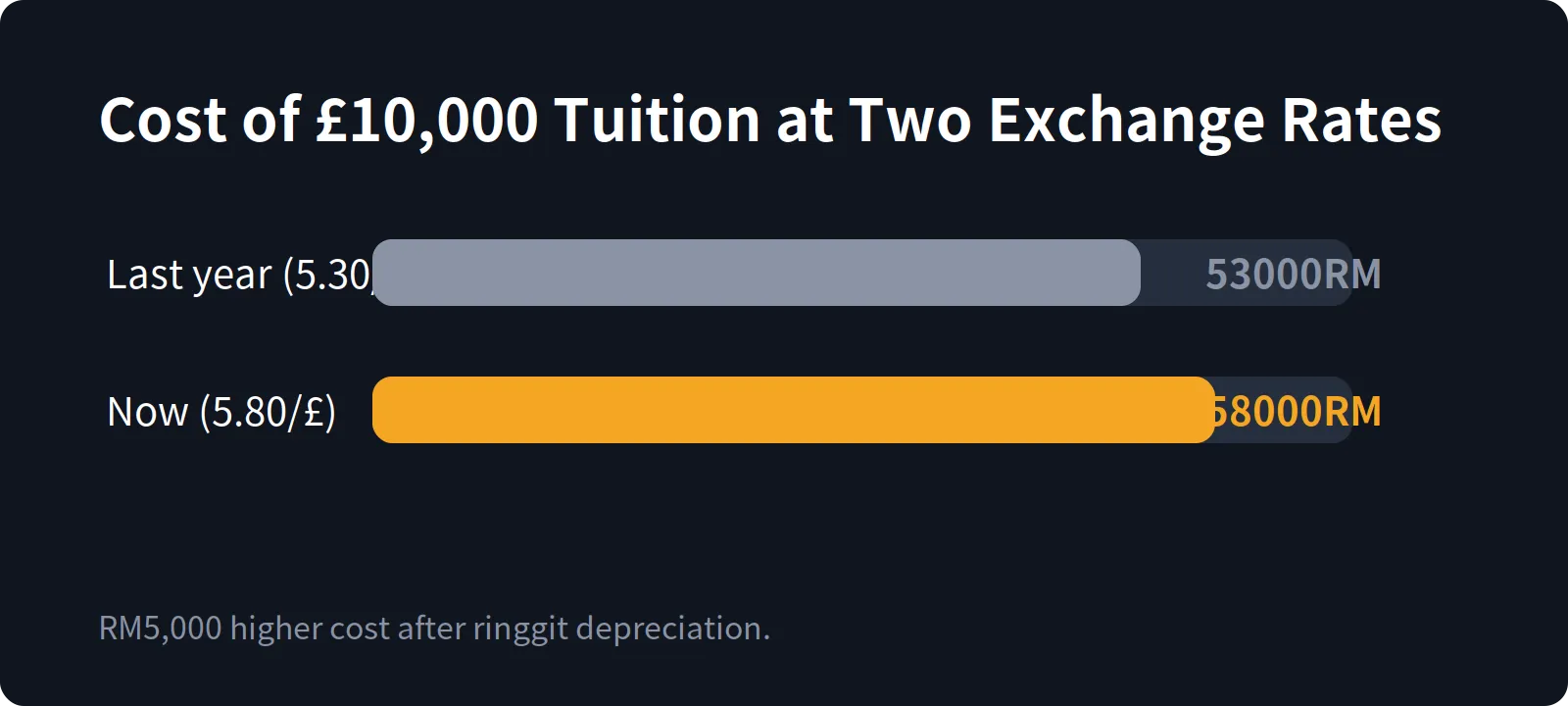
Hypothetical example: GBP 10,000 tuition fee.
Common Misunderstandings and Limitations
- “The published exchange rate is what I get.” Banks and money changers add a markup, so the rate you actually receive is slightly less favourable. Always check the effective rate after fees.
- “All costs rise in lockstep with the rate.” Some expenses are locked in ahead of time. When a university bills in ringgit or you prepay accommodation, a later ringgit fall may not affect that bill. Travel expenses such as meals and transport are paid day‑by‑day, so they are more sensitive to spot rates.
- “Online shopping prices change exactly like travel money.” Many cross‑border shopping platforms display prices in ringgit using their own internal exchange rate, which may be adjusted only periodically. A ringgit depreciation might not show up immediately on the price tag.
- “If the ringgit weakens by 5%, my total budget goes up 5%.” Your budget mix matters. If only part of your spending is in foreign currency, the overall budget impact is smaller. A student paying mostly for local food and transport in the host country, but with fees already fixed, may feel a milder effect than expected.
What It Is, And What It Isnt
Exchange rate cost impact explains how your ringgit outlay can shift when the ringgit moves against a particular currency. It is a budgeting tool, not a timing signal. It does not tell you where exchange rates are heading, when to buy foreign currency, or whether the ringgit is undervalued. Knowing the cost impact helps you plan and compare expenses realistically, but it offers no trading advantage, and that boundary is worth repeating: this concept measures cost sensitivity, not market direction.
Disclaimer:
The views in this article only represent the author's personal views, and do not constitute investment advice on this platform. This platform does not guarantee the accuracy, completeness and timeliness of the information in the article, and will not be liable for any loss caused by the use of or reliance on the information in the article.
WikiFX Broker
Latest News
U.S. Dollar Rallies As 10-Year Treasury Yield Tests New Highs: Analysis For EUR/USD, GBP/USD, USD/CAD, USD/JPY
WikiFXWikiFX Wishes You a Happy Mid-Autumn Festival
WikiFXJustMarkets Review 2026: Withdrawal Delay & Trade Execution Error Complaints Surface
WikiFXAzure Markets Review After Its Licence Page Returned 404
WikiFXRM330,000 Invested, Only RM35,000 Comes Back
WikiFXSTARTRADER Opens Weekend Trading on Two Chinese AI Stocks
WikiFXXPO FUND Review After the BVI Statement of 16 March 2026
WikiFXUSD and Commodities Forecasts: Some Maps Changed, Others Just Paid Off
WikiFXMeta Dismantles 3.8 Million Scam Linked Pages
WikiFXUS Dollar Price Forecast: Fed Rate Path Supports Dollar as EUR/USD and GBP/USD Diverge
WikiFX