

Global Broker Regulation Inquiry App
About WikiFX
English
简体中文
繁體中文
English
Pусский
日本語
ภาษาไทย
Tiếng Việt
Bahasa Indonesia
Español
हिन्दी
Filippiiniläinen
Français
Deutsch
Português
Türkçe
한국어
العربية
اردو


Bank Customers Win Back RM211,000 After Insider Fraud

WikiFX
|


Abstract:Two victims of a bank investment fraud in Kuching, Sarawak have finally recovered their losses in full, but only after a months-long process that required the direct intervention of a state politician and a sustained challenge against the very financial institution whose employee had wronged them.
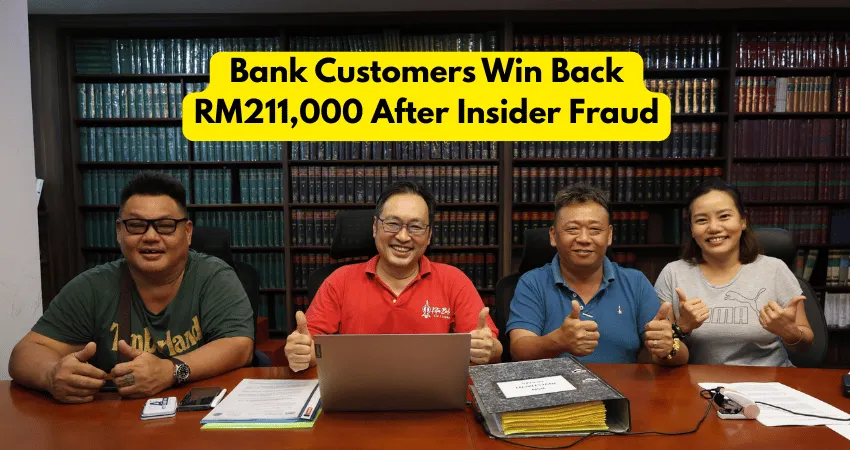
Two victims of a bank investment fraud in Kuching, Sarawak have finally recovered their losses in full, but only after a months-long process that required the direct intervention of a state politician and a sustained challenge against the very financial institution whose employee had wronged them.
The cases centre on Chai Wee Lieang and Yeo Liew Kuang, both of whom were approached in September 2025 by a then-employee at a bank branch on Jalan Tun Jugah in Kuching. Both men were persuaded by this individual to invest through what they understood to be a legitimate bank-facilitated fund. Chai handed over RM111,000 in cash. Yeo handed over RM100,000. The transactions took place at the branch itself, with the employee receiving the funds directly.
When news broke in November 2025 that the employee had been involved in a fraud scandal, both men returned to the bank to check on the status of their investments. They were told their money had been misappropriated by the officer and that the bank held no records of either investment. The funds had effectively vanished from the institution's system.
In February 2026, the bank issued partial refunds. Chai received RM22,690 and Yeo received RM30,000. The bank declined to release the remaining balances, citing concerns about the source of the original funds. This position left Chai still owed RM87,310 and Yeo still owed RM70,000, with no clear resolution in sight.
At that point, both men approached Chong Chieng Jen, the Sarawak Democratic Action Party chairman, for assistance. Chong took up their cases, writing directly to the bank and securing a meeting with the institution's chief executive officer at the time. He also raised the matter with the Deputy Finance Minister, making the case that the grounds cited by the bank for withholding the remaining refunds, suspicion about the source of funds, were not only unjustified but inverted the actual situation. The money had entered the bank through a legitimate employee interaction, and it was the employee, not the clients, whose conduct had been fraudulent.
In late June 2026, the bank relented. Chai received the outstanding RM87,310 and Yeo received the outstanding RM70,000. Both men expressed their gratitude to Chong at a public appearance where he announced the outcome.
Chong, however, was clear that the resolution of these two cases does not mark the end of the matter. Other victims of the same former employee remain without full refunds. He stated his intention to continue advocating on their behalf.
This case surfaces an aspect of investment fraud that is sometimes overlooked in broader discussions of the problem: the fraud did not originate from an external scammer operating through a phone, an app, or an online platform. It came from inside the institution where the victims placed their trust. The customers did nothing wrong. They handed money to an employee at a physical branch of their bank, received no acknowledgment or documentation that the bank later recognised, and were then told the funds were gone.
The bank's initial decision to withhold a significant portion of the refund based on suspicion about the source of funds adds another layer of frustration to an already difficult situation. It placed the burden of clarification on victims who had already been wronged, rather than on the institution whose internal controls had failed.
For bank customers, the case is a reminder that even face-to-face transactions with bank personnel are not automatically protected by institutional safeguards. Any investment instruction given to a bank employee should generate a paper trail, a receipt, or a system-generated acknowledgment that does not pass through the employee alone. If a bank representative encourages you to transact in cash at a branch without any formal documentation, that itself is a warning sign worth taking seriously.

Disclaimer:
The views in this article only represent the author's personal views, and do not constitute investment advice on this platform. This platform does not guarantee the accuracy, completeness and timeliness of the information in the article, and will not be liable for any loss caused by the use of or reliance on the information in the article.
WikiFX Broker
Latest News
RBI Vows to Steady 'Undervalued' Rupee After It Hits Five-Month Low
WikiFXSingaporean Man Arrested Over Gambling Investment Scam Linked to S$2.2 Million in Losses
WikiFXKuantan Investment Scam Raids Expose RM215,000 Operation
WikiFXTag Markets Broker Review: Regulated but Is It Safe for Traders?
WikiFXDoctor Loses RM300,000 in an Investment That Promised 10% Monthly Returns
WikiFXFBS Regulation Checks Before Choosing the Company Behind an Account
WikiFXLuxury Brand Owner Shot Dead After Losing US$100 Million in Trading Last Month
WikiFXOil, Yields and French Debt Keep Global Markets Under Pressure
WikiFXShareflo Finds 33,675 UK Companies Behind on Filings as Director ID Checks Take Effect
WikiFXGold Near Nine Week Low as Fed Rate Fears Intensify
WikiFX