

Global Broker Regulation Inquiry App
About WikiFX
English
简体中文
繁體中文
English
Pусский
日本語
ภาษาไทย
Tiếng Việt
Bahasa Indonesia
Español
हिन्दी
Filippiiniläinen
Français
Deutsch
Português
Türkçe
한국어
العربية
اردو



You Know the Rules. So Why Are You Still Blowing Accounts?

WikiFX
|


Abstract:Every Forex trader knows the rules: cut losses fast, trade with a plan, control position size. But knowing and doing are two completely different worlds. The gap between theory and execution is where most retail traders bleed their accounts dry. This article breaks down the real psychological and mechanical barriers to trading discipline — and gives you a practical system to close that gap for good, one pip at a time.
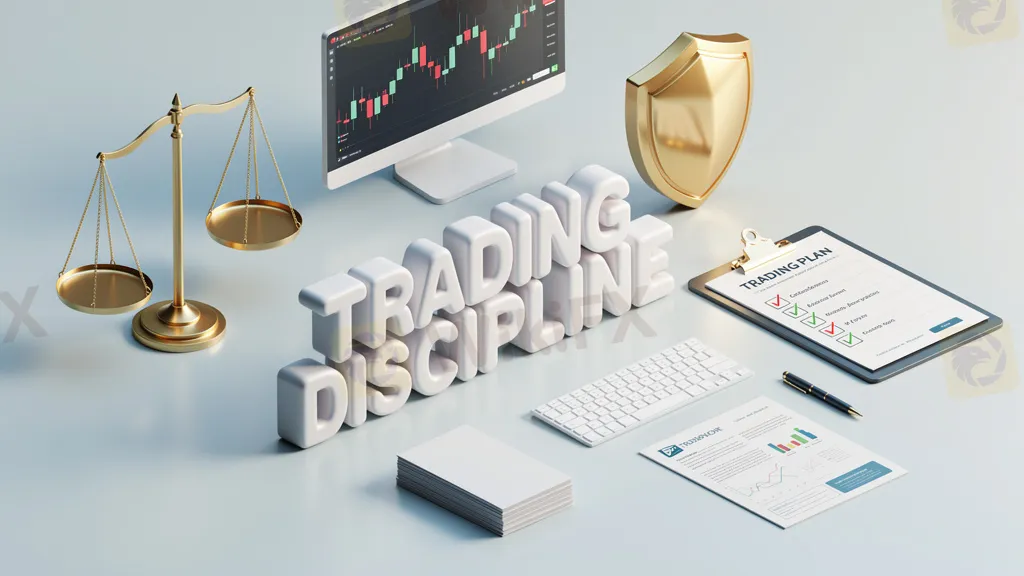
You Know the Rules. So Why Are You Still Blowing Accounts?
I've sat across from traders who could recite every rule in the book. Stop losses? Check. Risk 1-2% per trade? Yep. Trade with the trend? Of course. Yet their accounts look like a ski slope going downhill.
Here's the ugly truth: knowing is free. Doing costs you everything.
The distance between what you know and what you actually execute in live market conditions — that's where accounts go to die. This isn't a strategy problem. It's a discipline problem. And discipline isn't something you're born with. It's a system you build.
Let's build it.
Why Does Every Trader Fail to Follow Their Own Rules?
Because the market is designed to exploit your psychology.
When price moves against you 30 pips, your brain doesn't say “this is within normal variance.” It screams “do something!” That panic overrides every rule you memorized during calm backtesting sessions.
Several forces are working against you:
Greed. You hit your target of 50 pips. The trade keeps running. You remove the take profit. Then the market reverses and you give it all back. Classic.
Fear. You've had three losses in a row. A textbook setup forms on EUR/USD. You hesitate. You don't take it. It runs 80 pips without you.
Revenge trading. You blow a stop. You immediately re-enter, doubled up, trying to “get it back from the market.” The market doesn't care about your feelings. It takes that too.
These aren't character flaws. These are hardwired human responses. The only way to fight them is with structure.
The Three Layers of a Real Discipline System
Layer 1 — The Written Trading Plan (Your Contract With Yourself)
A plan that lives only in your head is not a plan. It's a suggestion. And when EUR/JPY is moving 60 pips in five minutes and your adrenaline is spiking, suggestions evaporate.
Your written plan must answer these questions before you open a single position:
- What pairs am I trading today?
- What is my maximum loss per trade (in dollar terms, not just percentage)?
- What are my entry criteria — and what disqualifies a setup?
- What is my stop placement rule? (Hint: set it where the trade is wrong, not based on how much you can afford to lose)
- What is my target, and will I trail or take profit at a fixed level?
- What news events are scheduled today that I should avoid?
Write this down. Every single session. When you have to write it, most of the impulsive trades vanish before they even happen. You can't write “I'm going to revenge trade GBP/USD at 3 AM” and feel good about it.
Layer 2 — The Pre-Session Checklist
Before you touch a chart, run through a daily checklist. This is not optional.
Market conditions check:
- Is the pair I want to trade in a clear trend, or is it consolidating?
- Are we trading in the high-volume London or New York session, or in thin Asian markets where spreads widen and false moves are common?
- Is there a major economic data release (non-farm payrolls, central bank decisions) in the next four hours?
Mind check:
- Am I trading after a big losing day? (If yes, reduce size by half or sit out)
- Have I slept? Eaten? Am I emotionally charged about something unrelated to trading?
- Am I clear-headed enough to accept a loss without revenge trading?
This isn't soft. Professional athletes have pre-game routines. Surgeons have checklists. Pilots have checklists. Traders who skip theirs are flying blind.
Layer 3 — The Trade Log (Your Judge and Jury)
This is the most powerful discipline tool most traders never use consistently.
For every trade, record:
- Currency pair and time of entry
- Entry price and direction
- Stop loss and take profit levels
- Reason for the trade (what setup triggered it?)
- Exit price and result in pips and dollars
- Emotional state during the trade
- Did you follow your plan? Yes or No.
That last field is everything. When you review your log after two weeks and see ten consecutive “No” answers under “followed plan,” you can't lie to yourself anymore. The log becomes your accountability partner.
One trader I knew said he stopped taking bad trades because he didn't want to write them in his journal. He was embarrassed to put them on paper. That embarrassment saved his account.
Position Size Is Discipline, Not Just Math
Here's something most traders don't understand: your position size directly controls your emotions.
Trade 0.01 lots on a $1,000 account and a 50-pip adverse move barely registers. Your analysis stays clear. You can hold for the trend.
Trade 0.5 lots on that same $1,000 account and a 50-pip move wipes 25% of your capital. Your hands are shaking. You close prematurely. You can't think straight.
Same chart. Same setup. Completely different psychology — caused entirely by lot size.
The formula is simple: Risk Amount ÷ Stop Loss in Pips × Pip Value = Position Size. Never skip this calculation. Not once. It should take 30 seconds. Those 30 seconds keep you alive in this market.
General guideline: risk no more than 1-2% of your account on any single trade. Not because it's a rule someone made up. Because at 1-2% risk, you can absorb 20-30 consecutive losses and still be in the game. At 10% risk per trade, three bad trades can destroy 30% of your capital and your confidence simultaneously.
The Stop Loss Is Not Optional
I've seen traders sit on losing EUR/USD positions for weeks, hoping the market “comes back.” Sometimes it does. More often, they eventually panic-close at 300 pips down, instead of the 40 pips their original stop would have cost.
Set your stop before you enter. Place it where the trade thesis is invalidated — below a key support level, above resistance, outside the consolidation range. Not at a dollar amount that feels comfortable. The market doesn't know what you can afford.
Once the stop is set, do not move it further away. Only move it toward your profit target. Never widen a losing stop.
Is Your Broker Working Against You? Here's How to Check
Before any of this discipline work matters, your foundation has to be solid. A shady broker can hunt your stops, widen spreads during news events, or delay execution at critical moments.
Always verify your broker's regulatory status before depositing. WikiFX is a free tool that lets you check any broker's license, regulatory history, and user complaints in seconds. If the broker isn't listed with a top-tier regulator — FCA in the UK, ASIC in Australia, or similar — walk away. No discipline system saves you from a fraudulent platform.
Three Practical Habits That Separate the Consistent From the Blown-Out
1. Set a daily loss limit and honor it like a stop loss on your whole session.
Decide before the session: if I lose X dollars today, I stop. Close the platform. Walk away. Come back tomorrow with a fresh perspective. Chasing losses within a session is one of the fastest ways to turn a bad day into a catastrophic week.
2. Take breaks. Seriously.
Day after day of staring at charts degrades your judgment gradually. You won't notice it happening. One successful trader said he stops trading when he feels his judgment dropping below 90%. Below that level, you start losing money — not because the market changed, but because you did.
3. Reduce size after losses, not after wins.
Most traders do the opposite. They bet bigger after wins (feeling confident) and try to recover losses by betting bigger after losses. This is mathematically and psychologically backwards. After a loss, drop to half your normal size until you're back to break-even on the week.
The Only Question That Matters
At the end of every trading session, ask yourself one thing:
Did I execute according to my plan today?
Not: did I make money?
Not: was the market fair?
Not: was I right about the direction?
Just: did I do what I said I would do?
Consistency in execution — even through losing periods — is what separates traders who last from traders who flame out. The edge you have in the market is small. Protecting it through disciplined execution is the only job that matters.
Before you even think about refining your strategy, check your broker on WikiFX. A regulated broker is the non-negotiable starting point. Then build your written plan, run your checklist, log every trade, and manage your size. Do these things every session, without exception.
The market will still be here tomorrow. Your capital needs to be too.
Disclaimer: This article is for educational purposes only and does not constitute financial advice. Forex trading involves significant risk of loss. Never trade with capital you cannot afford to lose. Past performance is not indicative of future results. Always conduct your own research and consider seeking independent financial advice before making trading decisions.

Disclaimer:
The views in this article only represent the author's personal views, and do not constitute investment advice on this platform. This platform does not guarantee the accuracy, completeness and timeliness of the information in the article, and will not be liable for any loss caused by the use of or reliance on the information in the article.
WikiFX Broker
Latest News
Australian Dollar posts fresh three-month high amid hawkish RBA prospects
WikiFXVietnam: Inflation and trade trends shape VND – Commerzbank
WikiFXBritish Pound climbs as USD fades, Hormuz risk keeps Fed in play
WikiFXSilver Price Forecast: Head-and-Shoulders risk builds below $67
WikiFXMT4 Phase-Out Accelerates as More Forex Brokers Move to MT5
WikiFXNSE Action Parker Derivatives 8 September 2026 and Seven Checks Before Funding
WikiFXDo You Know Your Cost of Swinging Gold? Gold CFD Costs Shift From Spreads To Overnight Fees
WikiFXBlackwell Global UK Loss Widens as Revenue Falls 37%
WikiFXXMR Markets Review 2026: Allegations of Failed Withdrawals & Bonuses
WikiFXAustralian Dollar rides thin-trading lift as Fed test looms
WikiFX