Abstract:Is VOLURR BROKERAGE safe or a scam for South Asian traders? Read our honest 2026 review covering SEBI/RBI status, offshore risks, Trustpilot feedback, and WikiFX safety rating.
 VOLURR BROKERAGE Safe or a Scam What South Asian Traders Must Know.png" title="Is VOLURR BROKERAGE Safe or a Scam What South Asian Traders Must Know.png">
If you‘ve been scrolling through trading forums or financial social media in India, Pakistan, or Bangladesh lately, chances are you’ve bumped into the name VOLURR BROKERAGE (volurr.com).
They present themselves as a sleek, modern gateway to global financial markets with fast execution, wide asset coverage, and tempting trading conditions.
But let‘s be real for a second—a flashy website and bold promises don't automatically mean your money is safe. Before you hit that deposit button with your hard-earned savings, it’s worth digging beneath the surface to see whats actually going on.
 Contents
Risk Verification Checklist for South Asian Traders
Before transferring any capital or signing up, run your plans through this quick sanity check:
- Local Regulatory Approval: Is VOLURR authorized by regional authorities like SEBI or RBI in India? (Answer: No)
- Tier-1 Global Oversight: Does the firm hold full-capacity licenses from top-tier regulators like the FCA (UK), ASIC (Australia), or CFTC (USA)? (Answer: No)
- WikiFX Safety Rating: Does VOLURR maintain a verified physical location and high trust index on independent broker trackers like WikiFX? (Answer: No, it holds a low safety score with risk alerts)
- Segregated Banking in South Asia: Are your funds deposited into local custodian banks monitored by financial authorities? (Answer: No)
- [ ] Withdrawal Track Record: Is the withdrawal process smooth and free of arbitrary delays or hidden compliance blocks? (Answer: Mixed user reports indicate recurring friction)
Local Regulatory Reality: The SEBI and Regional Stance
When we talk about trading forex or CFDs in South Asia, local legality is always a huge talking point.
Honestly, if you look at official regulatory registries—such as SEBI (Securities and Exchange Board of India) —VOLURR BROKERAGE is NOT registered as a recognized financial intermediary.
What does this mean for retail traders living in India, Sri Lanka, or Bangladesh?
- No Legal Protection: Local monetary regulators won't be able to step in or mediate if the broker suddenly refuses to process your withdrawal or freezes your account.
- Payment Processing Hassles: Because offshore brokers operate outside local banking frameworks, local bank transfers or card deposits might get flagged, blocked, or subjected to heavy fees.
- Domain Blockades: Unregulated offshore trading sites are frequently targetted by government authorities for domain filtering or ISP blocks.
Offshore Operations: Unmasking the Regulatory Shield
Okay, so VOLURR isn't licensed locally in South Asia. But what about its international footprint?
The broker claims to operate globally under offshore corporate frameworks. Now, to be fair, offshore licenses aren't automatically evil—plenty of international brokers use them to offer higher leverage and faster KYC onboarding.
However, if you think about it, offshore jurisdictions don't enforce strict investor compensation schemes, mandatory negative balance protection, or rigorous capital auditing. If an offshore entity goes under or mismanages client capital, retail traders are usually left holding the bag with very little legal recourse.
User Experience on Trustpilot
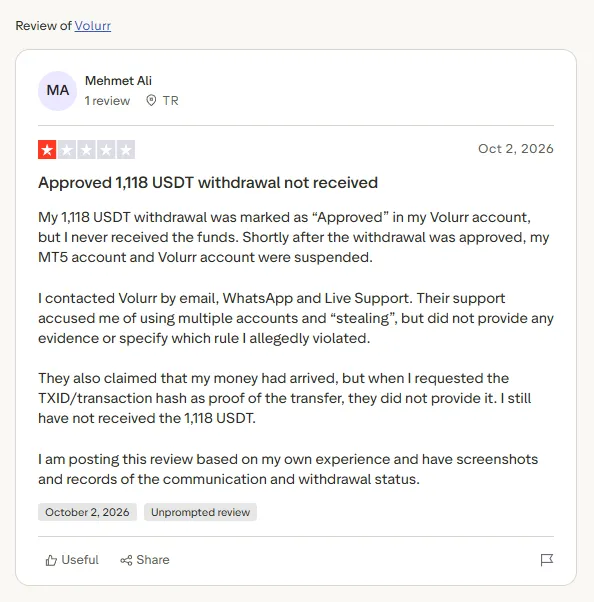
Its always a good idea to check real user feedback on public platforms like Trustpilot to see how a broker behaves in day-to-day operations.
When analyzing community reviews for volurr.com:
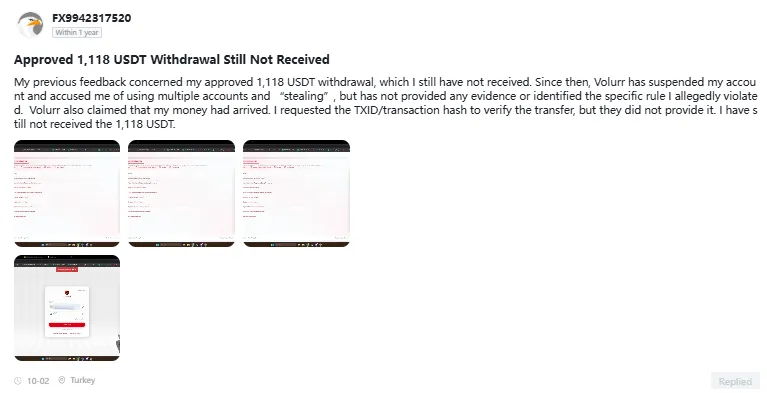
Several traders express frustration over sluggish customer support response times when technical glitches happen. More importantly, users report unexpected delays and lengthy verification hurdles right when they attempt to withdraw profits.
The WikiFX Safety Evaluation
Source: https://www.wikifx.com/en/dealer/3806411553.html?source=hMa4
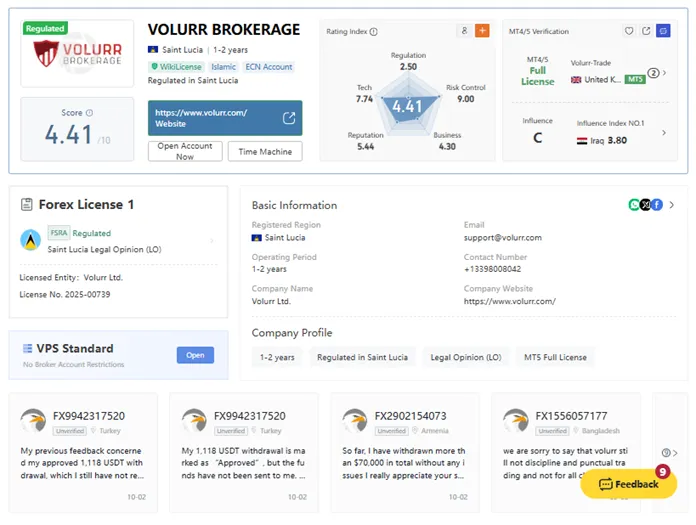
For traders who rely on independent monitoring portals, WikiFX provides a structured breakdown based on licensing, risk control, software authenticity, and business index.
In VOLURR BROKERAGE's profile on WikiFX, the broker receives a low overall safety rating accompanied by explicit risk warnings. The main red flags stem from:
- Absence of Tier-1 Regulatory Licenses: No strong oversight from high-caliber international bodies.
- Unverified Physical Footprint: No verified field survey confirming an active, physical corporate office.
- Higher Counterparty Risk: Categorized in the medium-to-high operational risk bracket due to weak regulatory backing.
Is VOLURR BROKERAGE Safe or a Scam?
So, let's address the big question directly: Is VOLURR BROKERAGE a complete scam, or is it safe?
The answer isn't strictly black or white. VOLURR BROKERAGE is not a fake “ghost” website or a classic Ponzi scheme without actual trading infrastructure—they do offer live market data and functional trading platforms.
However, calling them “Safe” for South Asian retail traders would be quite misleading. Due to the lack of SEBI/local authorization, zero Tier-1 regulation, and low safety ratings on monitoring portals, VOLURR BROKERAGE must be classified as a HIGH-RISK BROKERAGE.
Final Verdict: Make a Smart Choice with Your Capital
Exploring global trading opportunities can be exciting, but protecting your capital should always be your top priority.
If you're an experienced trader who fully understands the risks of offshore accounts and only uses small amounts of risk capital (money you can afford to lose), you might treat VOLURR as a secondary platform.
But for beginners or anyone looking for long-term security, peace of mind, and clear legal protections, opting for fully regulated, licensed brokerages is simply the smarter, safer way to go.
Frequently Asked Questions (FAQ)
Q1: Is VOLURR BROKERAGE registered or authorized by SEBI in India or monetary authorities in South Asia?
Answer: No. VOLURR BROKERAGE does not hold licenses from SEBI (India) operating purely as an unregulated offshore broker in these regions.
Q2: Why do I sometimes need a VPN to access the VOLURR website?
Answer: Because the broker lacks regional licenses, local telecom and government authorities periodically restrict or block access to its web domain to protect retail investors.
Q3: What should I do if my withdrawal request on VOLURR gets delayed?
Answer: Document every detail immediately—take screenshots of your balance, open trades, deposit receipts, and support chat transcripts. Since local regulators can't intervene, publishing your complaint on exposure portals like WikiFX is often your best bet to draw public attention.
Q4: Does trading with an offshore broker mean I will definitely lose my money?
Answer: Not necessarily, but your operational risk is significantly higher. Without strict regulatory enforcement, there is no guarantee that your funds are kept separate or that withdrawals will always be processed without unexpected friction.