

Global Broker Regulation Inquiry App
About WikiFX
English
简体中文
繁體中文
English
Pусский
日本語
ภาษาไทย
Tiếng Việt
Bahasa Indonesia
Español
हिन्दी
Filippiiniläinen
Français
Deutsch
Português
Türkçe
한국어
العربية
اردو


Why Survivorship Bias Fills Your Forex Feed With Winners

WikiFX
|


Abstract:A social feed shows winners because losers stay silent. This article explains survivorship bias, works through a hypothetical 100-trader example, and shows how fake screenshots and hidden losses warp a beginner's expectations.

 Contents
What Survivorship Bias Actually Is
Survivorship bias is the tendency to judge a group by the members who made it through a selection process while ignoring those who did not. In forex, the foreign exchange market, “surviving” simply means keeping an account active and staying in the game. When you scroll a trading feed, you mostly see survivors: profitable screenshots, large wins, or smooth account growth charts. Losers rarely post, and many of them have already stopped trading.
A famous example comes from a military study during World War II. Engineers wanted to add armour to returning bombers and studied the bullet holes on the planes that came back. They saw damage on the wings and body, but not on the engines. A statistician pointed out that planes hit in the engines never made it back, so the visible damage was misleading. The lesson for forex is the same: the data you can see is not the whole picture.
Survivorship bias explains why a feed looks better than reality. It does not tell you whether any particular strategy works. It is a filter, not a proof.
The Selection Problem Behind Every Screenshot
Before talking about fake screenshots, think about samples. A sample is a small slice of a larger group, and it is useful only if it represents the whole group. Social media is a poor sample because its selection process favours winners. A trader who had a good week is far more likely to post than someone who just lost a month of income.
Several forces push the feed in one direction:
- Losers stay silent. People rarely show losses, and when they do, the loss is often buried inside a lesson or a joke.
- The algorithm rewards engagement. An algorithm is the computer rule that decides what appears in your feed. A post with a huge green number gets more clicks, so platforms show it to more people.
- Screenshots can be fake or misleading. Some are edited, some come from demo accounts with imaginary money, and others hide the losing trades that happened before the winning one.
- The same winner repeats. A small number of active posters can dominate the feed, so one lucky streak can look like the normal experience.
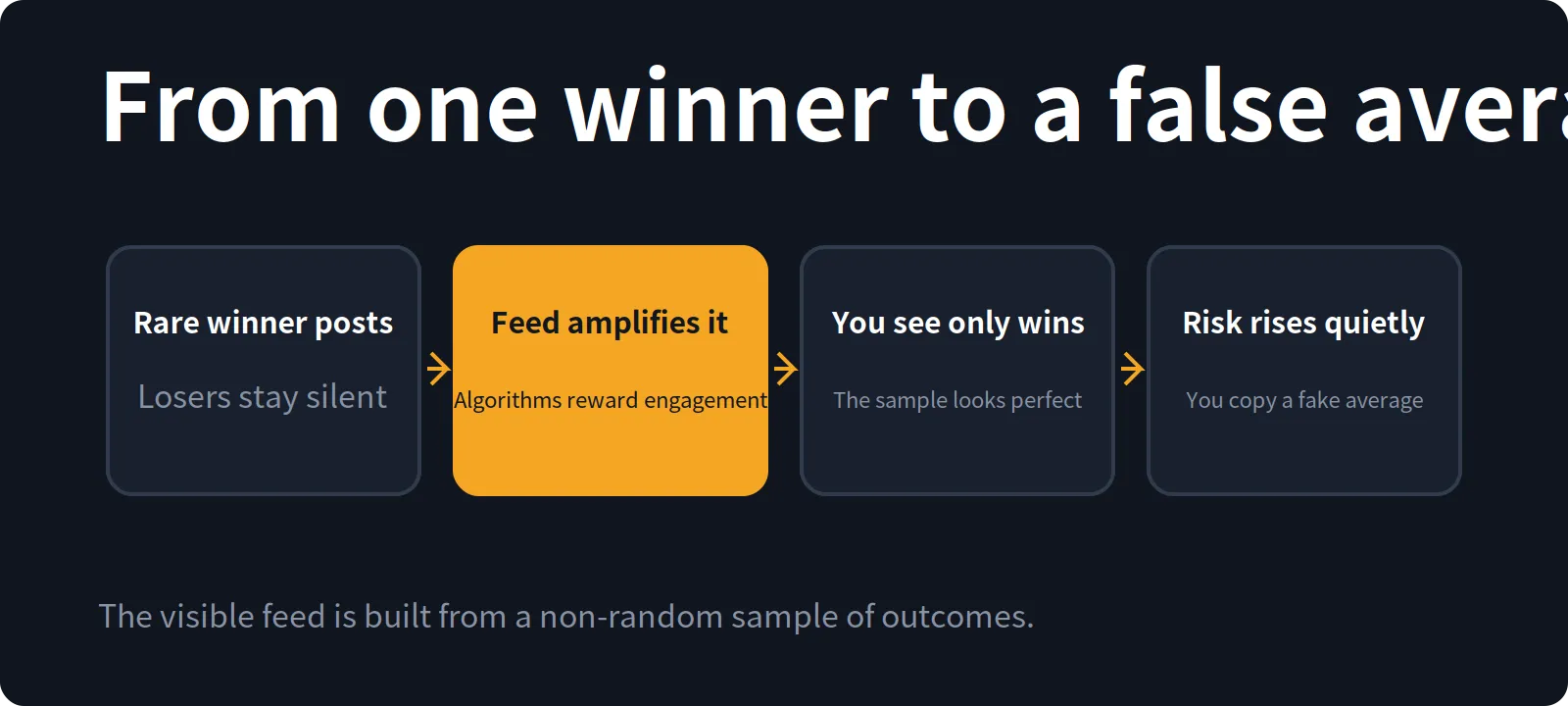
How a single visible winner creates an over-optimistic social feed
A Hypothetical Game: 100 Traders, One Feed
To see the math behind the bias, imagine a classroom of beginners. Say 100 people open the same style of demo account, each with $1,000 of virtual money, and all trade foreign exchange for three months. This whole scenario is a hypothetical illustration, not a real market record or a prediction.
Define the distortion as:
survivorship gap = average outcome shown - average outcome of the full group.
At the end of three months, the results look like this:
- 5 traders finish with $1,300, a gain of 30%.
- 15 traders finish with $1,050, a gain of 5%.
- 40 traders finish with $950, a loss of 5%.
- 40 traders lose 25% or more. Of these, 25 finish with $750, a loss of 25%, and 15 finish with $400, a loss of 60%.
Now calculate the full group average. Count each return in percentage points. Multiply each return by the number of traders in that group:
- 5 x 30 = 150
- 15 x 5 = 75
- 40 x -5 = -200
- 25 x -25 = -625
- 15 x -60 = -900
Add those: 150 + 75 - 200 - 625 - 900 = -1500. This total is the combined return across all 100 traders. Divide by 100 to get the average: -15%. The whole classroom loses 15% of its starting money on average.
Now imagine only the top 5 traders post their screenshots. The other 95 stay silent. A new follower scrolling the feed sees five winners and zero losers. The visible average return is +30%.
Apply the formula: 30% - (-15%) = 45 percentage points. A percentage point is the unit used when you compare two percentages, so the visible average is 45 of those units higher than reality. The feed makes the typical outcome look 45 points better than it was. This number still ignores edited screenshots and demo accounts, so the true distortion can be even larger.
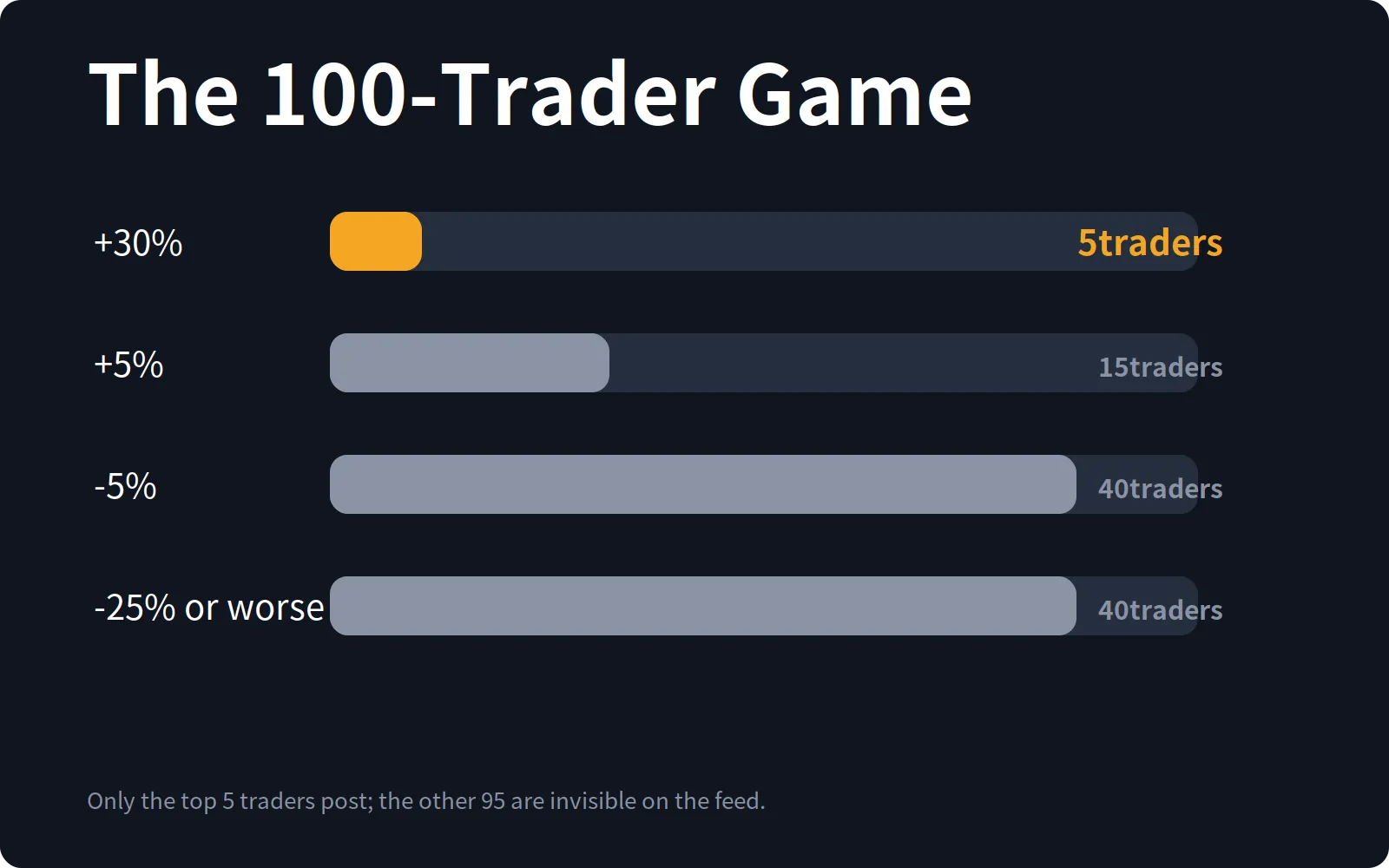
Number of traders in each outcome group after three months
What to Do with This Bias
Survivorship bias should change how you read a trading feed. It does not tell you which currency pair to buy or when to enter or exit. It is not proof that forex is a scam, and it is not proof that profitable trading is impossible. It is simply a reminder that the missing data probably exists and is probably painful.
- New traders may believe a 30% gain in three months is common. In the hypothetical game, that outcome belonged to 5 out of 100 people, while the full group on average lost money.
- Copying the style of a visible winner feels useful, but a single screenshot hides the failed attempts behind it. Survivorship bias shows one lucky path, not a repeatable method.
- Some traders conclude they are unusually bad because everyone online wins. The opposite is closer to the truth: losing is the statistical majority, and the winning minority is overrepresented.
- The bias does not mean every profitable screenshot is fake. It means you cannot tell which ones are real, typical, or repeatable. One screenshot proves one moment, not a system.
- Fear of missing out, or FOMO, makes the distortion worse. When a new trader sees a strong post, raises position size, the amount put into one trade, and tries to copy it, a small loss can turn into a bigger one.
Survivorship bias and outright fake screenshots are different problems. Fake screenshots misreport one account's history, while survivorship bias hides the accounts that are not shown. On social media, the two usually appear together.
A more honest picture of typical outcomes comes from asking for full account history, including drawdowns. A drawdown is the drop from a peak to a later low. Questions about losing weeks and losing strategies matter more than questions about winning shots.
An anonymous post is a claim that needs evidence, not a fact. Learning to question a screenshot will not produce profit by itself, but it corrects expectations before money is at risk.
Disclaimer:
The views in this article only represent the author's personal views, and do not constitute investment advice on this platform. This platform does not guarantee the accuracy, completeness and timeliness of the information in the article, and will not be liable for any loss caused by the use of or reliance on the information in the article.
WikiFX Broker
Latest News
US Dollar Price Forecast: DXY Holds Firm Ahead of NFP, Can GBP/USD and EUR/USD Recover?
WikiFXGold Forecast: the USD Index Soars to New 2026 Highs
WikiFXEURUSD HTF Outlook: Policy Compression Near Premium
WikiFXChatGPT Trading Boom Exposes Forex Investors to New Risks
WikiFXTreasury Yields Eye Declines as Payrolls Miss and Wage Growth Slows
WikiFXWinproFx Review 2026: Mixed User Reports on Trading and Withdrawals
WikiFXdbinvesting Broker Review: Regulated but Is It Safe for Traders?
WikiFXSEC Says AI Investment Scams Took $15 Million
WikiFXThe Copytrading Risks that Nobody Warns You About
WikiFXUK Opens Crypto Gateway Ahead of Regulatory Overhaul
WikiFX