

Global Broker Regulation Inquiry App
About WikiFX
English
简体中文
繁體中文
English
Pусский
日本語
ภาษาไทย
Tiếng Việt
Bahasa Indonesia
Español
हिन्दी
Filippiiniläinen
Français
Deutsch
Português
Türkçe
한국어
العربية
اردو


Why Your Stop Loss Feels Like a Failure (and That's Normal)

WikiFX
|


Abstract:Stop loss orders feel emotionally heavy, not because they cause losses, but because they turn an imagined future into a realised loss. This article explains the mechanism and offers a simple journaling approach to observe your reactions.
You place a trade, set a stop loss, and watch price drift against you. A stop loss is an order given to your broker to close a trading position automatically when the price reaches a level you set in advance. The stop fires, you feel a sting, and then price reverses without you. It is tempting to blame the stop loss for the loss, but the feeling usually has more to do with how the brain processes a realised loss, a loss that becomes actual when a position is closed, than with the tool itself. This article explains what a stop loss is, why it creates such a strong emotional reaction, and how you can observe those reactions without letting them steer your next decision.
 Contents
The Stop Loss Is a Risk Contract, Not a Crystal Ball
A stop loss is not a forecast of where price will go. It is a risk limit set before or during a trade. Many currency pairs are quoted in pips. A pip is the smallest common price increment in a currency pair. For a pair like EURUSD, one pip is usually 0.0001. The stop price is chosen as a boundary for how much loss you are willing to accept in normal market conditions.
As a purely hypothetical teaching example, not a trading recommendation, suppose you open a long position in EURUSD, which means you expect the price to rise, at 1.1555 and set a stop loss at 1.1455. The distance is 0.0100, or 100 pips. If price falls to 1.1455, your platform will try to close the position automatically. The expected loss, before trading costs and slippage, is the amount represented by those 100 pips. Slippage is the difference between the price you expect to receive and the price at which your order is actually filled. Slippage can happen in fast markets or when price jumps from one level to another without trading in between, which is called a gap. If price gaps below 1.1455, the actual fill could be worse than 1.1455, so a stop loss is a risk limit, not a price guarantee.
The key point for beginners is simple: a stop loss does not cause the market to reverse. It only defines the point at which you stop hoping and the platform enforces a decision you made earlier.
Why the Brain Treats a Hit Stop as a Personal Failure
Loss aversion is a well-documented tendency in which people feel the pain of a loss more strongly than the pleasure of an equal gain. A stop loss makes a loss concrete at a precise moment, so the pain arrives all at once. By contrast, an open losing trade can still be imagined as a future winner. That imagined future keeps hope alive, and hope can feel more comfortable than accepting a small realised loss now.
When a stop is hit and price later recovers, hindsight bias adds another layer. Hindsight bias is the tendency to look back and believe an outcome was predictable, even though it was not clear at the time. You tell yourself that the stop was wrong because price returned. But that conclusion uses information you did not have when the stop was placed. The stop was not a forecast. It was a pre-commitment to exit if a specific scenario happened.
This is why the same stop loss can feel like a safety net before the trade and a trap after it is hit. Your emotional system reacts to the outcome, not to the quality of the decision at the time.
What to Write Down Before and After a Stop Is Hit
You cannot stop an emotional reaction, but you can observe it. One simple psychological exercise is to keep a stop-loss journal. The goal is not to judge yourself, only to spot repeated patterns. Before a trade, you might note the following:
- What is my reason for this trade, and what price level would make that reason invalid?
- What is the planned maximum loss I am accepting before I click buy or sell?
- Is my stop based on a market level, a monetary amount, or a feeling of how much pain I can tolerate?
After the stop is hit, return to the same note and add:
- What was the first emotion: anger, relief, shame, or something else?
- Did I feel an urge to move the stop, remove it, or immediately re-enter in the opposite direction?
- What story did I tell myself about the stop: that it was wrong, that the market is against me, or that my plan failed?
- Whether the outcome was painful or pleasant, did it change my understanding of the risk, or only my emotional state?
The pattern matters more than any single trade. If every losing trade feels like a betrayal by the stop loss, the journal can help you distinguish between the emotional reaction to the loss and whether the stop was triggered according to the rules you set. If you frequently move or remove stops when price gets close, the journal can make that habit visible without telling you what to do next. That awareness is the starting point for better forex risk management, which is the set of habits a trader uses to control how much can be lost on any single trade. Emotional consistency and a clear written record are part of trading psychology.
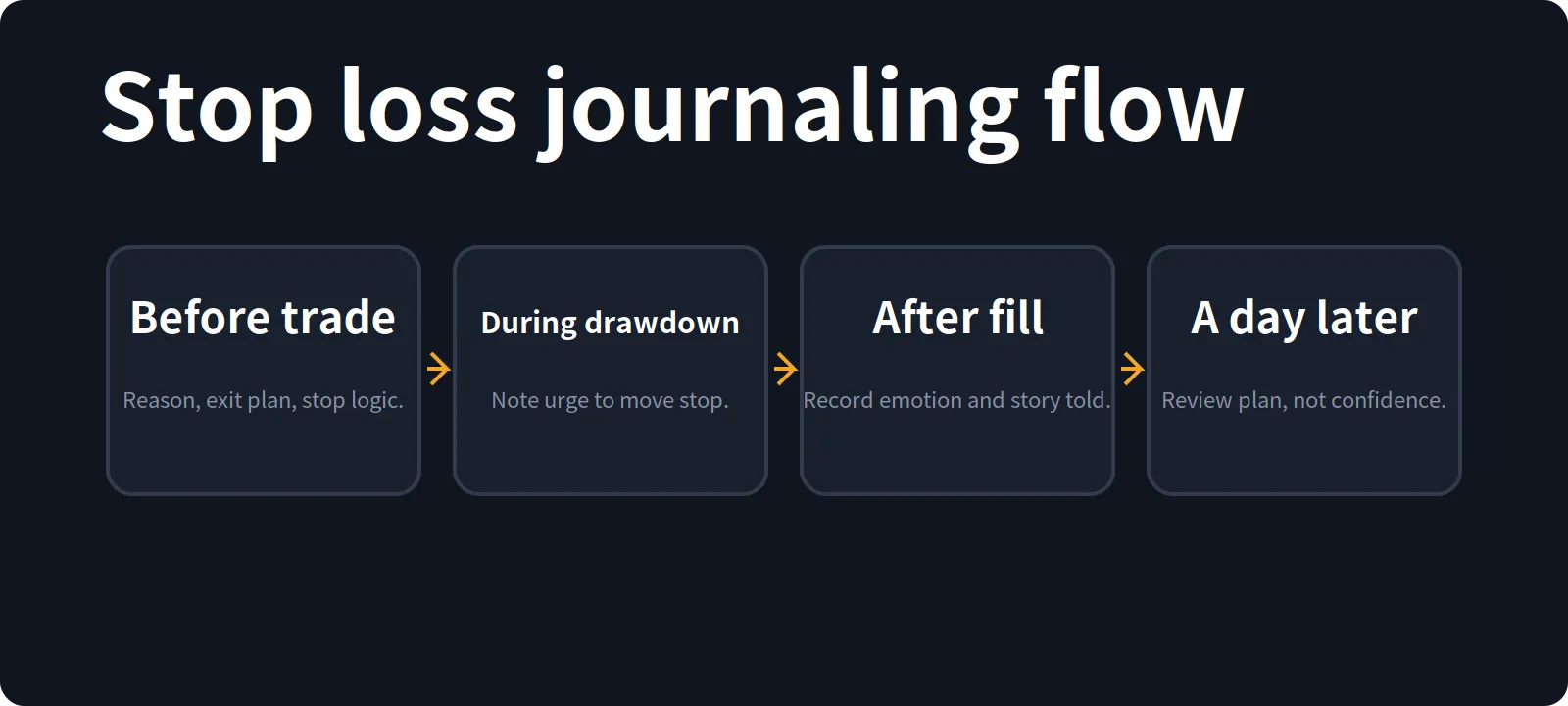
A simple self-observation loop for stop-loss events.
Disclaimer:
The views in this article only represent the author's personal views, and do not constitute investment advice on this platform. This platform does not guarantee the accuracy, completeness and timeliness of the information in the article, and will not be liable for any loss caused by the use of or reliance on the information in the article.
WikiFX Broker
Latest News
Alpari Broker Exposed: What Are Other Traders Saying About This Broker?
WikiFXGold Forecast: the USD Index Soars to New 2026 Highs
WikiFXUS Dollar Price Forecast: Dollar Holds Firm as Fed Bets Ease, EUR/USD and GBP/USD Struggle
WikiFXUK Opens Crypto Gateway Ahead of Regulatory Overhaul
WikiFXUS Bonds Eye Softer Inflation After Core PCE Undershoots Forecasts
WikiFXTrade W Broker Exposed: User Feedback, Delayed Orders and Office Survey
WikiFXWebull Uses Ai To Prepare Trades, Users Can Review & Approve Them Manually
WikiFXGRAND MARKETS Review 2026: Traders Report Fast Trade Execution & Low Spreads. Should You Invest?
WikiFXSTARTRADER Raises Client Fund Insurance to US$30Million
WikiFXTNG eWallet Opens Global Stock Trading to 8.5 Million Users
WikiFX