

Global Broker Regulation Inquiry App
About WikiFX
English
简体中文
繁體中文
English
Pусский
日本語
ภาษาไทย
Tiếng Việt
Bahasa Indonesia
Español
हिन्दी
Filippiiniläinen
Français
Deutsch
Português
Türkçe
한국어
العربية
اردو


Stagflation Premium Without Stagflation Confirmation

WikiFX
|


Abstract:A severe maritime supply shock has triggered a structural repricing in global crude benchmarks, introducing fresh inflationary headwinds that are upending central bank rate cut expectations and reshaping major FX pairs ahead of a critical US employment report.
The Anomaly
The textbook playbook is broken. A simultaneous crude supply shock and labor market deceleration should produce a clear, directional signal for rate markets. It has not. Instead, the effective closure of the Strait of Hormuz has generated a pricing paradox: energy benchmarks are embedding a stagflationary premium into every asset class, while the underlying macroeconomic confirmation — persistently hot CPI, deteriorating real wages, sustained demand destruction — remains conspicuously absent from the hard data.
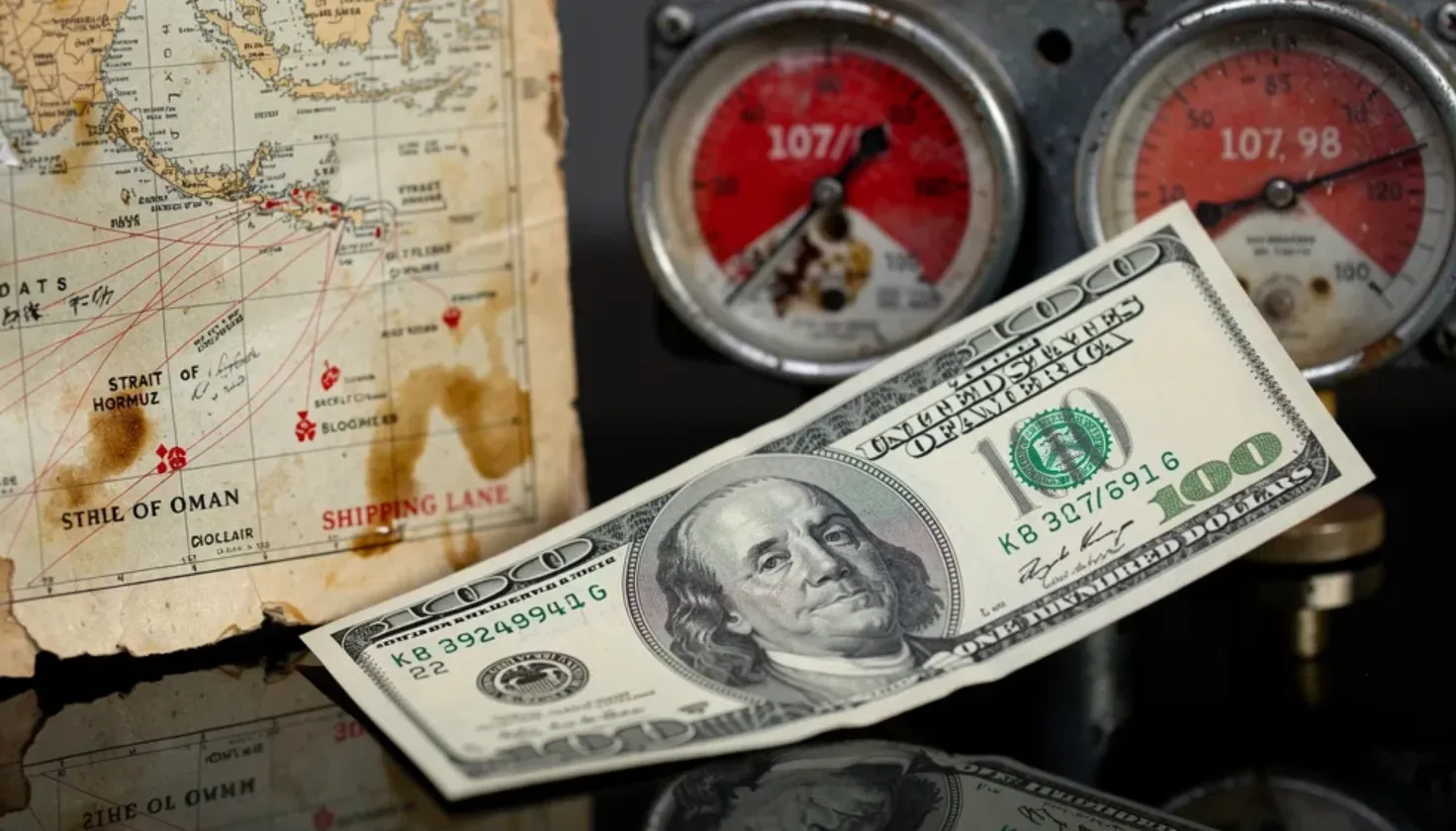
Brent has been structurally repriced to $107/bbl and WTI to $98/bbl, not on demand acceleration, but on pure physical supply constraint. Rabobank's transit recovery projection — a return to roughly 80% of standard Hormuz throughput by August — means these are not spot dislocations. They are forward cost embedments. Manufacturing input chains are already absorbing the shock. Yet the DXY sits near 100.00, neither collapsing under recession fears nor rallying on the conventional inflation-hedge bid. That stasis is the anomaly. A dollar pinned at a psychologically critical threshold, simultaneously pressured by soft labor expectations and nominally supported by a hawkish rate-hold scenario, is a market in genuine arithmetic conflict with itself.
The Structural Mechanics
Liquidity & Flows: The Dollar's Paralysis at 100.00
The DXY's failure to break decisively from the 100.00 handle is not indecision — it is structural compression. Institutional positioning reflects two contradictory macro bets held simultaneously. Real-money accounts are hedging energy-driven inflation by maintaining dollar longs, a historically reliable response to commodity shocks that pressures EM and commodity-importing economies. Against this, systematic and CTA strategies have been reducing dollar exposure in response to deteriorating US growth signals, with consensus NFP at a historically soft 60,000 payroll additions now acting as a gravitational ceiling on further dollar appreciation. The net result is a liquidity logjam: significant gross positions on both sides of the trade cancel each other into an artificial equilibrium. What appears as stability is, mechanically, a high-tension standoff between two institutional thesis frameworks.
Derivatives & Hedging: Rate Optionality Is Mispriced Into Vol
The more structurally significant distortion sits in short-dated rate options. With the Federal Reserve's easing path now ambiguous — a soft NFP print argues for cuts, embedded energy inflation argues against them — implied volatility in front-end rates has expanded without producing clean directional gamma exposure. Options desks are running complex delta-hedging flows that are partially suppressing yield moves in either direction, creating an artificial compression in the very signals that FX markets rely on to establish carry differentials. The BOE two-cut pricing, combined with EUR/USD's cap below the 1.1550 nine-day EMA, reflects a similar dynamic in European rate space: money market repricing is happening, but it's being absorbed by hedging activity faster than spot FX can fully discount it. Silver at $73.00 is the clearest expression of this: the metal is registering macro anxiety without triggering the decisive real-yield collapse that would historically validate the move.
Policy Divergence: Central Banks Caught in the Hormuz Bind
The Hormuz closure has placed every major central bank in an analytically indefensible position. The standard policy response to a supply-side inflationary shock — hold or hike rates to suppress second-round effects — directly conflicts with the softening growth signals that would otherwise justify easing. The Fed cannot cut without risking the inflation spiral that a $107 Brent environment can generate. It cannot hold without accepting that 60,000 NFP prints represent a genuine labor market deterioration. The ECB and BOE face analogous constraints: European currencies are pressured not by acute capital flight, but by the rational expectation that European policymakers will blink first, cutting into energy inflation because their growth outlooks are structurally weaker. The AUD/NZD bifurcation crystallizes this — Australia's commodity export revenues provide a natural buffer; New Zealand, facing contractionary Chinese PMI as its primary demand engine, does not.
The Historical Contrast
The 1973 Arab Oil Embargo provides the intuitive reference point, but the comparison obscures more than it reveals. In 1973, the transmission mechanism was blunt: supply dropped, inflation surged, central banks initially failed to respond, and stagflation was cemented over 24 months of policy paralysis. The institutional plumbing today operates on an entirely different architecture. Modern derivatives markets allow participants to price a stagflationary scenario into vol surfaces and forward curves before the macro confirmation arrives in the hard data. In 1973, markets had no mechanism to front-run the policy dilemma this precisely. The current moment is therefore not analogous to a 1973 energy embargo — it more closely resembles the 2011 Libyan supply shock, where Brent briefly breached $120/bbl on geopolitical premium alone, forced a hawkish ECB rate hike in April of that year, and that hike was subsequently identified as a material policy error that deepened the Eurozone sovereign debt crisis. The 2011 episode demonstrates that the danger is not the supply shock itself, but the institutional response to a cost-push inflation signal that may prove transitory — and the current Hormuz closure, with an 80% throughput recovery projected by August, carries that same embedded structural risk.
The Current Paradigm
What the market is currently running is a conditional stagflation discount — a regime premium applied to every asset class without the underlying macro conditions having formally arrived. The Hormuz closure has short-circuited the normal sequencing in which a supply shock first moves commodity prices, then filters into CPI prints, then forces a central bank recalibration, and then reprices FX and rate markets. That sequence, which historically unfolds over six to twelve months, has been compressed into days by the speed of modern institutional hedging and systematic repricing. The result is a market that has already charged the stagflation toll — in Brent forwards, in suppressed Fed cut pricing, in Sterling and EUR/USD ceilings, in Silver's contested vol — before the US labor market, the Federal Reserve's dot plot, or a single second-quarter CPI print has validated the thesis. The DXY at 100.00, Silver at $73.00, and EUR/USD below 1.1550 are not predictions of what comes next. They are the arithmetic residue of every institutional desk in the world holding two incompatible macro narratives at the same time, waiting for Friday's NFP to force a resolution neither side currently has the data to justify.


Disclaimer:
The views in this article only represent the author's personal views, and do not constitute investment advice on this platform. This platform does not guarantee the accuracy, completeness and timeliness of the information in the article, and will not be liable for any loss caused by the use of or reliance on the information in the article.
WikiFX Broker
Latest News
Inflation fears on the rise as one-year outlook in Fed survey hits highest level since May 2023
WikiFXOil Turned on Its Vertex Day: What It Means for Gold
WikiFXOil, Yields and French Debt Keep Global Markets Under Pressure
WikiFXRBI Vows to Steady 'Undervalued' Rupee After It Hits Five-Month Low
WikiFXDoctor Loses RM300,000 in an Investment That Promised 10% Monthly Returns
WikiFXShareflo Finds 33,675 UK Companies Behind on Filings as Director ID Checks Take Effect
WikiFXTag Markets Broker Review: Regulated but Is It Safe for Traders?
WikiFXSri Lanka's NDB Bank Fraud Losses Rise to Rs. 13.6 Billion as Final Audit Flags Governance Failures
WikiFXGold Near Nine Week Low as Fed Rate Fears Intensify
WikiFXLuxury Brand Owner Shot Dead After Losing US$100 Million in Trading Last Month
WikiFX