

Global Broker Regulation Inquiry App
About WikiFX
English
简体中文
繁體中文
English
Pусский
日本語
ภาษาไทย
Tiếng Việt
Bahasa Indonesia
Español
हिन्दी
Filippiiniläinen
Français
Deutsch
Português
Türkçe
한국어
العربية
اردو


Market, Limit, and Stop Orders in Forex Explained Simply

WikiFX
|


Abstract:This article explains the three core forex order types, market, limit, and stop, along with a practical hypothetical example. It defines bid, ask, and spread, clears up common misunderstandings, and highlights what each order guarantees (and what it doesn’t).

 Contents
What Are Forex Order Types and How Prices Work?
When you place a trade in the forex market, you are telling your broker exactly how and when to execute it. That instruction is called an order. Think of it as a precise command: you could instruct your broker to trade immediately at the current price, to wait until the price drops to a certain level before buying, or to activate a sell once a barrier is broken. The main order types give you control over entry and exit, helping you follow a plan rather than reacting impulsively.
Three order types cover most trading situations: market orders, limit orders, and stop orders. A market order is an instruction to execute a trade immediately at the best available price. A limit order sets a specific price at which you are willing to trade; it only executes if the market reaches that price or better. A stop order lies in wait until the market touches a trigger price, then it becomes a market order. Each one solves a different problem, and understanding how they interact with real‑time prices is essential for any beginner.
To use orders correctly, you must first grasp how prices are quoted in forex. Every currency pair has two prices at any moment: the bid, which is the highest price a buyer is willing to pay, and the ask, which is the lowest price a seller will accept. The bid is the price you can sell at, and the ask is the price you can buy at. The small gap between them is called the spread.
For example, suppose EUR/USD is quoted at 1.1485 / 1.1487. The bid is 1.1485, the ask is 1.1487, giving a spread of 2 pips (a pip typically represents the fourth decimal place in most currency pairs). A market buy order would fill at the ask (1.1487), and a market sell order would fill at the bid (1.1485). This spread is the transaction cost you pay instantly, and it affects every order type, especially when price is moving fast.
With this foundation, order types become tools that let you decide whether to accept the current spread or to wait for a more favourable price.
How Each Order Type Works (With a Hypothetical Example)
Please note, this scenario is purely hypothetical and designed to illustrate order mechanics. It is not a trading recommendation.
Lets walk through the three basic orders using a single scenario. Assume EUR/USD is trading with a bid of 1.1485 and an ask of 1.1487, and you believe the pair will eventually rise.
- Market order: Suppose you decide to buy without delay. You send a market order and get filled at 1.1487. The trade is instant, but you pay the spread. If the market is moving quickly, the fill could be at a slightly different price, this is called slippage (the gap between the expected price and the actual fill).
- Limit order (buy): If you would rather buy at a lower level to reduce cost, you could place a limit buy order at 1.1460. This means your broker will buy only if EUR/USD‘s ask price reaches 1.1460 or lower. Until that happens, the order sits idle. The trade gets filled at exactly 1.1460 or better if available, but there is a risk: the price might never pull back to 1.1460, leaving you out of the trade.
- Stop order (buy): Alternatively, you might only want to enter if the price breaks above a resistance level. (A resistance level is a price where the market has historically faced selling pressure that keeps it from rising further.) To capture such a move, you place a stop buy order at 1.1505. Once EUR/USD’s ask reaches 1.1505, the order turns into a market order and is executed at the next available ask, which could be 1.1506 or higher. Because it becomes a market order, the fill is not guaranteed at exactly the trigger price.
Similar logic applies to sell orders: a market sell fills at the bid; a limit sell is placed above the current price (to exit a buy position at a profit); a stop sell (often called a stop-loss) is placed below the current price to limit losses.
An extended type is the stop-limit order. It adds a limit price to a stop trigger. For instance, a stop-limit buy with a stop at 1.1505 and a limit at 1.1510 means: when the ask hits 1.1505, a limit order to buy at 1.1510 or better is activated. This gives you more price control but can leave you unfilled if the market gaps beyond your limit.
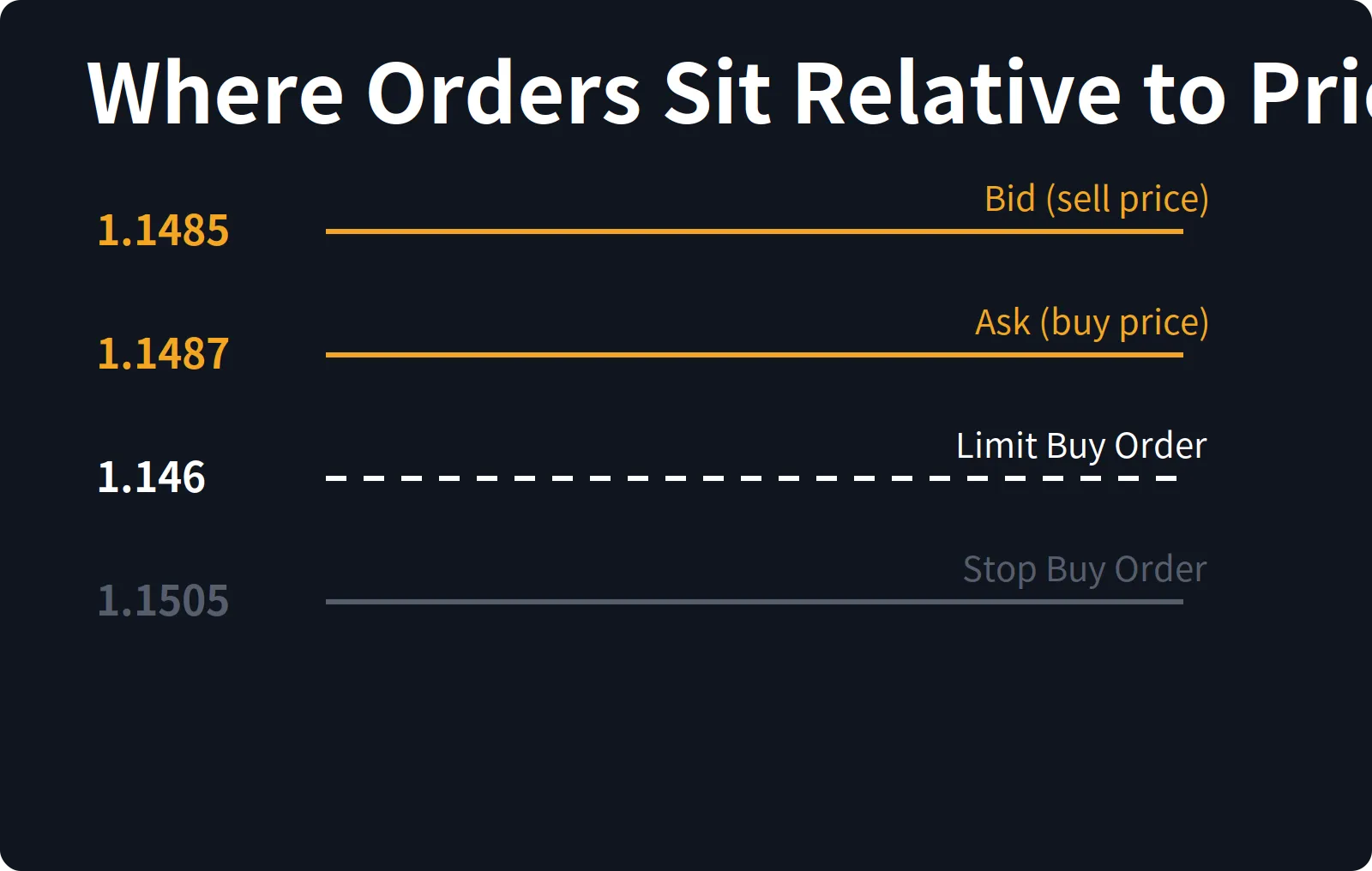
This hypothetical diagram shows a limit buy order placed below the market and a stop buy order placed above.
Common Misunderstandings and Limitations
New traders often misread what an order guarantees. Here are the most frequent mix‑ups:
- A stop order is not a guaranteed price. It is a guaranteed trigger to enter the market. Once triggered, it behaves like a market order. Slippage can push the actual fill price away from the stop level, especially during news releases.
- A limit order guarantees a price but not a fill. Your broker will only execute it if the market trades at that price or better, and only if there is enough liquidity. If the market touches the price briefly but no fills are available, your order may not be executed.
- Market orders always execute, but the cost can vary. In calm markets, the spread is small and stable. In volatile moments, the spread can widen dramatically, and a market order may fill at a worse price than the quoted spread a moment earlier.
- A stop-loss does not cap loss perfectly. If the market gaps through your stop price, the resulting market order can fill well beyond your intended level, leading to a larger loss than expected.
- Order types are not trading strategies. They are mechanical tools. Setting a stop does not make a trade profitable; it only defines your exit trigger.
The Bottom Line: What Orders Are and Aren't
Forex order types are execution instructions. They give you point‑and‑shoot precision so you decide exactly when and how your money enters the market. They are not crystal balls, nor do they predict direction. Use them to manage your entries and exits according to a plan, not to guess where price will go next. When you understand their mechanics and limitations, you gain the clarity to avoid costly surprises while keeping control of every trade.
Disclaimer:
The views in this article only represent the author's personal views, and do not constitute investment advice on this platform. This platform does not guarantee the accuracy, completeness and timeliness of the information in the article, and will not be liable for any loss caused by the use of or reliance on the information in the article.
WikiFX Broker
Latest News
First Light News: BoE Decision in Focus
WikiFXRockGlobal Review for India: Which Licence Was Cancelled on 19 July 2024?
WikiFXINFINOX Review of the GBP 99200 FCA Fine for India
WikiFXIndia Just Bought a Record $15.2B of US Treasures in July — What It Means for INR and FII Flows
WikiFXSBCFX review: What Does the 28 August SFC Warning Mean?
WikiFXRoboForex Faces Fresh Scrutiny Over Withdrawals and Regulation
WikiFXLeading the Transparency Movement, The Trust Dialogue with AUS GLOBAL
WikiFXIf You Still Struggle To Make Money After Passing a Prop Firm Challenge
WikiFXMalaysia Police Busted a Scam Call Centre & Arrested 3 Chinese Nationals
WikiFXU.S. Dollar Pulls Back As Traders Take Profits After Rally: Analysis For EUR/USD, GBP/USD, USD/CAD, USD/JPY
WikiFX