

Global Broker Regulation Inquiry App
About WikiFX
English
简体中文
繁體中文
English
Pусский
日本語
ภาษาไทย
Tiếng Việt
Bahasa Indonesia
Español
हिन्दी
Filippiiniläinen
Français
Deutsch
Português
Türkçe
한국어
العربية
اردو



Why Your Forex Spread Widens on Weekends and Public Holidays

WikiFX
|


Abstract:Forex liquidity tightens over weekends and Malaysian public holidays because key banks and institutions step away, causing bid-ask spreads to widen. This article explains why it happens, walks through a hypothetical cost calculation, and points out the most common beginner mistakes, so you can better understand execution risk during thin markets.

 Contents
What Is Forex Liquidity?
Liquidity is the ease with which a currency can be bought or sold without causing a large price movement. When many buyers and sellers are active, the market is said to be liquid. In an illiquid market, even a modest trade can push the price sharply and fill your order at an unexpected level.
The foreign exchange market is the world's largest and most liquid market overall, with trillions traded daily. However, that liquidity is not spread evenly across every hour of the day or every day of the year. It ebbs and flows as major financial centres open and close, and it drops noticeably over weekends and during certain public holidays.
The Key Concepts: Market Participants and the Bid-Ask Spread
Liquidity comes from market participants: banks, hedge funds, corporations, and retail traders like you. These players do not all trade at the same time. The highest liquidity usually occurs when the London and New York sessions overlap, because two of the biggest pools of money are active simultaneously.
One of the most direct ways you see liquidity is in the bid-ask spread. When your broker quotes a currency pair, it shows two prices: the bid (what you can sell at) and the ask (what you can buy at). The spread is the difference between these two, usually measured in pips. For a highly liquid pair like EUR/USD during peak hours, the spread might be just 0.5 pips. In a very thin market, that same spread can balloon to several pips or more.
Why Liquidity Changes Around Weekends and Malaysian Public Holidays
Forex is not a single exchange with set opening hours. It is an over-the-counter market where transactions happen directly between participants across the globe. The market is technically open 24 hours a day from Sunday evening in Sydney until Friday evening in New York, but real trading liquidity depends on whether key institutions are actively quoting and matching orders.
During a Malaysian public holiday, many local banks and institutions in the Asian time zone are closed. While the wider market does not stop, the pool of participants shrinks, especially for currencies linked to the ringgit and Asian cross pairs. But even for major pairs like EUR/USD, a regional holiday can reduce overall liquidity if several Asian centres are offline. The same logic applies to weekends: from the New York close on Friday until the Sydney open on Sunday, virtually all the world's major interbank desks are shut. Some retail brokers may still display prices, but behind those quotes there is very little depth, so spreads can widen dramatically.
Malaysian public holidays such as Hari Raya, Chinese New Year, Deepavali, and National Day tend to see thinner volume during Asian hours. Beginners sometimes assume that because the market never closes, the spreads will be the same as on a normal Tuesday, but that is not the case.
Hypothetical Example: Calculating the Cost of a Wider Spread
To understand what this means for your trading costs, let us walk through a hypothetical example. Suppose you trade one mini lot (10,000 units) of EUR/USD. At a normal time, the spread might be 0.5 pips. On a quiet weekend when only retail brokers are quoting indicative prices, the spread could rise to 2.0 pips. On a Malaysian public holiday with many local participants absent, the spread might reach 3.0 pips.
For EUR/USD, one pip move on a mini lot is worth roughly USD 1.00. The immediate cost to open a trade is therefore:
- Normal market: 0.5 pips × USD 1 = USD 0.50
- Weekend: 2.0 pips × USD 1 = USD 2.00
- Malaysian public holiday: 3.0 pips × USD 1 = USD 3.00
These are opening costs only. If the spread is also wide when you close the trade, your round-trip cost doubles. On the public holiday example, entering and exiting could cost USD 6 – twelve times what you would pay during the normal London session. This hypothetical example shows how much more expensive it can be to trade during thin liquidity, and it does not account for slippage, which adds further unpredictability.
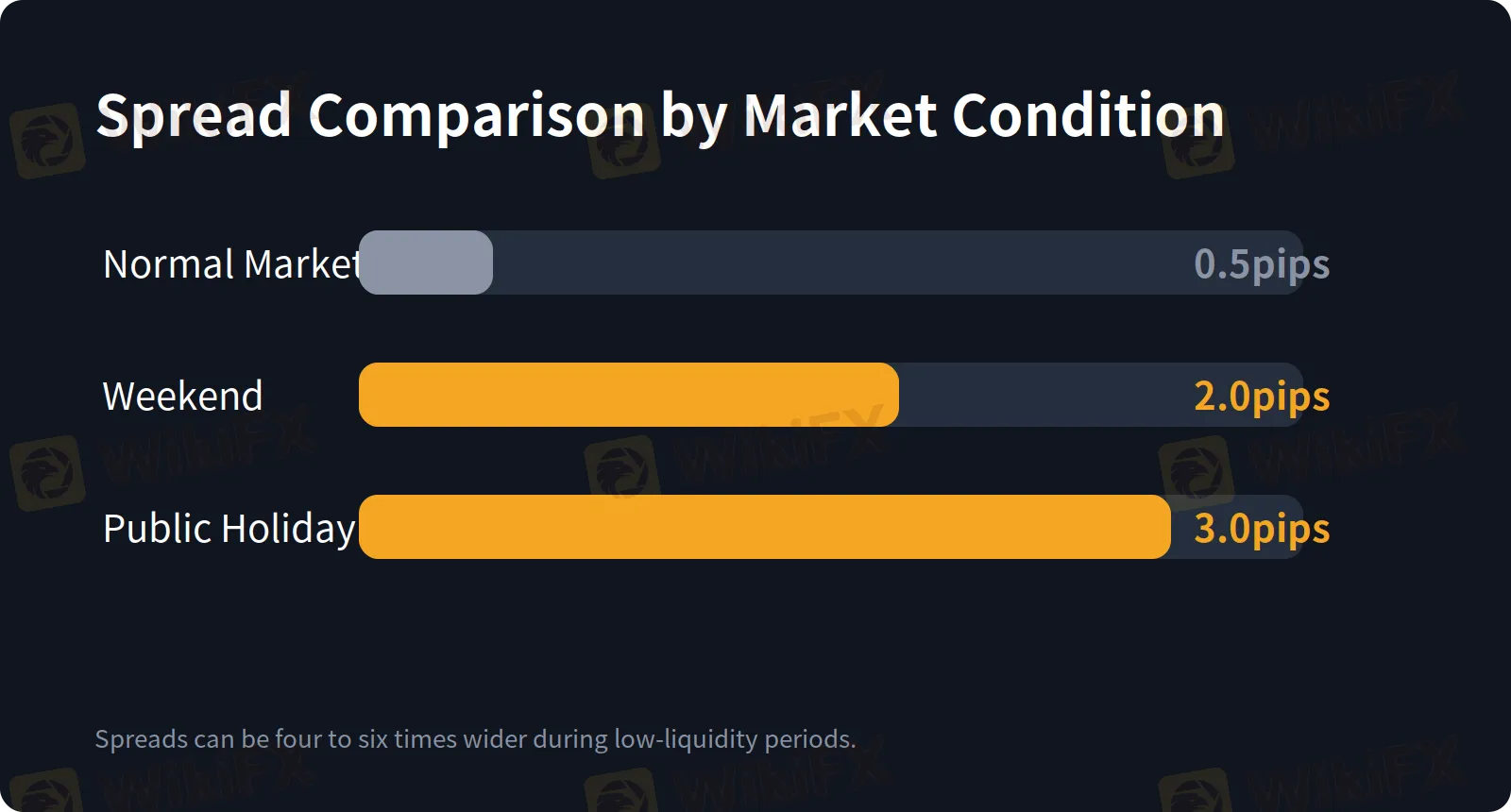
Hypothetical EUR/USD spreads in pips for different market conditions.
Common Mistakes Beginners Make
- Assuming the forex market never closes, so spreads are always the same. It is true the market does not shut completely on weekdays, but the number of active participants determines your cost.
- Trading around Malaysian holidays without checking an economic calendar. Price charts may still move on your screen, but you may not get filled at the price you see because the real market behind your brokers quotes is thin.
- Thinking that weekends are normal trading days. The best liquidity is gone from late Friday until Sunday evening Malaysian time, and many serious traders simply avoid opening new positions during that window.
- Confusing a Malaysian public holiday with a global holiday. Hari Raya may bring thinner Asian liquidity but does not necessarily cause the same spread widening in EUR/GBP as a UK bank holiday would. The effect is strongest on pairs directly involving the MYR or Asian currencies.
The Bottom Line: It Is About Cost and Execution Risk, Not Market Direction
Liquidity tells you nothing about where the price will go. It only tells you about the quality of the trading environment at a given moment. Low liquidity does not mean you will lose money on a trade, but it means you will probably pay a wider spread and may experience more slippage. This knowledge helps you make more informed choices about when you want to be active in the market and when you might prefer to step aside.
Disclaimer:
The views in this article only represent the author's personal views, and do not constitute investment advice on this platform. This platform does not guarantee the accuracy, completeness and timeliness of the information in the article, and will not be liable for any loss caused by the use of or reliance on the information in the article.
WikiFX Broker
Latest News
EURUSD | Demand Zone Holding, Bulls Eyeing Higher Resistance
WikiFXKudotrade Review 2026: Reported Slippage & Trade Execution Issues You Should Know
WikiFXEUR/USD: Bearish Structure Shift
WikiFXFxPro Opens Five CFDs To Weekend Trading
WikiFXValutrades Rejects Exit Rumors Amid Client Review
WikiFX1MDB Recovery Still Leaves RM20 Billion Burden
WikiFXMalaysia Pursues RM4.2 Billion Claim Against Singapore's DBS Bank
WikiFXFxPro Adds Weekend Trading for Five CFD Markets
WikiFXYen Speculators Turn Net Long as USD/JPY Holds Near Seven-Month Low
WikiFX