

Global Broker Regulation Inquiry App
About WikiFX
English
简体中文
繁體中文
English
Pусский
日本語
ภาษาไทย
Tiếng Việt
Bahasa Indonesia
Español
हिन्दी
Filippiiniläinen
Français
Deutsch
Português
Türkçe
한국어
العربية
اردو


HTFX Review 2026: Withdrawal Complaints, Offshore Regulation, and Account Access Risks

WikiFX
|


Abstract:HTFX carries a high visible risk profile in the provided WikiFX data: a low WikiFX Score of 1.61, offshore Vanuatu VFSC regulation, and a large cluster of withdrawal-related complaints. The repeated reports of delayed or failed withdrawals, weak support responses, and login or platform access concerns mean traders should be extremely cautious before depositing.
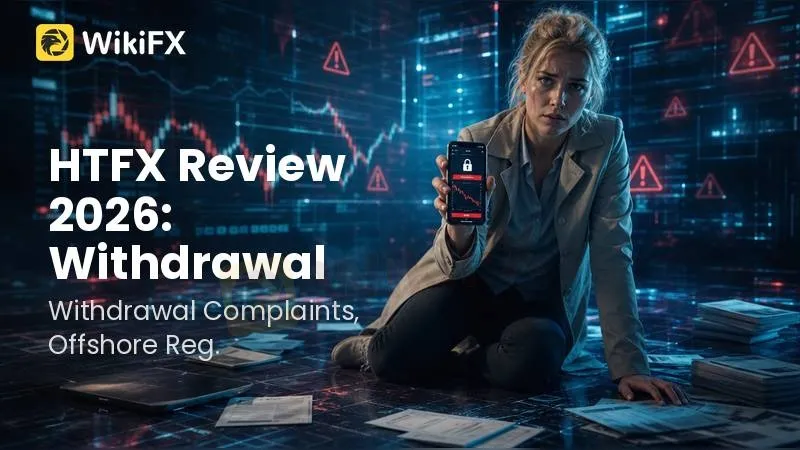
Executive Summary (TL;DR): HTFX is listed as a broker founded in 2017, with offshore regulation from the Vanuatu Financial Services Commission and a WikiFX Score of 1.61. The clearest risk signal is not just the low score, but the repeated trader reports describing failed withdrawals, delayed payments, unanswered emails, and account or website access problems.
In this HTFX review, the main question is simple: can you reasonably trust this broker with your money? The available WikiFX data shows MT4/MT5 support, three account types, and a low entry threshold, but it also shows serious warning signs. Before you find a broker for Forex trading, the withdrawal record and regulatory protection should matter more than headline spreads or leverage.
 Contents
Regulation and Safety
HTFX is described as a United Kingdom-based broker established in 2017. The listed regulator is the Vanuatu Financial Services Commission, under the organization name HTFX VU LIMITED, with regulation number 700650. The license annotation in the data is “offshore regulation.”
That regulation status matters. Offshore supervision is not the same as being overseen by a top-tier regulator with stronger compensation rules, tighter capital requirements, and more transparent enforcement. For you as a trader, this means the practical protection may be limited if there is a dispute over withdrawals, account balances, or order execution.
The WikiFX safety section does not provide details such as investor compensation, segregated client accounts, or a stronger onshore license. That missing detail reduces confidence. With an offshore-regulated Forex broker, counterparty risk becomes a bigger part of the decision: if the broker delays or refuses payment, your ability to recover funds may depend heavily on the broker‘s own processes and the offshore regulator’s response.
WikiFX Score and Visible Risk Signals
The WikiFX Score shown for HTFX is 1.61. Treat that as a live data point, not a permanent verdict, but it is clearly low in the provided record. The brokers influence rank is C, and the summary states that WikiFX received 169 user complaints about HTFX in the most recent three-month period covered by the data.
The listed disadvantages are also direct: multiple exposure reports, the platform being rated as a funds plate, and a high number of customer complaints. Those are not minor notes. They point to a broker profile where you should not rely only on the fact that a license exists. A license can reduce risk, but it does not erase a pattern of user complaints.
Trading Conditions
HTFX lists three account types: Cent, Standard, and ECN. The Cent account shows a minimum deposit of $50, leverage up to 1:500, and spreads from 1.5. The Standard account is listed with an entry condition of “$1,00,” leverage up to 1:500, and spreads from 1.5. The ECN account lists a $1,000 entry condition, leverage up to 1:500, and spreads from 0.0.
The data also shows a 30.00 stop-out ratio, minimum cash of 0.01, and permission for hedging, scalping, and EA trading. These conditions may look flexible, especially for active traders, but high leverage deserves caution. At 1:500, a small market move can magnify both profits and losses very quickly. For Forex trading costs, the spread figures are useful, but they do not tell the full story because the source does not provide full commission, swap, or execution-quality data.
Deposit and transfer channels listed include credit card, RPN Pay, ChipPay, local depositor, international wire transfer, Alipay, Teleport, and Tether. The presence of several payment routes does not, by itself, prove that withdrawals will be smooth.
Platform and Account Access
HTFX is listed as using MT4 and MT5. The software section describes the tested MT5 platform as customizable, multilingual, with useful search functions and clear fee reports. However, it also states that the platform lacks two-step login and biometric authentication for safer access.
That is relevant to login safety. If you ever access an HTFX account, make sure you use only the official website URLs listed in the source data and avoid entering credentials through third-party links or suspicious contacts. The cases also include reports of website access problems, MT4/MT5 connection issues, and trading account login failure, but those are user-reported incidents rather than a verified technical audit.
Trader Complaints and Withdrawal Pattern
The complaint pattern is the strongest warning in the available data. The cases supplied include many reports from China, Hong Kong, Vietnam, Indonesia, Thailand, Russia, Ghana, Australia, Ireland, Singapore, Turkey, and the United States. Most revolve around the same issue: withdrawal requests approved or submitted, but funds not arriving.
Several examples are specific. One trader said they deposited around $6,000 to $7,000 and later had less than $3,000 in withdrawal requests delayed for nearly a year, with official email unanswered. Another reported depositing $100 in March 2025, growing the balance to $108, then being unable to withdraw while customer service gave automated-style replies and the trading account could not be accessed. A Vietnamese complainant said two withdrawal requests totaling $12,188 had not been processed after a July 2025 request, despite repeated emails and messages. Another Vietnamese case described a $5,000 withdrawal request with no clear reason or official response.
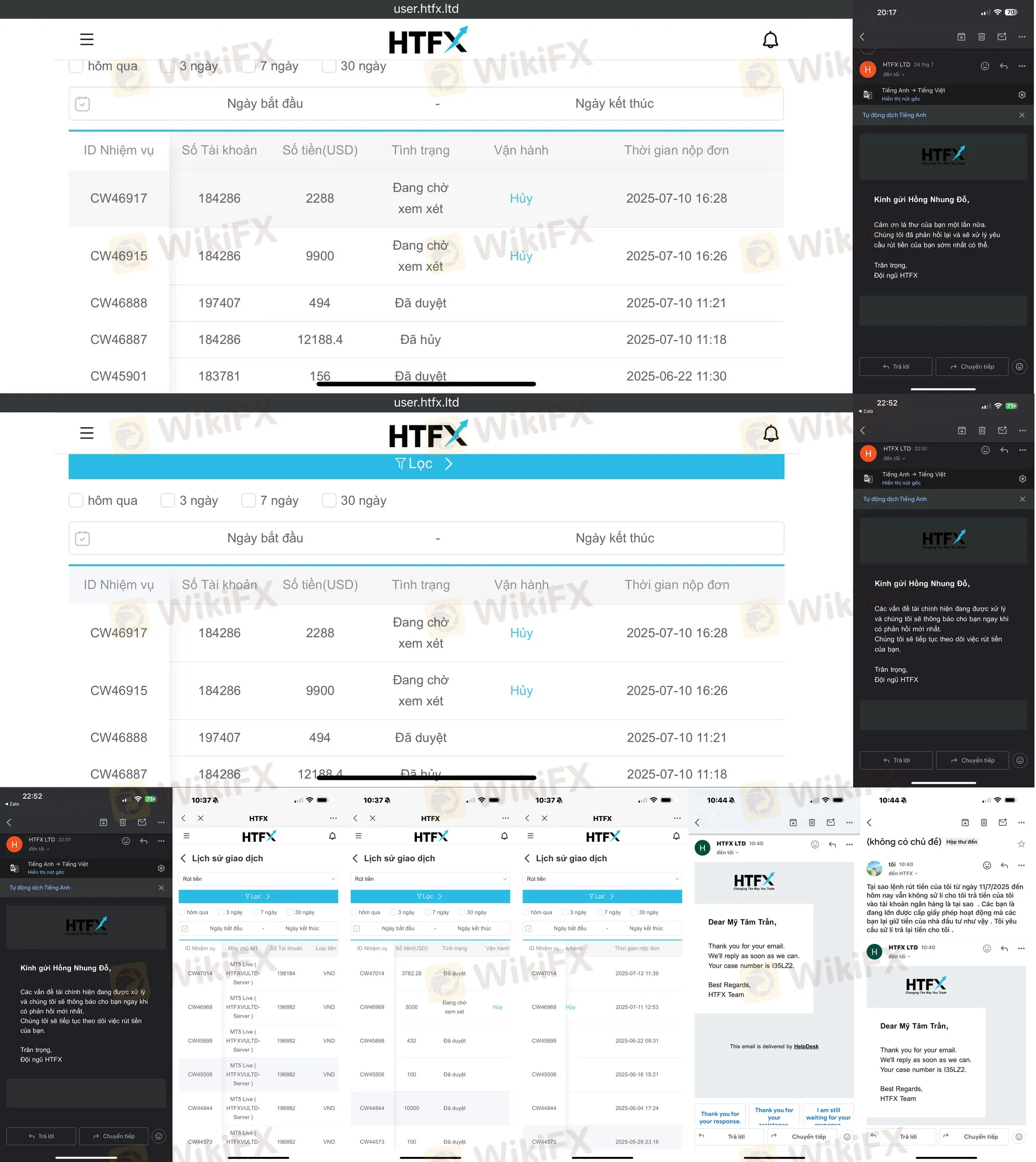
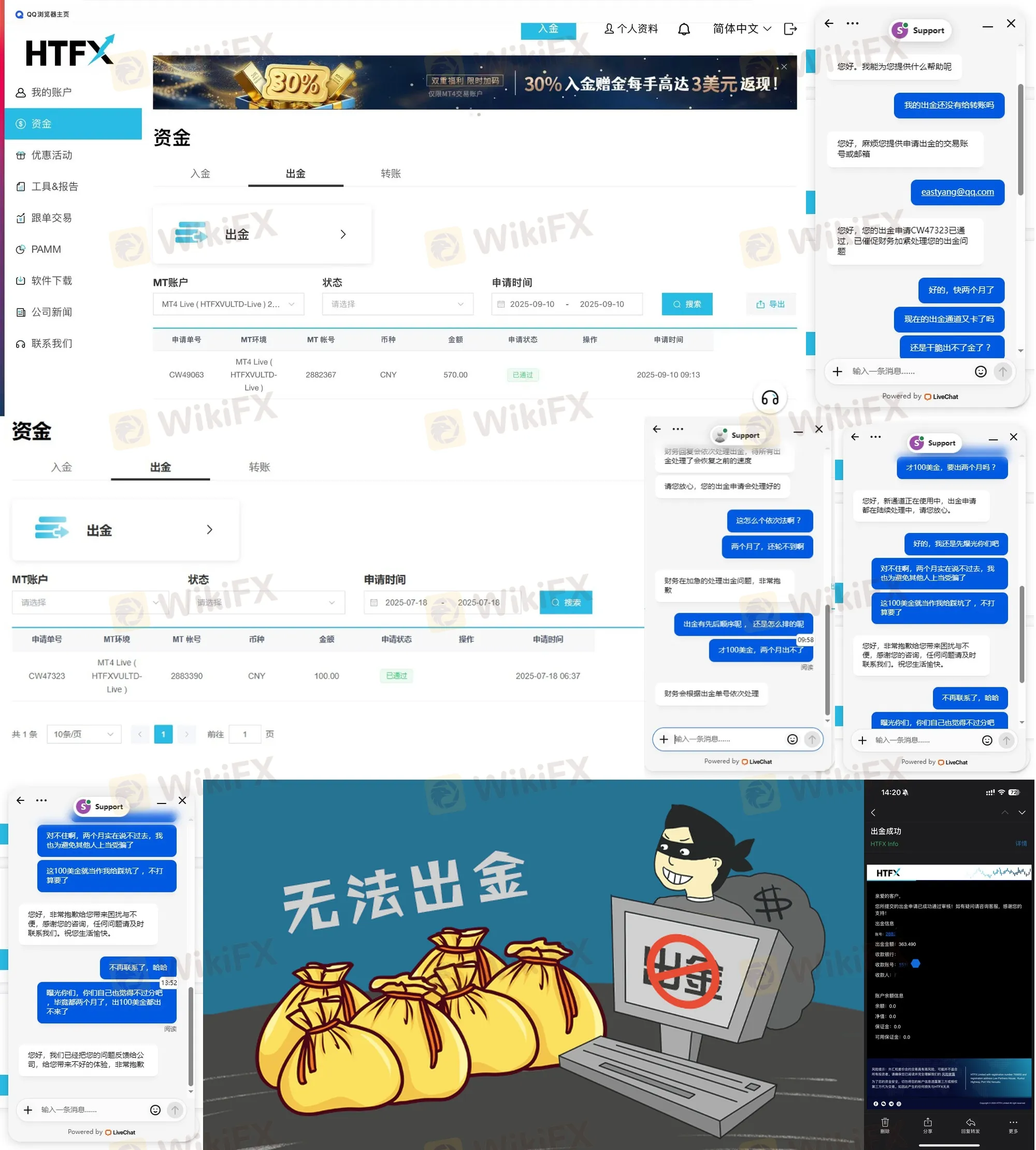
The complaints also include smaller amounts: $100, $200, $570, and about $363.49. That matters because withdrawal problems are not limited to large balances in these reports. Repeated users said customer service responded with phrases such as “finance is processing,” “please wait patiently,” or “we have urged the finance department,” without giving a firm payment date.
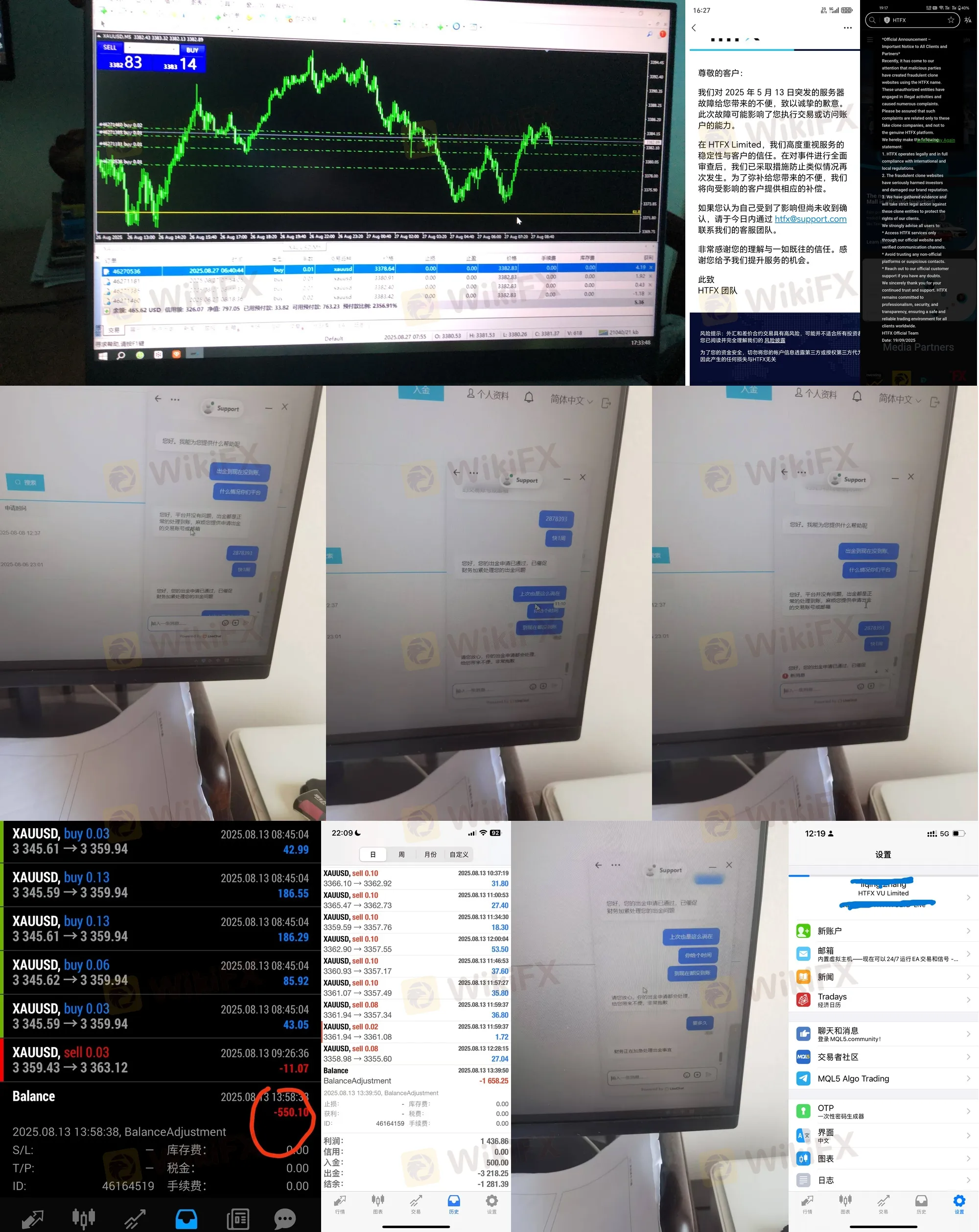
A few cases go beyond withdrawals. Some users reported severe slippage, frozen or non-moving price feeds, profit deductions after platform freezes, inability to trade on MT5, and website or account access failures. These reports are allegations from users, but the volume and consistency make them a serious risk signal.
Customer Service and Operational Transparency
The listed customer service channels are a phone number, +678 29816, and email support@htfx.com, with English support. The source says most relevant answers may be received, but waiting times may be long.
That fits poorly with the complaint record. Many users said emails were not answered, customer service gave mechanical replies, or support could not be reached. If a broker is handling withdrawal stress well, you would normally expect clear processing timelines, written explanations, and consistent escalation. The cases describe the opposite.
Final Verdict: Should I open an account?
Based only on the provided WikiFX data and complaint cases, HTFX appears high risk for new deposits. The broker has offshore Vanuatu VFSC regulation, a low WikiFX Score of 1.61, and a heavy concentration of recent withdrawal complaints across multiple countries. MT4/MT5 availability and low entry account options do not outweigh repeated reports of delayed or failed withdrawals.
If you already have funds with HTFX, keep detailed records of withdrawal requests, account screenshots, emails, payment receipts, and support conversations. If you have not deposited yet, the safer choice is to pause until the withdrawal complaint pattern is clearly resolved and independently verified.
Status changes daily. Before depositing, check the WikiFX App for the latest real-time certificate.

Disclaimer:
The views in this article only represent the author's personal views, and do not constitute investment advice on this platform. This platform does not guarantee the accuracy, completeness and timeliness of the information in the article, and will not be liable for any loss caused by the use of or reliance on the information in the article.
WikiFX Broker
Latest News
CMC Markets Extends US Share Trading Into Overnight Session
WikiFXUK Chancellor Healey: Economy demonstrates welcome resilience despite global uncertainty
WikiFX11.09.26 Daily Forecast
WikiFXProp Firm FTMO to Acquire OANDA with $422 Million
WikiFXRBI's Record $136-Billion NRI Deposit Campaign: Closed Early, Windfall and Risks for Traders
WikiFXUnited States Dollar Index holds onto gains above 99 ahead of US CPI data
WikiFXSilver Forecast: XAG/USD rebound capped as bearish bias holds
WikiFXGold price in India: Rates on September 11
WikiFXBritish Pound jumps after strong UK monthly GDP data
WikiFXEUR/JPY Price Forecast: Softens to near 179.00, bearish bias remains intact below 100-day SMA
WikiFX