Abstract:Octa vs XTB Showdown: One Is Banned By The RBI, The Other Has 24 Years Of Stock-Market Pedigree — Which Should Indian Traders Actually Trust In 2026?
If you are an Indian trader who has done even a casual Google search for forex brokers, two names will have crossed your screen — Octa (formerly OctaFX) and XTB. Both are widely advertised, both have massive global followings, and both claim to offer competitive trading conditions for retail traders.
But these two brokers could not be more different in their philosophy, regulation, and legal standing in India. Octa is a mobile-first, high-leverage, beginner-friendly offshore broker that has rapidly grown across emerging markets — including, controversially, India. XTB is a 24-year-old publicly-listed European broker with deep Tier-1 regulation that has specifically chosen NOT to accept Indian clients in 2026.
Yes, you read that right. XTB does not accept Indian residents. And Octa, the one that does serve Indian residents, has been adde
Octa vs XTB Showdown: One Is Banned By The RBI, The Other Has 24 Years Of Stock-Market Pedigree — Which Should Indian Traders Actually Trust In 2026?
If you are an Indian trader who has done even a casual Google search for forex brokers, two names will have crossed your screen — Octa (formerly OctaFX) and XTB. Both are widely advertised, both have massive global followings, and both claim to offer competitive trading conditions for retail traders.
But these two brokers could not be more different in their philosophy, regulation, and legal standing in India. Octa is a mobile-first, high-leverage, beginner-friendly offshore broker that has rapidly grown across emerging markets — including, controversially, India. XTB is a 24-year-old publicly-listed European broker with deep Tier-1 regulation that has specifically chosen NOT to accept Indian clients in 2026.
Yes, you read that right. XTB does not accept Indian residents. And Octa, the one that does serve Indian residents, has been added to the Reserve Bank of India's Alert List of unauthorised forex brokers.
This is the comparison that explains why one of them got blacklisted and the other refuses to operate where it cannot legally comply. By the end of this article, you will understand a crucial truth about retail forex: the broker that wants your business the most aggressively is often the one you should trust the least.
Why Forex Broker Comparison Matters (Especially In India)
Indian retail traders face a unique double bind. On one hand, SEBI does not authorise offshore forex brokers for retail clients, so every international broker accessible to Indians operates in a legal grey zone. On the other hand, Indian domestic platforms offer extremely limited forex product range and very conservative leverage.
In this environment, broker comparison is not a luxury — it is a survival skill. The wrong broker choice can mean:
- Frozen accounts when you become profitable
- “Compliance reviews” that mysteriously coincide with withdrawal requests
- Spreads that mysteriously widen during news events
- RBI Alert List entries that put you on the wrong side of FEMA
- Total loss of capital with zero legal recourse
Comparing brokers across regulation, operational history, user feedback, and trading conditions — the way WikiFX does it — is the only defence retail traders have. Now let us do exactly that for Octa and XTB.
Side-by-Side Broker Profile
The Regulatory Reality: One Of These Brokers Got Banned
This is the single most important section of the comparison. Read it carefully.
Octa's Indian Status (the bombshell):
In October 2024, the Reserve Bank of India officially added Octa (and its predecessor entity OctaFX) to its Alert List of unauthorised forex trading platforms. This is not a rumour, not speculation — it is a documented RBI list of forex brokers that Indian residents are warned against.
What does this mean practically?
- Indian traders using Octa are operating outside the legal framework of FEMA (Foreign Exchange Management Act).
- The Enforcement Directorate (ED) has explicit jurisdiction over FEMA violations.
- Octa onboards Indian traders through its Comoros Union-based entity (Octa Markets Ltd), which provides effectively zero protection.
- Multiple Indian traders have already lodged complaints describing profit-voiding, spread widening during news, and account manipulation.
Octa's primary regulator for non-EU clients is MISA (Mwali International Services Authority) in Comoros — an offshore-tier regulator with minimal enforcement teeth. The CySEC licence applies only to EU clients, which excludes you if you are in India.
XTB's Indian Status (the surprise):
XTB has decided not to accept Indian residents as clients. This sounds like a negative until you understand why. XTB operates under FCA (UK) and CySEC (Cyprus) Tier-1 regulation, and accepting Indian clients without proper authorisation would expose the broker to regulatory action in its home jurisdictions. Rather than risk that, XTB simply does not onboard Indian users.
Quick Term Explainer — “Tier-1 vs Offshore Regulation”: Tier-1 regulators (FCA, ASIC, CFTC) require minimum capital reserves of USD 1 million+, segregated client funds, regular audits, and have real enforcement teeth. Offshore regulators (MISA, Vanuatu VFSC, Comoros) may require less than USD 50,000 in capital and have minimal audit or enforcement infrastructure. The difference is the difference between “regulated” and “regulated in name only”.
Trading Conditions: Costs That Actually Matter
Octa Trading Conditions:
- USD 20 minimum deposit (extremely accessible — possibly too accessible for unprepared traders)
- 0.6 pip EUR/USD spread on average
- Zero commission (mark-up embedded in spread)
- Maximum 1:1000 leverage (extremely high — a double-edged sword)
- 100 percent swap-free accounts by default
- Indian INR deposit/withdrawal supported through local rails
XTB Trading Conditions (Standard Account):
- USD 0 minimum deposit (lowest barrier in the industry)
- 0.5 pip EUR/USD spread average
- Zero commission on forex, indices, commodities
- Maximum 1:500 leverage (international entity)
- xStation 5 proprietary platform widely awarded as best-in-class
- 11,700+ tradable instruments
- No deposit fees; withdrawal fees apply below threshold amounts
On pure cost-per-trade, XTB is genuinely competitive. But the real differentiator is the 11,700+ instrument range — XTB offers real share dealing, ETFs, and a far broader product universe than Octa's CFD-only offering.
User Feedback: The Reality Behind The Marketing
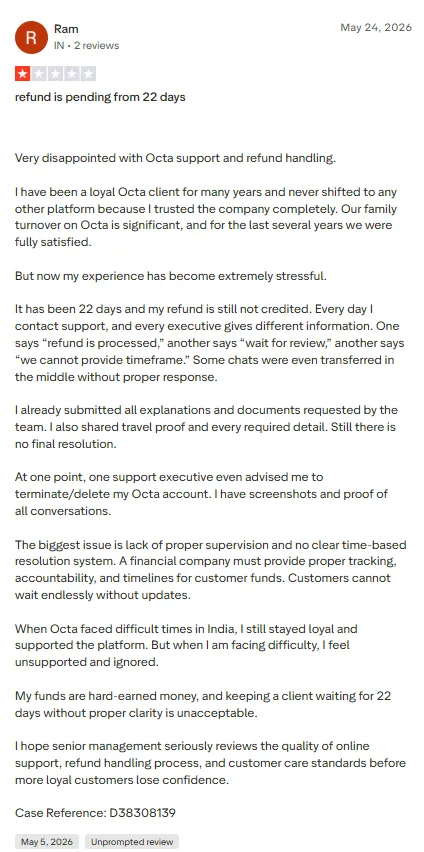
Octa user feedback is mixed and has deteriorated noticeably in the past 12 months. Specific complaints from Indian traders include the one that appeared in May 2026.
- According to the complaint, the customer claims to have been a long-term and loyal Octa client who trusted the platform for many years.
- According to the complaint, the customer's family conducted significant trading activity on Octa and had been satisfied with the broker's services in the past.
- The main issue concerns a refund request that has allegedly remained unresolved for 22 days.
- The customer states that despite contacting support daily, they have not received a clear resolution or refund credit.
- The complainant alleges that different support representatives provided inconsistent and contradictory information, including:
- The refund has been processed.
- The case is under review.
- No timeframe can be provided.
- The customer claims some support chats were transferred to other agents without proper follow-up or resolution.
- According to the complaint, all requested documents and explanations were submitted, including travel-related proof and other supporting information.
- Despite providing the requested information, the customer states that no final decision or update has been communicated.
- The complainant further alleges that one support representative advised them to delete or terminate their Octa account, which they found inappropriate.
- The customer claims to possess screenshots and records of all support conversations.
- A major concern highlighted is the alleged lack of:
- Proper case supervision.
- Transparent refund tracking.
- Accountability from support teams.
- Clear resolution timelines.
- The complainant argues that a financial services provider should maintain a structured system for handling customer funds and refund requests.
- The customer expresses disappointment that, despite remaining loyal to Octa during challenging periods, they feel unsupported when facing their own issue.
- The complaint emphasizes that the delayed funds represent hard-earned money, making the prolonged wait particularly frustrating.
- The customer urges Octa's senior management to review and improve:
- Customer support quality.
- Refund processing procedures.
- Complaint resolution mechanisms.
- Overall customer service standards.
- Case Reference: D38308139.
Core Allegation: The customer alleges excessive delays in refund processing, inconsistent communication from support staff, and a lack of transparency and accountability in handling their refund request.
XTB user feedback is generally positive, with high marks for:
- Transparency in board management and corporate structure (publishes board details, unlike most brokers)
- xStation 5 platform usability
- News-driven communication (XTB proactively warns clients of spread widening during volatility)
- Reliable withdrawal processing
XTB does receive complaints about:
- Above-average forex spreads on the Standard account compared to ECN-only competitors
- Inactivity fees after 12 months of dormancy
- Slow customer support response times (English-only outside business days)
But critically, XTB does not have a pattern of profit confiscation complaints. The complaint nature is operational, not existential.
The Verdict — But With An Important Caveat
On every meaningful criterion, XTB is the dramatically better-regulated, more transparent, and more institutionally credible broker:
- 24 years operational history vs. 14 years
- Publicly listed on Warsaw Stock Exchange (full financial transparency) vs. private
- FCA + KNF + CySEC Tier-1 regulatory stack vs. offshore-only for retail clients
- 11,700+ instruments vs. ~250
- No history of pattern complaints vs. RBI Alert List entry
HOWEVER — XTB does not accept Indian clients. This is the binding constraint.
If you are an Indian resident, the practical comparison is moot — you cannot legally open an XTB account. Your alternatives are:
- Use SEBI-regulated Indian brokers (limited forex range but legally compliant)
- Use offshore brokers that DO accept Indian clients but are NOT on the RBI Alert List (Vantage, FP Markets, IC Markets, etc.)
- Avoid brokers on the RBI Alert List entirely — including Octa
The Verification Step You Cannot Skip
Here is what most Indian traders do not realise: the RBI Alert List is updated periodically, but it is not the only verification you need to do. Even brokers not currently on the RBI list may have other red flags — clone firms operating under their name, regulatory licence mismatches, or accumulating complaint patterns.
Open the WikiFX app on your phone right now and verify any broker before you deposit. Here is what to check specifically:
- The RBI Alert List status — WikiFX cross-references RBI's published list and flags brokers that appear on it.
- All claimed regulatory licences — verified against actual regulator databases.
- The Exposure section — every documented complaint with country, amount, and date.
- The clone-firm warnings — many fake Octa and XTB apps exist; verify you are downloading the genuine one.
- The historical score trend — has the broker's score been declining over the past 12 months?
WikiFX is the single most powerful verification tool retail traders have, and it is free. The traders who lost funds to Octa's profit-voiding scheme could have seen the warning signs on WikiFX before depositing. Do not repeat their mistake.
Trade smart. Verify first. Choose Tier-1 regulation over Tier-3 leverage every single time.
Download the WikiFX App for extensive broker investigation reports.

More Insightful Articles for You