

Global Broker Regulation Inquiry App
About WikiFX
English
简体中文
繁體中文
English
Pусский
日本語
ภาษาไทย
Tiếng Việt
Bahasa Indonesia
Español
हिन्दी
Filippiiniläinen
Français
Deutsch
Português
Türkçe
한국어
العربية
اردو


Managing the Mental Strain and Isolation of Solo Trading

WikiFX
|


Abstract:Solo trading can be an isolating experience that leads to stress, mind games, and overtrading. This article breaks down practical ways to manage the mental strain of trading alone, including journaling, finding an accountability partner, and knowing when to walk away from the screen.
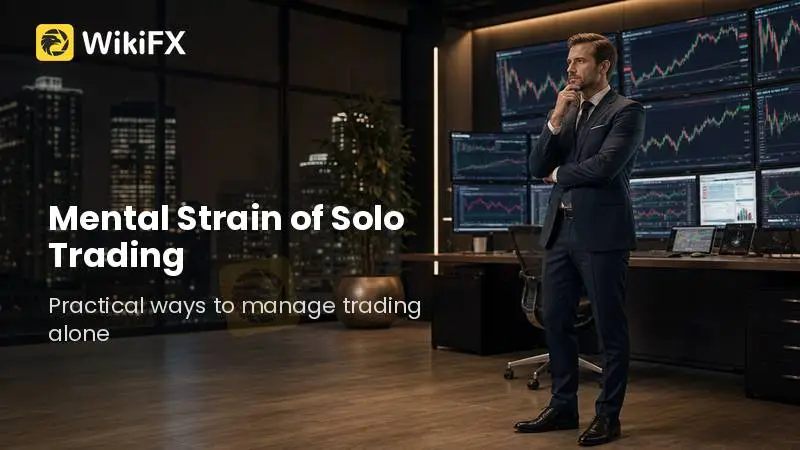
Many beginners start Forex trading dreaming of independence, only to find that staring at a screen by themselves all day can quickly become overwhelming. When you sit alone in a room watching prices move up and down, it is easy to feel isolated, stressed, and disconnected from reality. This isolation can play tricks on your mind, distorting your thinking and leading to costly mistakes.
 Contents
Accept the Stress Without Letting It Break You
It is a common misconception that successful professional traders sit quietly with absolute, Zen-like control over their emotions. The reality is that as long as there is financial risk and uncertainty, stress is a completely normal reaction. The goal is not to eliminate stress entirely—which is impossible—but to prevent it from turning into full-blown distress.
When you trade alone, a string of losses can easily make you feel panicked or reckless because there is no one around to talk you down. Recognizing that tension is just a built-in part of the business helps you stay grounded. If you expect a certain level of stress, you are less likely to panic when it arrives.
Remember the Market Is Not Out to Get You
When you trade in isolation, it is incredibly easy to start personifying the market. If you suffer an unexpected loss, your mind might convince you that the market is specifically hunting your stop losses or deliberately punishing your account.
The truth is much simpler: the market is not a single living entity actively plotting against you. It is just a snapshot of the collective thoughts, fears, and logic of thousands of individual participants making decisions. The market is not after your money. If you practice strict risk management and do not over-leverage your account, the market cannot force you out. Reminding yourself of this removes the emotional weight from a bad trade and helps you view the charts objectively.
Use a Journal to Break the Silence
As veteran trader Larry Pesavento noted, trading is a lonely business. You are the captain of your ship, but that also means you carry all the burden alone. One of the most effective ways to combat this isolation is to keep a detailed trading journal.
A journal is not just about tracking pips; it is about tracking your mind. Writing down your thoughts, fears, and reasons for taking a trade forces you to self-evaluate. It acts as an external voice when you have no coworkers to exchange ideas with.
Beyond a written log, finding an accountability partner—whether a spouse, a friend, or a fellow trader online—can make a massive difference. Having someone review your weekly results helps you stay honest, realistic, and less trapped in your own head.
Why You Need to Step Away from the Screen
Without a boss or a fixed schedule, solo traders often fall into the trap of overtrading simply because they feel they need to be doing something. Sitting in front of the charts for hours on end usually leads to taking low-quality setups out of sheer boredom or a false sense of duty.
Try to cultivate a habit of not doing. You do not miss opportunities by choosing not to trade; the Forex market gives you a nearly endless stream of price action, and there is always another setup around the corner. Learn to step away from the screen. Taking regular breaks conserves your mental energy, protects your trading capital, and keeps you connected to the real world outside your trading terminal.
Your mental environment is just as critical as your trading strategy. By managing your daily stress, logging your trades, and knowing when to walk away, you can navigate the isolation of retail Forex trading. To remove at least one unnecessary source of anxiety—broker reliability—you can quickly check your broker's regulatory status on WikiFX. Once you know your funds are sitting with a legitimate platform, you can spend less time worrying and fully focus on managing your mind.

Disclaimer:
The views in this article only represent the author's personal views, and do not constitute investment advice on this platform. This platform does not guarantee the accuracy, completeness and timeliness of the information in the article, and will not be liable for any loss caused by the use of or reliance on the information in the article.
WikiFX Broker
Latest News
New Zealand Dollar steady above 0.5900 as traders eye RBNZ, Fed
WikiFXPolish Zloty: Fiscal slippage and cautious NBP weigh – Commerzbank
WikiFXCanadian Dollar strengthens despite hawkish Fed rhetoric
WikiFXEuro strengthens against Canadian Dollar ahead of Germanys HICP data
WikiFXEuro: Limited downside, range defined against US Dollar – Scotiabank
WikiFXJapanese Yen: Supported below 160 against US Dollar – Scotiabank
WikiFXAustralian Dollar holds firm amid hawkish Fed and RBA expectations
WikiFXUSD/JPY Forecast: Retreats from one-month high but dip-buying eyed
WikiFXJapanese Yen: BoJ normalization expectations and contained moves – BNY
WikiFXForex Today: Attention shifts to US ISM, JOLTs and inflation in Europe
WikiFX