


Global Broker Regulation Inquiry App
About WikiFX
English
简体中文
繁體中文
English
Pусский
日本語
ภาษาไทย
Tiếng Việt
Bahasa Indonesia
Español
हिन्दी
Filippiiniläinen
Français
Deutsch
Português
Türkçe
한국어
العربية
اردو
DBG Markets | Understanding Margin in CFDs: How to Avoid Margin Call Risk Part 1
Abstract:Understanding Margin in CFDs: How to Avoid Margin Call RiskTrading Contracts for Difference (CFDs) can offer high returns with relatively low capital outlay—but it also carries significant risk, espec

Trading Contracts for Difference (CFDs) can offer high returns with relatively low capital outlay—but it also carries significant risk, especially when it comes to margin. One of the most important concepts CFD traders need to understand is margin call risk.
In this article, DBG Markets breaks down what margin is, why margin calls occur, and how you can avoid them to manage your trading account more effectively.
What is Margin in CFDs?
Margin in CFD trading is the amount of money trader needs deposit to open and maintain a leveraged position. It acts as collateral to cover potential losses. Put it simple, when trading on margin, you are essentially borrowing funds from your broker to control a larger position than your capital would allow.
There are two main types of margins—Initial margin and Maintenance Margin.
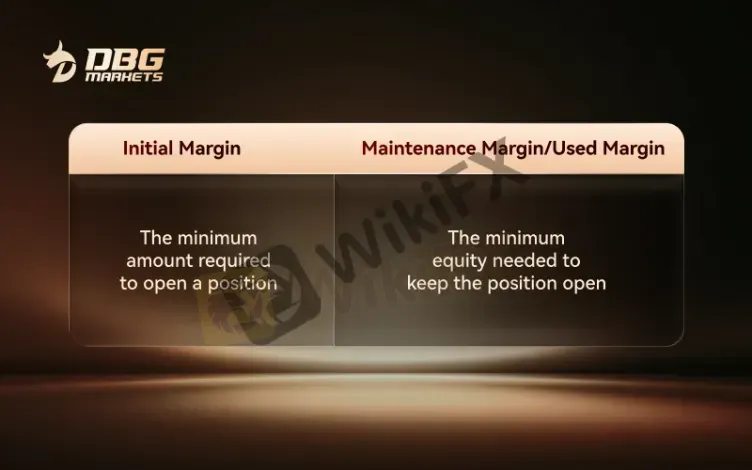
For example, with DBG Markets providing leverage of 500:1 on Forex pairs, it requires a 0.2% margin to open a trade. This means you only need $200 to control a $100,000 position.
Why Do Margin Calls Occur?
Margin call occurs when your account equity falls below the brokers required margin which is the maintainenance margin. This usually happens due to:
· Adverse price movements in the market.
· High leverage amplifying small losses.
· Insufficient funds in the account to cover unrealized losses.
When your account equity is too low to support open positions, the broker may request that you deposit more funds or begin closing your positions automatically—a process known as forced liquidation.
Margin Terminology in Forex & CFDs
Forced liquidation—when your broker closes positions due to insufficient margin—can be frustrating and costly.
To avoid a margin call and the risk of forced liquidation, its crucial to first understand the key margin-related terms. These terms are the foundation of risk management in CFD and forex trading:
· Free Margin: The available equity in your account to open new trades.
· Used Margin: The portion of your funds currently being used to maintain open positions.
· Equity: Account balance including unrealized profits or losses.
· Leverage: The ratio that amplifies your trading size (e.g., 1:100).
· Margin Requirement: The percentage of a positions value that must be held as margin.
· Margin level: This percentage shows the health of your trading account. A margin level below a certain threshold (e.g., 100% or 50%) may trigger a margin call or automatic liquidation.
Disclaimer:
The views in this article only represent the author's personal views, and do not constitute investment advice on this platform. This platform does not guarantee the accuracy, completeness and timeliness of the information in the article, and will not be liable for any loss caused by the use of or reliance on the information in the article.
WikiFX Broker
Latest News
EMAR MARKETS Review 2026: Complaints, High Leverage, and Withdrawal Risk Signals
 WikiFX
EMIRAX MARKETS Review 2026: Unregulated Status, High Leverage, and Withdrawal Complaints
WikiFXHow the Bullet Theory Fixes the Habit of Overtrading
WikiFXReview 2026: Interactive Brokers Regulation, Complaints, and Platform Access
WikiFXReview 2026: STMARKET Regulation, MT5 Access, and Withdrawal Complaint
WikiFXOver 100 Malaysian Retirees Gather to Expose How Investment Scams Wiped Out Their Life Savings
WikiFXSquaredFinancial Review 2026: Heavy Complaints, Withdrawal Delays, and Profit Deletions
WikiFXUbuntu Invest Review 2026: Is This Forex Broker Safe?
WikiFXMaking Sense of Central Bank News: How Revaluation, Interest Rates, and Reserves Move Currencies
WikiFXFive Chinese Fined RM4,000 Each for Promoting Cryptocurrency Investment Scheme in Malaysia
WikiFXCurrency Calculator
USD

CNY
Current Rate:0
Enter amount
USD
Redeemable Amount
CNY
Calculate 