Abstract:When people want to trade and look into Moneta Markets, they find mixed and confusing information. The broker looks legitimate on paper and has licenses from well-known regulators. But many users have made serious complaints about losing capital and being treated unfairly. The main question—is MONETA MARKETS safe or scam—doesn't have an easy answer. The situation is complicated.
This article will help clear up the confusion. We'll look at real user reviews and specific MONETA MARKETS complaints, mostly using information from WikiFX. Our goal is to give you a fair analysis that compares what the company claims against what users actually experience. To get the complete picture, we'll look at data from WikiFX's detailed profile, which shows both the company's regulatory status and important user warnings. You can check this profile anytime for the latest updates.
Is MONETA MARKETS Safe or Scam?
When people want to trade and look into target="_blank" kwlink="6384064000816950219725">target="_blank" kwlink="6384064003964245074080">Moneta Markets, they find mixed and confusing information. The broker looks legitimate on paper and has licenses from well-known regulators. But many users have made serious complaints about losing capital and being treated unfairly. The main question—is MONETA MARKETS safe or scam—doesn't have an easy answer. The situation is complicated.
This article will help clear up the confusion. We'll look at real user reviews and specific MONETA MARKETS complaints, mostly using information from WikiFX. Our goal is to give you a fair analysis that compares what the company claims against what users actually experience. To get the complete picture, we'll look at data from WikiFX's detailed profile, which shows both the company's regulatory status and important user warnings. You can check this profile anytime for the latest updates.
What the Company Claims
Before we talk about user problems, let's look at the basic facts that make Moneta Markets seem legitimate. These are the trust signals that attract traders and support the broker's claim of being “safe.” According to public records and data checked by WikiFX, the broker has several good credentials.
These official trust signals make a strong case for the broker's credibility.
· FCA Regulation (United Kingdom): Moneta Markets has a license (No. 613381) from the Financial Conduct Authority (FCA). This is a top-level regulator known for strict oversight. It requires clients capital to be kept separate and gives access to the Financial Services Compensation Scheme (FSCS), which protects up to £85,000 if the broker goes out of business.
· FSCA Regulation (South Africa): The broker is also regulated by the Financial Sector Conduct Authority (FSCA) in South Africa, giving another layer of regulatory oversight in an important financial region.
· Years in Business: With 5-10 years of operation, Moneta Markets isn't new. This track record suggests business stability that quick scams usually don't have.
· Real Physical Offices: WikiFX survey teams have found and confirmed that Moneta Markets has real offices in the United Kingdom, Thailand, and Dubai, proving they have a real global presence.
Warning Signs and User Problems
Even with strong regulation, user experiences tell a very different and worrying story. WikiFX has issued a clear warning: “The WikiFX Score of this broker is reduced because of too many complaints!” This isn't a small problem; the complaints are many, consistent, and describe big financial losses and unfair treatment. By looking at these repeated issues, we can see clear patterns of risk.
Claims About Taking Profits
A main and very concerning theme in user complaints is that Moneta Markets takes away profits and sometimes the original deposit, especially after a trader becomes successful.
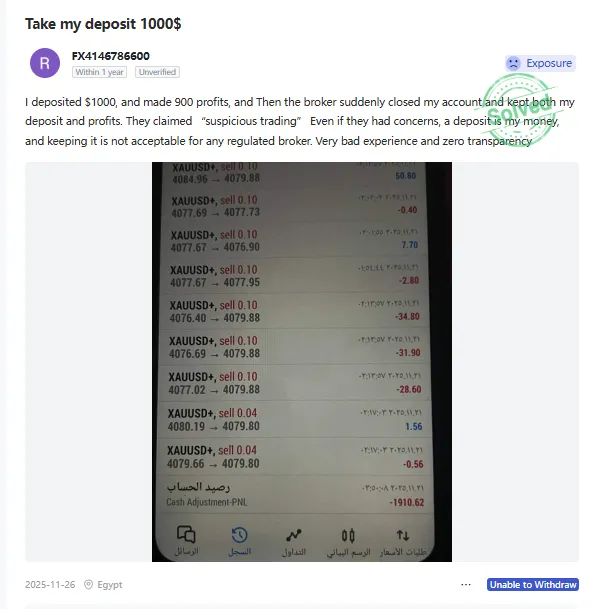
> A person from Egypt said they put in $1000 and grew their account to $1900. The broker then supposedly closed the account and took both the $900 profit and the original $1000 deposit, claiming “suspicious trading” without a clear explanation.
This isn't the only case. A similar story came from a trader in Taiwan who was successful and asked to withdraw funds.
> The Taiwanese trader was accused of “breaking external hedging rules” after their account made money. Moneta Markets supposedly gave no proof for this claim, refused the withdrawal, and locked the user out of their account, preventing access to both profits and original capital.
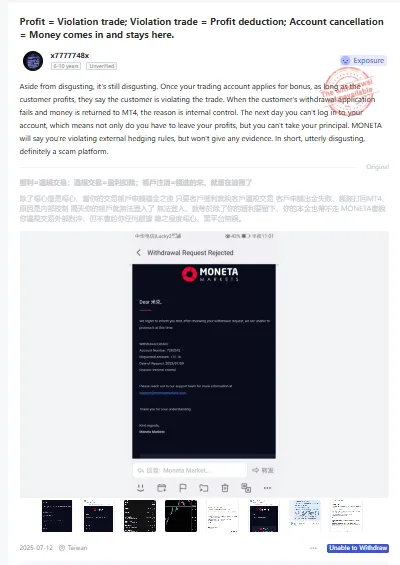
This pattern suggests that making money can lead to punishment from the broker, which is a major warning sign for any trader.
The NexoBot PAMM Problem
One of the biggest and best-documented series of complaints involves a Percentage Allocation Management Module (PAMM) account in Brazil managed by a third party called NexoBot. Many users report huge losses and claim Moneta Markets was involved or negligent.
> A user from Brazil who lost over $1000 described how the PAMM manager stopped allowing withdrawals. When the client asked for help, the local Moneta Markets account manager and the broker's main support were reportedly unhelpful. Importantly, users claim Moneta Markets was involved by letting the PAMM manager use “order masking,” a feature that hid big losing trades from investors, making them think everything was fine.
The size of this incident is shocking. Another affected user highlighted the system-wide failure and huge financial damage.
> This user claims the fraud affected over 1000 clients, with total losses of over $5 million. They say Moneta Markets failed to properly check the PAMM manager and later tried to have complaints removed in exchange for a questionable “recovery” plan, making trust even worse.
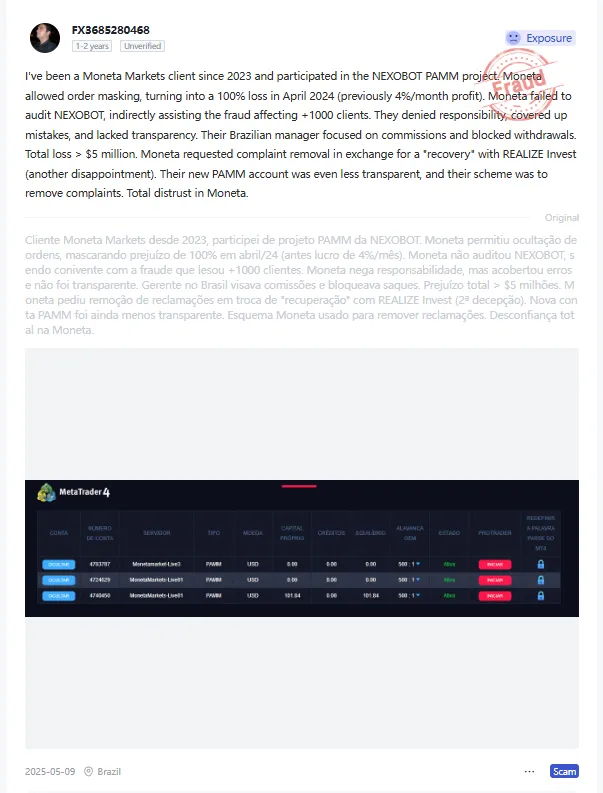
This case shows a serious risk with third-party services on the platform and questions the broker's checking and crisis management.
Sudden Fees and Strategy Rejection
Other complaints point to different ways of taking funds from client accounts or punishing successful trading methods. These actions often seem random and without a clear reason in the client agreement.
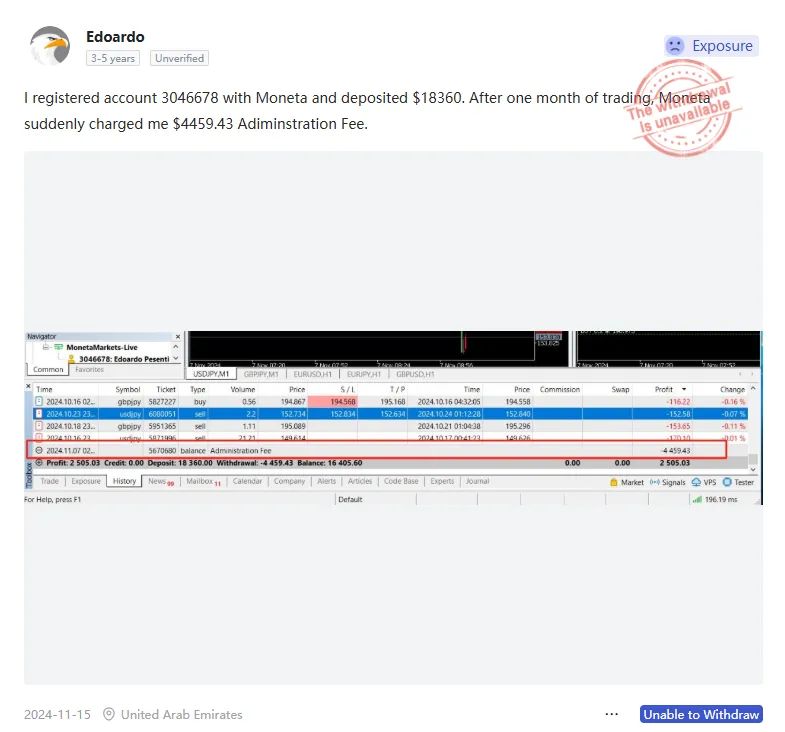
> A trader from the UAE said that after a month of trading on an $18,360 deposit, Moneta Markets suddenly charged a huge “$4459.43 Administration Fee” to the account.
Another form of punishment seems to target automated or systematic traders. A user who used an Expert Advisor (EA) noticed a big difference in how the broker treated winning versus losing strategies.
> This trader from Brazil explained that while their EA was losing money, everything was fine. However, once they changed the strategy and it became profitable, Moneta Markets supposedly rejected all withdrawal requests.
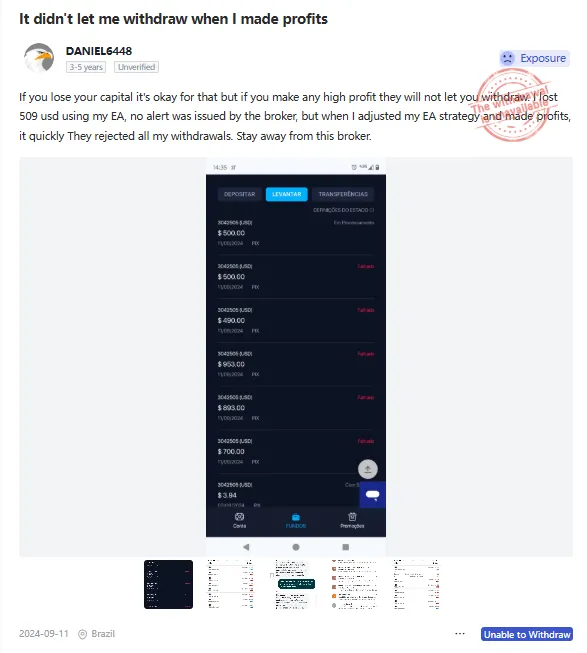
This collection of complaints shows a troubling pattern that goes beyond isolated technical problems or poor customer service. The issues are system-wide, financially damaging, and consistently target profitable or successful clients.
The Other Side
To stay objective, it's important to acknowledge that not all user experiences with Moneta Markets are negative. The broker continues to attract and keep many clients, and there's a lot of positive feedback praising specific parts of its service. Weighing these serious risks against the benefits praised by other traders is essential for a complete opinion. A side-by-side comparison, like the one available on the full WikiFX report, is often the clearest way to see this contrast.
Many satisfied users point to the broker's excellent trading conditions, strong platforms, and, in their experience, reliable service.
These positive reviews often come from traders who value low transaction costs and platform variety. They report smooth operations, fast withdrawals, and a seamless trading experience, standing in stark contrast to the severe issues reported by others.
Understanding Two Different Experiences
Why do user experiences with Moneta Markets vary so much? The evidence suggests that the most severe problems aren't random but happen under specific, high-risk conditions. Our analysis of the complaint patterns shows that traders are most at risk when:
1. They make significant, fast profits.
2. They use third-party managed account services such as PAMM.
3. Their accounts are registered under a less-strict offshore entity.
The broker's offering of extremely high leverage, up to 1000:1, is both good and bad. While it attracts traders seeking high capital efficiency, it also creates an environment of huge risk for both the trader and the broker. Some brokers operating with a B-book (market maker) model may be motivated to block withdrawals from highly profitable clients to protect their own profits.
Also, having different corporate entities is an important factor. While Moneta Markets is regulated by the FCA in the UK, it also operates through other entities, some of which may be registered offshore. The WikiFX data shows MT4/5 servers located in Mauritius, a common offshore location. A broker might be regulated by the FCA, but you must confirm the entity your account is actually registered with. This important detail, often found in the fine print or on a detailed broker profile, such as the one on WikiFX, determines your level of protection and which regulator has oversight. Clients under an offshore entity typically don't get the same protections, such as compensation schemes, as those under the FCA.
Is It a Safe Choice?
We can't call Moneta Markets a simple scam, as it's a formally regulated broker with verified operations and many satisfied customers. However, it's equally impossible to call it completely safe.
The evidence shows a broker with two faces. On one hand, it offers attractive trading conditions and holds top-tier licenses. On the other, it's troubled by a documented, severe and recurring pattern of complaints involving profit taking, involvement in third-party management failures, and punishment of successful traders. These warning signs represent a significant and real financial risk.
In the end, the decision depends on your individual risk tolerance. For careful traders who prioritize the absolute security of their invested capital and profits above all else, the serious issues raised in these user complaints are likely too significant to ignore. The possibility of a smooth experience doesn't eliminate the documented risk of huge loss. Always do thorough research before investing.
You can always research better on the new WikiFX app, demonstrating effective broker regulation inquiry comparisons for informed decision-making. Download it to start experiencing.