Abstract:When trading forex, besides mastering chart patterns and trading strategies well, to be a successful trader, understanding your entire portfolio's sensitivity to market volatility is also essential.

Because currencies are priced in pairs, no single currency pair can trade completely independently of the others. You must have ever noticed that when a certain currency pair rises, another currency pair falls. That involves the term “Currency Correlation”. Once you are aware of these correlations and how they change, you can use them to control the risk exposure of your entire portfolio.
Here we will cover the basic definition of currency correlations and why it is important in forex currencies trading.
What is Currency Correlation?
In the financial world, correlation is a statistical measure of how two variables relate to one another. The greater the correlation coefficient, the more closely aligned they are.
A statistical measure referring to the extent of linear relationship between two or more variables, in other words, of the degree to which the movements of two currency pairs are related. For example, if two currency pairs have a high correlation, their prices tend to rise and fall in sync. Although the measure suggests some causal relationship between the variables, the relationships between pairs and the correlation values tend to change from time to time.
What is the Correlation Coefficient?
The correlation coefficient is used in pairs trading, and it measures the correlation between different assets – in this case, currency pairs. The standard measure of correlation is the correlation coefficient, a number between -1 and 1 that indicates the strength and direction of a the linear relationship. A correlation coefficient of -1 indicates that the currency pairs are perfectly negatively correlated, that is, a higher value for one pair tends to correspond to a lower value for the other. A correlation coefficient of 1 means that they are perfectly correlated, indicating a higher value for one variable tends to correspond to a higher value for the other. The weaker the relationship, the closer the correlation coefficient is to 0.
Positive Correlation
When two currency pairs move in the same direction – so if one pair moves up, then so does the other. For example, the correlation of EUR/USD and GBP/USD is positive because if the demand for U.S. Dollars increases, the level of both currency pairs will usually decline. Conversely, if the demand for U.S. Dollars falls, then the levels of both currency pairs will tend to increase.
Negative Correlation
Negative correlation is the opposite of positive correlation, with the exchange levels of currency pairs usually moving inversely to each other. For example, a negative correlation exists between the EUR/USD and USD/JPY currency pairs. When demand for U.S. Dollars increases, the currency pairs often move in opposite directions, with USD/JPY generally increasing due to the U.S. Dollar being the base currency in the pair, and with EUR/USD declining since the U.S. Dollar is the counter currency in that pair.
How To Calculate Currency Correlation?
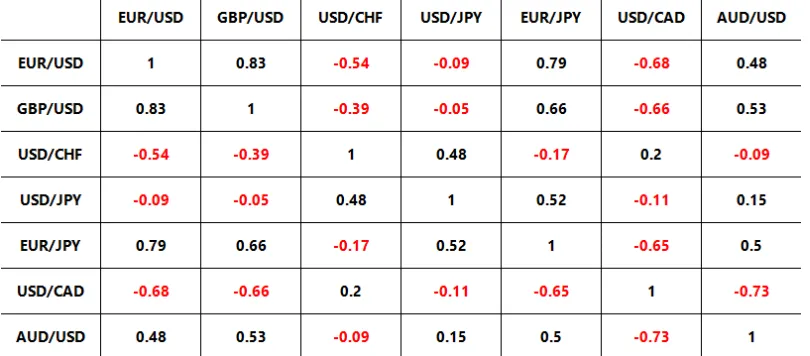
Currencies can be affected by a variety of factors – central bank policies, the global economy, local political and social issues, etc. Below you can find a table which shows the correlation between currencies for an hour, a day, a week, a month, three months, six months and a year.
The forex currency pair correlation table shows the correlations that were calculated over a period of one month.
Interpretation Of The Results
let's try to understand these figures and what they mean. If the result is between:
0 – 0.2: the correlation between the pairs is insignificant; therefore, the exchange rates move randomly.
2 – 0.4: the correlation is not that small but is not strong either
4 – 0.7: there is an average correlation
0.7 – 0.9: shows that there is a strong correlation between the pairs
0.9 – 1: indicates that the two pairs correlate very strongly
Impact of Currency Correlation on Forex Trading
· They can form a basis of a statistically high probability Forex trading strategy.
· They can illustrate the amount of risk you are exposed to within your Forex trading account. For example, if you have bought several currency pairs with a strong positive correlation, then you are exposed to higher directional risk.
· You can avoid positions that effectively cancel each other out. EUR/USD and USD/CHF have a powerful negative correlation. If you have a directional bias, buying both EUR/USD and USD/CHF will counteract the moves in each pair.
· Understanding correlations can allow you to hedge or diversify your exposure to the Forex market.
· If you have a directional bias for a given currency, you can spread your risk using two strongly positive correlated pairs, in terms of diversification.
· If you are looking to hedge a position (holding it with low risk of losses) you can take a position in a negatively correlated pair. If you were to initiate a 'long buy' for EUR/USD, and it begins to move in an unfavourable direction, you can then hedge your position by purchasing a currency pair that has a negative correlation to EUR/USD, like USD/CHF.
How to use Correlations to Trade Forex?
There are many ways that correlations can be used as part of a forex trading strategy, such as through hedging, pairs trading and commodity correlations. To start trading forex correlations pairs, all you need to do is the follow the below steps:
· Open a live account. Alternatively, you can practise with virtual funds on demo trading account.
Research the forex market. Improve your knowledge of currency pairs and what affects them, such as inflation, interest rates and other economic data.
· Pick a currency correlation strategy. It is often a good idea to build a trading plan beforehand.
· Explore risk management tools, such as stop-loss and take-profit orders, which can be useful for managing risk in volatile markets. Remember that these do not always protect you from market gapping or slippage.
· Place your trade. Decide whether to buy or sell and determine entry and exit points.
Conclusion
Currency pairs correlation is usually the thing that everybody has heard about before but nobody really knows how to use it properly before this lesson starts. If you want to succeed and thrive in this hectic environment, and eventually make a profit, you need to know the intricacies of it.