
Global Broker Regulation Inquiry App
About WikiFX


Nigeria's Central Bank Holds Rate at 23% and Pledges Data-Driven Path to Lower Inflation

WikiFX
|


Abstract:Nigeria's Monetary Policy Committee held the benchmark rate at 23% on 24 November 2026, citing five months of easing inflation, $54.02 billion in reserves and a new CBN-NNPC foreign exchange agreement.
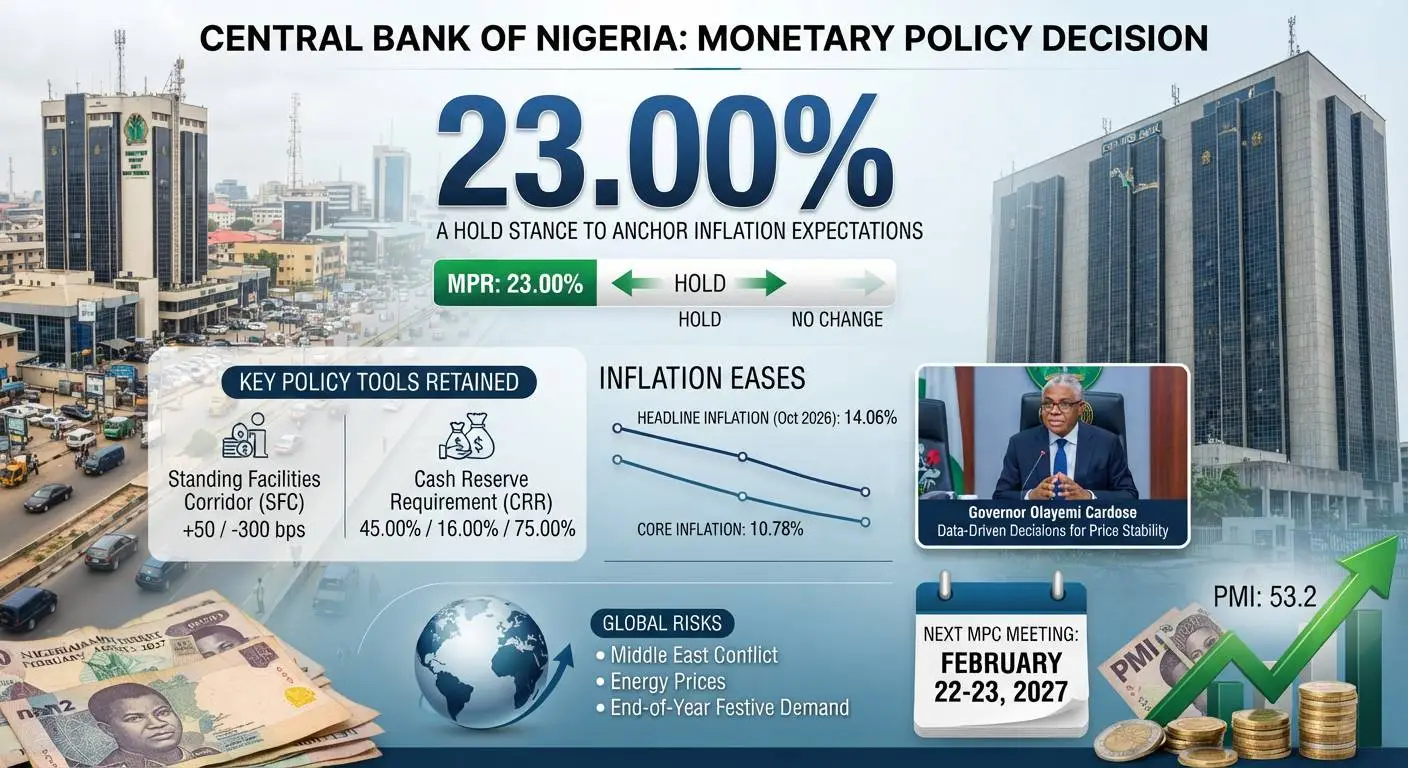
Nigeria's central bank kept its benchmark interest rate unchanged at 23.00 per cent on Tuesday, 24 November 2026, signalling that it intends to hold a tight policy stance while inflation continues to ease. According to the Central Bank of Nigeria's Monetary Policy Communique No.165, the ten members of the Monetary Policy Committee who attended the two-day meeting on 23 and 24 November judged that keeping the current settings would help anchor inflation expectations and support the disinflation process.
 Contents
A Hold Across All Policy Tools
The committee did not change any of its main tools. Alongside the 23.00 per cent Monetary Policy Rate (MPR, the benchmark rate the central bank charges banks), it retained the Standing Facilities Corridor at plus 50 and minus 300 basis points around the MPR. That corridor sets the rates at which banks can borrow from the central bank overnight or park surplus cash with it.
The Cash Reserve Requirement (CRR, the share of customer deposits banks must hold with the central bank rather than lend out) was also left in place. It stays at 45.00 per cent for deposit money banks, 16.00 per cent for merchant banks and 75.00 per cent for non-TSA public sector deposits. Keeping the CRR high limits how much of their deposits banks can push into lending, which is one way the committee keeps pressure on prices.
The committee said headline inflation had moderated for five consecutive months, reflecting sustained exchange rate stability and improved monetary policy transmission. It added, however, that prevailing headwinds had slowed the pace of that moderation, which is why members favoured holding the current stance rather than loosening it.
Inflation Eases Across Food and Core Measures
The communique set out the price data behind the decision. Headline inflation (the year-on-year change in the general price level) fell to 14.06 per cent in October 2026 from 14.63 per cent in September, with both food and core components contributing to the decline. Core inflation, which strips out volatile items such as food and energy, eased to 10.78 per cent from 12.95 per cent, driven mainly by housing, education services, and insurance and financial services.
The committee linked the core decline to its restrictive monetary policy stance and to sustained stability in the foreign exchange market. Food inflation slipped to 19.13 per cent from 19.59 per cent as prices of processed food and farm produce moderated following the start of the harvest season.
Activity data also pointed to expansion. The composite Purchasing Managers' Index (PMI, a survey-based gauge where readings above 50 indicate growth) rose to 53.2 index points in October from 53.0 in September, helped by improved activity in the industrial, agricultural and services sectors. Gross external reserves stood at US$54.02 billion as of 17 November 2026, enough to cover 10.26 months of imports of goods and services.
Risks the Committee Is Watching
The committee listed several upside risks to prices. It pointed to the ongoing Middle East conflict, which could sustain pressure on energy prices, and to anticipated spending from the end-of-year festive season and election-related activities, which could lift aggregate demand and push prices higher. It said it would remain data-dependent and vigilant in taking further appropriate measures.
On the external side, the committee said global growth is projected to moderate in 2026 before regaining momentum in 2027, reflecting elevated energy prices, persistent trade policy uncertainty and diminishing fiscal space. It said investment in artificial intelligence and other technology sectors is expected to partly offset those headwinds. Global price pressures are expected to intensify in 2026 but ease progressively in 2027, with risks tilted to the upside from energy and supply chain disruptions, cyber attack vulnerability, commodity and freight costs, and increasing global trade fragmentation.
The committee also welcomed a Memorandum of Understanding between the Central Bank of Nigeria and the Nigerian National Petroleum Company Limited. It said the agreement aims to enhance foreign exchange inflows, support energy project financing and improve macroeconomic stability, and that effective implementation would strengthen foreign exchange market liquidity, support further growth in external reserves and enhance investor confidence. Members also acknowledged improved remittance inflows and described the banking system as resilient, underpinned by adequate capital buffers and improved risk management, while encouraging the Bank to remain vigilant in its regulatory surveillance.
What the Committee Expects Next
The committee said the domestic outlook remains positive for the rest of 2026 and into 2027, supported by improved crude oil production and sustained expansion in agriculture, services and industry. It expects disinflation to be sustained over the short to medium term on the back of the restrictive policy stance, continued foreign exchange market stability and improved food supply, while flagging continued disruption to global energy supplies and adverse weather conditions as key risks.
For readers new to foreign exchange, the rate decision matters because a high benchmark rate can influence the return investors earn on naira-denominated assets relative to other currencies, which in turn can affect demand for the naira. The communique itself does not state any market reaction or exchange rate level, and it makes no forecast for the naira.
The communique was signed by Governor Olayemi Cardoso. The committee reaffirmed its commitment to closely monitor domestic and external developments and to keep future decisions data-driven and consistent with the objective of maintaining price stability. Its next meeting is scheduled for Monday, 22 and Tuesday, 23 February 2027.
Finally, WikiFX would like to remind everyone that before using any stock, futures, or forex brokers, remember to check the platform's regulatory information, trading environment, field inspection reports, user reviews, and overall rating on the WikiFX App. This will help you effectively avoid problematic scam platforms and rogue brokers, safeguarding your capital.

Disclaimer:
The views in this article only represent the author's personal views, and do not constitute investment advice on this platform. This platform does not guarantee the accuracy, completeness and timeliness of the information in the article, and will not be liable for any loss caused by the use of or reliance on the information in the article.
WikiFX Broker
Latest News
US stocks fall further as fears over AI intensify
WikiFXUS Dollar Price Forecast: Dollar Steadies Before PCE, DXY Holds 103.80 as EUR/USD, GBP/USD Stall Below Pivots
WikiFXS&P/ASX 200 Steady as Nvidia Reinstates Huang and Markets Rally
WikiFXEURUSD | Daily Bearish Structure and Potential Reversal Zone
WikiFXNaira Slips to N1,445 in Parallel Market as Election Jitters and Festive Demand Widen Dollar Gap
WikiFXInteractive Brokers Review 2026: Are Funding Issues and Trading Restrictions Raising Concerns?
WikiFXGoldman Sachs Sees More Dollar Strength Before a Modest 2027 Pullback
WikiFXMT5's AI Upgrade Is a Trading Tool, Not a Broker Safety Check
WikiFXLMAX Group Review: FCA-Regulated, but Clone Websites and Withdrawal Complaints Demand Caution
WikiFXNigeria's Central Bank Holds Rate at 23% and Pledges Data-Driven Path to Lower Inflation
WikiFX