

Global Broker Regulation Inquiry App
About WikiFX
English
简体中文
繁體中文
English
Pусский
日本語
ภาษาไทย
Tiếng Việt
Bahasa Indonesia
Español
हिन्दी
Filippiiniläinen
Français
Deutsch
Português
Türkçe
한국어
العربية
اردو



Currency Depreciation vs Free Fall: What Beginners Get Wrong

WikiFX
|


Abstract:A beginner-friendly explanation of how a normal currency depreciation differs from an exchange rate free fall, with a clear hypothetical calculation and common misunderstandings.

 Contents
What Currency Depreciation Actually Means
An exchange rate is the price of one currency expressed in another. For example, EURUSD tells you how many US dollars one euro buys. When a currency is floating, its exchange rate is set mostly by supply and demand in the foreign exchange market, not by a government announcement. Currency depreciation is a gradual, often orderly fall in that price over weeks or months. It usually reflects changing economic fundamentals such as a wider trade deficit, lower relative interest rates, or higher inflation in the country that issues the currency.
Depreciation is not the same as devaluation. Devaluation is a deliberate official decision to lower a fixed or managed exchange rate. Depreciation is a market outcome for a floating currency, so nobody needs to announce it. Businesses and traders may still plan around a slow depreciation because the decline is spread over time.
What Exchange Rate Free Fall Means
A free fall is a sharp, disorderly drop in an exchange rate over a very short period, often a few days or even hours. It usually reflects panic, sudden capital flight, a political shock, or a sudden loss of confidence in the currency. Capital flight means investors quickly move money out of a country because they fear losses. Free fall is not a slow shift in fundamentals; it is a crisis-like move.
The key differences from ordinary depreciation are speed and disorder. Prices can gap, meaning they jump from one level to another without trading at the levels in between. Liquidity can thin out, so there may be fewer buyers and sellers willing to trade at normal prices. Volatility, which measures how violently a price moves up and down, can spike to extreme levels. Think of depreciation as a long, gentle downhill walk and free fall as sliding down a steep cliff.
A Hypothetical Calculation: Slow Slide vs Sudden Drop
To see the difference in numbers, use the percentage change formula:
Percentage change = [(Ending rate - Starting rate) / Starting rate] × 100.
This is a purely hypothetical demonstration, not a forecast or a trading signal. For this illustration, assume a recent reference EURUSD level of 1.1555. In the first scenario, the price depreciates gradually to 1.1400 over 90 trading days. The calculation is:
(1.1400 - 1.1555) / 1.1555 = -0.0155 / 1.1555 = about -1.34%.
So the currency declined by 1.34% over 90 trading days.
In the second scenario, a free-fall episode pushes EURUSD from 1.1555 to 1.1000 in only 5 trading days. The calculation is:
(1.1000 - 1.1555) / 1.1555 = -0.0555 / 1.1555 = about -4.8%.
So the currency declined by 4.8% over 5 trading days. The free-fall drop is roughly 3.6 times larger in percentage terms, and it happens over a window that is 18 times shorter than the gradual scenario. The point is not the exact numbers; the point is the contrast in scale and speed.
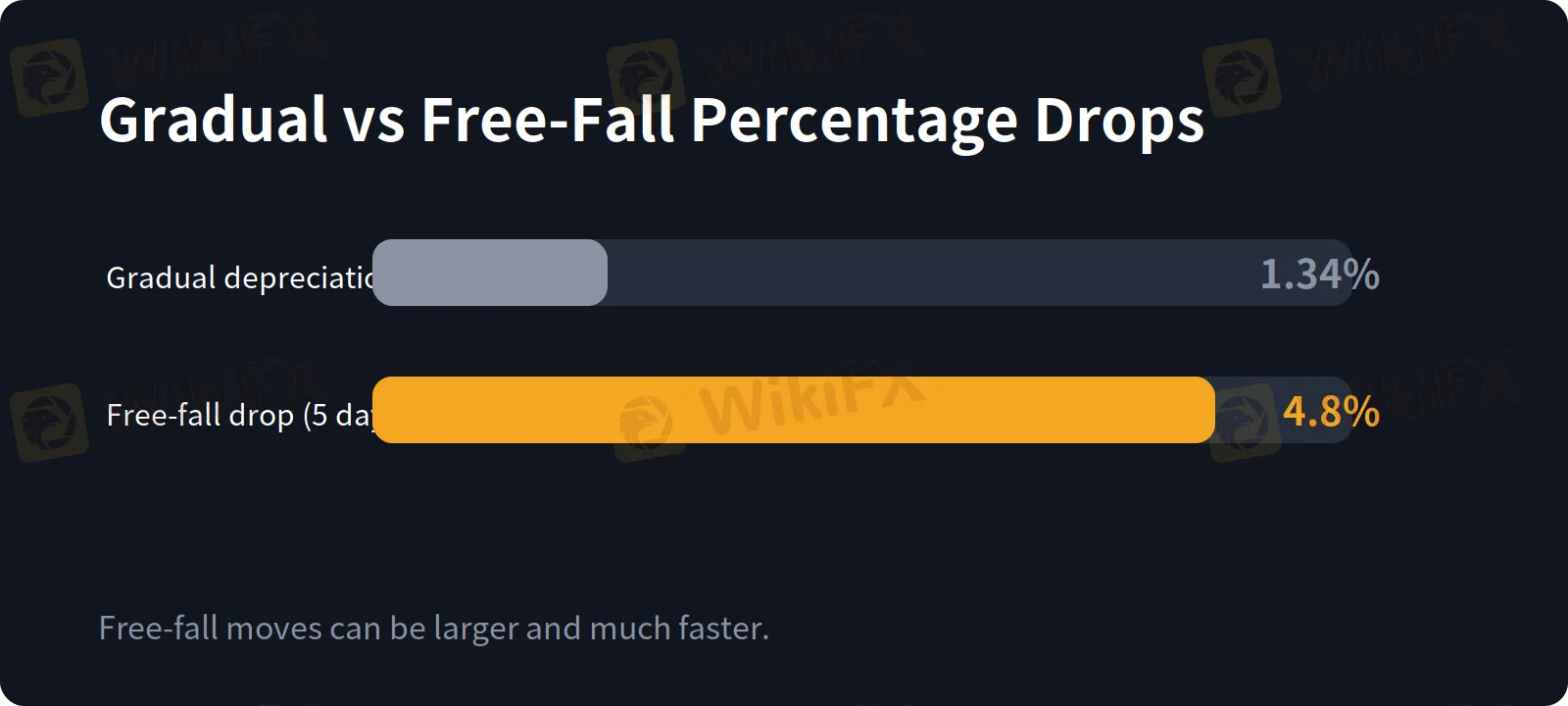
Hypothetical EURUSD percentage declines from a reference level of 1.1555 in two scenarios.
Common Beginner Misunderstandings
- They are the same thing, just with different names. This misses the difference in time frame and market psychology. Ordinary depreciation can be absorbed by traders and businesses over months. Free fall creates immediate uncertainty and can force emergency policy responses.
- A small daily percentage move cannot be a free fall. Free fall can include a series of extreme daily moves. What matters is the cumulative drop over days, not a single session. For example, a currency that falls 4.8% over five trading days may have its worst single-day drop at 1.5%, but the five-day move is still severe.
- If a currency has been depreciating for months, a free fall was predictable. Many free falls follow an orderly slide, but the trigger is often an unforeseen shock. A long gradual decline does not guarantee a crash. A crash can also happen without months of prior depreciation.
- Depreciation is always bad for the economy. A gradual depreciation can help exporters by making their goods cheaper for foreign buyers, though it also raises the cost of imported goods. A free fall is a different story. It is rarely viewed as helpful because it signals instability and can quickly feed inflation.
- Central banks always stop a free fall quickly. Sometimes intervention can slow a slide, but intervention may fail if foreign exchange reserves are limited or if confidence is gone. A free fall reflects deep selling pressure that policy tools may not be able to reverse immediately.
The practical lesson is not how to predict either move. The goal is to recognise the difference between an orderly market adjustment and a disorderly market event. That distinction shapes how analysts describe risk, and it helps beginners understand what they are reading.
Disclaimer:
The views in this article only represent the author's personal views, and do not constitute investment advice on this platform. This platform does not guarantee the accuracy, completeness and timeliness of the information in the article, and will not be liable for any loss caused by the use of or reliance on the information in the article.
WikiFX Broker
Latest News
VG Markets Review: A Real FSCA Licence, But Why Only a 4.47 Score?
WikiFXStoneX Agrees to Acquire Brazil FX Bank Banco Travelex
WikiFXReview 2026: GFS Withdrawal Complaints, Regulation Gaps, and Broker Risk Signals
WikiFXLQH Markets Review: Unregulated Broker With Growing Withdrawal Complaints
WikiFXExclusive Capital Review: Regulated by CySEC, but Traders Report Withdrawal Problems
WikiFXGold Climbs Toward $4,400 as September Fed Hike Odds Tumble
WikiFXNigeria's net FX flow falls 29% to $4.94bn in March
WikiFXTriumphFX Review: Revoked Licence and TFX Token Losses Warrant Caution
WikiFXWHITEFOREX Review: Is Your Deposit Safe?
WikiFXVonway Review: Withdrawal Complaints and a Regulator Warning
WikiFX