

Global Broker Regulation Inquiry App
About WikiFX
English
简体中文
繁體中文
English
Pусский
日本語
ภาษาไทย
Tiếng Việt
Bahasa Indonesia
Español
हिन्दी
Filippiiniläinen
Français
Deutsch
Português
Türkçe
한국어
العربية
اردو


admiral Review 2026: Is This Forex Broker Safe?

WikiFX
|


Abstract:admiral has a WikiFX Score of 7.52 and shows multiple regulatory entries, including regulated licenses under the UK FCA and Cyprus CYSEC, offshore regulation under the Seychelles FSA, and an unverified Australia ASIC record. However, regulatory disclosures and a notable volume of user complaints mean traders should approach this broker with caution.
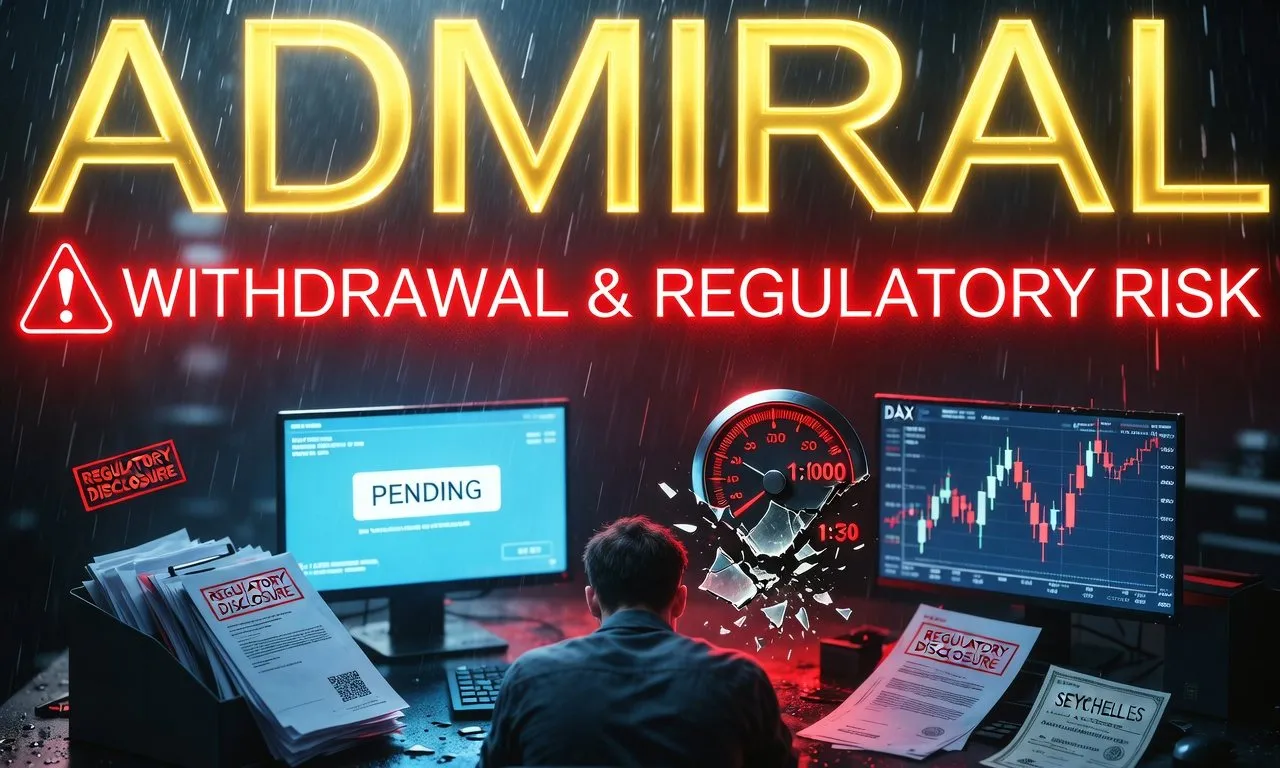
admiral is a forex and CFD broker established in 2001, with a WikiFX Score of 7.52 and an influence rating of A. The broker is listed with multiple regulatory records, including regulated status under the UK FCA and Cyprus CYSEC, offshore regulation under the Seychelles FSA, and an unverified Australia ASIC record. While the score and platform offering appear relatively strong, the broker also has regulatory disclosures and a high number of recent complaints, which are important risk factors for traders to consider.
 Contents
Pros and Cons of admiral
- ✅ WikiFX Score of 7.52 with an A influence rating.
- ✅ Regulated entries under the UK FCA and Cyprus CYSEC.
- ✅ Offers MT4, MT5, and a proprietary trading platform.
- ✅ Five account types are listed, including Zero.MT4, Trade.MT4, Zero.MT5, Trade.MT5, and Invest.MT5.
- ✅ Forex leverage is listed up to 1:1000, with index leverage up to 1:500.
- ✅ Spreads are listed from 0 on selected account types.
- ✅ Expert Advisor trading is allowed according to the provided data.
- ❌ Australia ASIC status is marked as unverified.
- ❌ Seychelles FSA status is offshore regulation.
- ❌ WikiFX records show 4 regulatory disclosure items.
- ❌ WikiFX reports 18 user complaints.
- ❌ User cases include withdrawal delays, profit-withholding allegations, account restrictions, and leverage changes.
- ❌ The reviewed platform setup lacks two-step login and biometric authentication according to the software data.
admiral Regulation and License Safety
admiral has a mixed regulatory profile. On one hand, the broker has regulated entries under the UK FCA and Cyprus CYSEC, which is a positive factor compared with brokers that have no verified regulatory records. On the other hand, the Australia ASIC entry is marked as unverified, and the Seychelles FSA license is identified as offshore regulation. This creates a profile that is not simply “safe” or “unsafe,” but one that requires careful entity-level checking before opening or funding an account.
UK FCA License
The UK FCA record lists Admiral Markets UK Ltd with license number 595450 and a regulatory status marked as regulated. This is one of the stronger points in the brokers profile because it indicates that at least one listed entity is under active regulatory supervision.
Cyprus CYSEC License
The Cyprus CYSEC record lists Admirals Europe Ltd with license number 201/13 and a regulated status. This adds another regulated entity to the brokers profile. However, traders should still confirm which legal entity they are registering with, because different entities may operate under different conditions and levels of oversight.
Seychelles FSA License
The Seychelles FSA record lists Admirals SC Ltd with license number SD073 and an offshore regulatory status. Offshore regulation is typically treated as a higher-risk category in broker reviews because the level of oversight may differ from stricter regulatory jurisdictions. Traders should pay attention to whether their account is opened under this offshore entity.
Australia ASIC Record
The Australia ASIC record is marked as unverified. The provided data also shows a different organization name under this record, which makes this entry a risk point rather than a clear regulatory advantage. Traders should not treat this as confirmed protection unless the license details are independently verified through official channels.
Regulatory Disclosures and Risk Notes
WikiFX lists 4 regulatory disclosure items related to admiral. The disclosures include warnings about unauthorized or blacklisted domains, investor alerts, and official-domain matching concerns. One CYSEC disclosure states that certain domains in a warning list do not belong to or are not authorized as Cyprus Investment Firms. Other disclosure entries refer to unauthorized entities or blacklisted websites.
Overall, admiral has regulated licenses, but the combination of offshore regulation, an unverified record, and regulatory disclosures means traders should verify the exact entity, domain, and license certificate before depositing funds.
Real User Feedback and Complaints
WikiFX reports that complaints about admiral reached 18 in the last 3 months. The cases provided show several recurring complaint themes: withdrawal issues, profit cancellation or withholding, account restrictions, leverage changes, and requests for additional payments before withdrawals.
One user reported that their professional status was removed without notification and leverage was reduced to 1:30. The user claimed this caused them to miss a DAX trading opportunity and resulted in a major loss across funded accounts.

Several users complained that withdrawal requests were not processed. In some cases, users said they were asked to pay taxes, withdrawal charges, conversion fees, insurance deposits, or additional deposits before funds could be released. One case stated that after repeated follow-ups, the support response stopped and the user was blocked on a messaging channel.
A cluster of complaints alleged that profitable accounts were reviewed, restricted, or placed into close-only mode, after which users were told they could withdraw only deposited funds but not profits. Some users claimed that admiral cited Terms and Conditions violations but did not provide sufficient evidence, according to their reports. Claimed withheld amounts in the cases include figures around 8,500 to 9,000 USD and one complaint specifically mentioned 9,021 USD.
Another complaint described a task-like payment process where the user deposited increasing amounts and then could not withdraw. While this case is included in the complaint data, traders should carefully distinguish between the licensed broker entity and any third-party or impersonation scheme, especially because the regulatory disclosures also refer to unauthorized domains and official-domain matching risks.
The overall feedback pattern is concerning. Even though admiral has regulated records, the complaint volume and repeated withdrawal/profit-withholding allegations should be taken seriously.
admiral Forex Trading Conditions and Fees
admiral offers forex, metals, cash index CFDs, energy CFDs, stock CFDs, ETF CFDs, bonds CFDs, agriculture CFDs, commodity futures, stocks, and ETFs depending on the account type. Cryptocurrency trading is not listed as available in the provided data.
Leverage
The maximum leverage is listed as 1:1000 for forex and 1:500 for indices. This is very high leverage, which can amplify both gains and losses. One user complaint also stated that leverage was reduced to 1:30 after professional status was removed, so traders should confirm the leverage terms attached to their account category and entity before trading.
Spreads
The listed main spreads vary by account type:
- Zero.MT4: from 0
- Trade.MT4: from 1.2
- Zero.MT5: from 0
- Trade.MT5: from 0.6
- Invest.MT5: from 0
Minimum trade size is listed as 0.01 for several trading accounts. Stop-out ratio is shown as 30.00 for the MT4 and MT5 trading accounts, while Invest.MT5 shows 0.00 in the provided data.
Account Types
admiral lists 5 account types: Zero.MT4, Trade.MT4, Zero.MT5, Trade.MT5, and Invest.MT5. Entry conditions vary by currency and account type. The Invest.MT5 account is focused on stocks and ETFs, while the MT4 and MT5 trading accounts cover forex and CFD instruments.
Platforms
admiral supports MT4, MT5, and a proprietary platform, with mobile access available on Android and iOS. The reviewed platform data describes MT5 as highly customizable, multilingual, and equipped with useful search and fee-reporting features. Traders can access the markets via the admiral login on MT4, MT5, or the proprietary mobile app, but the software data also notes that the setup lacks two-step login and biometric authentication, which weakens account-access security.
The platform experience is described as average, and the provided summary states that Windows, MacOS, Web, and other application support are not available.
Final Verdict
admiral is not a simple low-score broker: it has a WikiFX Score of 7.52, an A influence rating, multiple account types, MT4/MT5 support, and regulated entries under the UK FCA and Cyprus CYSEC. These are meaningful positives.
However, the risk side is also clear. The broker has an unverified Australia ASIC record, offshore Seychelles FSA regulation, 4 regulatory disclosure items, and a notable number of recent user complaints. The complaint data repeatedly refers to withdrawal problems, additional payment requests, profit removal, account restrictions, and unexplained T&C enforcement allegations.
For cautious traders, admiral may be worth reviewing only after verifying the exact licensed entity, checking whether the account is under a regulated or offshore entity, and confirming all withdrawal and trading terms in advance. The safest approach is to avoid funding any account until the regulatory certificate, official domain, and account conditions are fully confirmed.
To stay safe and view the latest regulatory certificates, check admiral on the WikiFX App.
Disclaimer:
The views in this article only represent the author's personal views, and do not constitute investment advice on this platform. This platform does not guarantee the accuracy, completeness and timeliness of the information in the article, and will not be liable for any loss caused by the use of or reliance on the information in the article.
WikiFX Broker
Latest News
Indias retail inflation jumps to 5.54% in September, above estimates
WikiFXFirst Light News: Chip Rout Rattles Equities as Q3 Earnings Season Kicks Off
WikiFXUS Dollar Price Forecast: DXY Eyes 102.49, Can EUR/USD Hold 1.1180 Ahead of CPI?
WikiFXED Files Charge Sheet in Nexa Evergreen Investment Case Involving Rs 2,676 Crore
WikiFXU.S. Dollar Pulls Back From Yearly Highs: Analysis For EUR/USD, GBP/USD, USD/CAD, USD/JPY
WikiFXNPBFX Broker Review: Regulated but Is It Safe for Traders?
WikiFXConsumer prices rose at 3.7% annual rate in September as gas costs skyrocket
WikiFXIndian Police Arrest Two in Alleged ₹10 Crore Crypto Investment Fraud
WikiFXScore Capital Markets Ltd 2026 Review: Gateway or Trap?
WikiFXCMC Markets Secures LSEG Data Deal to Accelerate Global Expansion
WikiFX