

Global Broker Regulation Inquiry App
About WikiFX
English
简体中文
繁體中文
English
Pусский
日本語
ภาษาไทย
Tiếng Việt
Bahasa Indonesia
Español
हिन्दी
Filippiiniläinen
Français
Deutsch
Português
Türkçe
한국어
العربية
اردو
Overcoming Profit Fear: Why Holding a Winning Trade Feels So Hard
Abstract:Beginner Forex traders often struggle with the psychological hurdle of closing winning trades too early while letting losing trades drag on. This article explains the behavioral economics behind this 'profit fear,' exploring concepts like loss aversion and the sunk cost fallacy, and provides practical steps to keep emotions out of trading decisions.
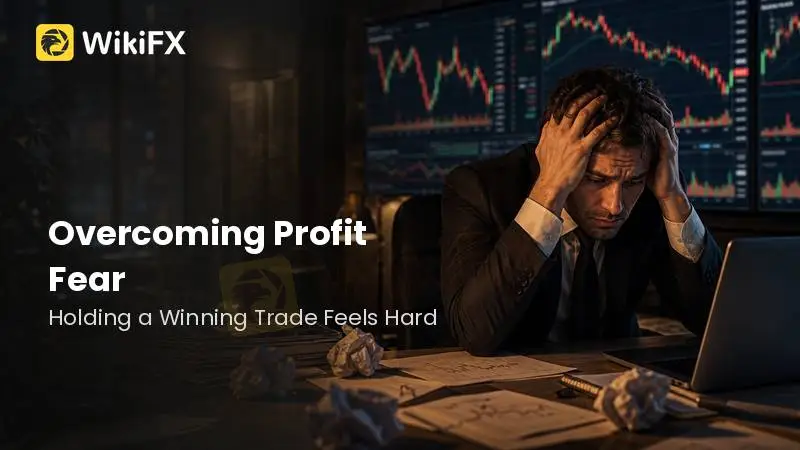
It is the most common confession from beginner Forex traders: “When my trade goes into profit, I get stressed and close it quickly. But when it goes into a deep loss, I can sit on it and hold it for days.”
Why does it feel so agonizing to hold a winning trade, yet so natural to tolerate a losing one? If you look at your trading history and find a dozen tiny wins wiped out by two massive losses, you are not alone. You have what is known as “profit fear,” and it is not just poor discipline—it is a deeply wired psychological trap.
 Contents
The Hidden Trap of Loss Aversion
In behavioral economics, there is a concept called “loss aversion.” Researchers have found that humans feel the pain of a loss much more intensely than the happiness of a gain.
When your Forex trade finally turns blue and shows a small profit, your brain does not naturally celebrate. Instead, it immediately starts worrying about losing that money. The fear of watching a winning trade reverse and turn back into a losing one creates intense anxiety. To relieve that stress, you close the position early. You secure a tiny profit, but you miss out on the larger, more meaningful market move.
You are not trading the market; you are trading your own fear of losing what you just gained.
The Sunk Cost Fallacy in Forex
So, why are we so patient when a trade is losing money? The answer lies in what economists call the “sunk cost fallacy.”
A sunk cost is an expense—whether it is money, time, or emotional energy—that has already been spent and cannot be recovered. In trading, once a position goes into the negative, beginners feel they have invested too much to just walk away.
This leads to “commitment bias.” Once we make a decision to buy or sell a currency pair, it becomes psychologically difficult to admit we were wrong. Instead of accepting firmness and taking a small $10 loss, we try to justify our bad entry. We stare at the chart, hoping that market sentiment will suddenly reverse in our favor. We dig our heels in deeper, refusing to accept the loss, and sometimes even deposit more money to hold off a margin call.
Separating Market Sentiment From Your Hopes
Market sentiment is the overall attitude of investors in the market—whether they are bullish (driving prices up) or bearish (driving prices down). It is driven by crowd psychology, fear, and greed.
The market does not care about your open position. Yet, when traders hold a losing trade, they start trying to predict market sentiment based on hope rather than facts. They begin to ignore their technical analysis. If you are holding a buy position but the moving averages and price action clearly show strong downward momentum, holding on will not change the market's direction. Group psychology will override your personal need for the trade to recover.
How to Stop Sabotaging Your Trades
Overcoming profit fear and the sunk cost fallacy requires a shift in how you manage your trades. Here is how you can break the cycle:
Set Your Limits Before You Enter
Always set a Stop Loss and a Take Profit before you execute a trade. Once the trade is live, emotions immediately take over. Set your boundaries while your mind is still clear and rational, and let the market hit one or the other.
Focus on Future Actions, Not Past Mistakes
If you are floating in a heavy loss, evaluate the chart practically. Ask yourself: “Knowing what the chart looks like right now, would I enter this same trade today?” If the answer is no, cut your loss. Do not hold a bad trade just because you are already in it.
Let Technical Indicators Do Their Job
If you use trendlines, moving averages, or support and resistance levels to analyze the market, you must trust them. If the market is still trending successfully toward your Take Profit and your indicators show no sign of reversal, sit on your hands. Trust your strategy over your anxiety.
Trading psychology relies heavily on managing your stress levels. The less stress you carry, the better your decisions will be. One straightforward way to remove unnecessary worry is to ensure you are trading on a legitimate platform. Before funding an account, take a moment to check your brokers regulatory status on the WikiFX app. Once you know your funds are secure and you are dealing with a transparent broker, you can focus 100% of your mental energy on managing your trades, cutting those losses short, and finally letting your profits run.

Disclaimer:
The views in this article only represent the author's personal views, and do not constitute investment advice on this platform. This platform does not guarantee the accuracy, completeness and timeliness of the information in the article, and will not be liable for any loss caused by the use of or reliance on the information in the article.
WikiFX Broker
Latest News
trading.com Review 2026: Regulation, MT5 Access, and Complaint Signals
 WikiFX
Behind The Screenshots: The Forex Success You See Online May Not Be Real
WikiFXThe NFP Gap Slippage: Why Your 1.1000 Stop Executed at 1.0950
WikiFXFBS Review 2026: Complaints, Withdrawals, and Risk Signals
WikiFXDollar Gains While Yen Finds Support
WikiFXDollar Advances on Middle East Conflict
WikiFXThe 3-Bullet Rule: How a Paper Card Stops Overtrading
WikiFXVALUTRADES Review 2026: Slippage Complaints, Regulation, and Safety Risks
WikiFXQuotex Review 2026: Official Warnings, Blocked Accounts, and High Risk
WikiFXAxim Trade Review: Withdrawal Alarms, Weak Regulation, and a Broker Risk Traders Cannot Ignore
WikiFX