

Global Broker Regulation Inquiry App
About WikiFX
English
简体中文
繁體中文
English
Pусский
日本語
ภาษาไทย
Tiếng Việt
Bahasa Indonesia
Español
हिन्दी
Filippiiniläinen
Français
Deutsch
Português
Türkçe
한국어
العربية
اردو



U.S.-Iran Framework Agreement Enters a Critical Stage


Abstract:【Chart 1: U.S. and Iran Illustration】The United States and Iran are intensifying negotiations over a framework agreement covering the reopening of the Strait of Hormuz and nuclear-related issues. Whil
【Chart 1: U.S. and Iran Illustration】
The United States and Iran are intensifying negotiations over a framework agreement covering the reopening of the Strait of Hormuz and nuclear-related issues. While both sides have reported progress, major differences remain, making the timing of a final agreement uncertain.
On May 24, President Donald Trump stated that the deal was “not yet fully finalized,” but said it could become a “good and appropriate agreement.” U.S. officials noted that Irans leadership would still need time to review and approve any proposal. Meanwhile, Tehran continues to take a firm stance, emphasizing that no final commitments have been made on nuclear matters and that the release of frozen Iranian assets remains a key demand.
The reopening of the Strait of Hormuz, a vital route for global energy shipments, is at the heart of the talks. Under the proposed framework, the U.S. would ease maritime restrictions on Iran, while Iran would fully reopen the strait and help maintain regional stability. However, disagreements persist over control of the waterway. Iran insists on retaining full authority over the strait, while the U.S. opposes any transit fees on international shipping.
Nuclear policy and frozen assets remain additional sticking points. Washington seeks long-term restrictions on Irans uranium enrichment activities, while Tehran favors a shorter suspension period and wants immediate access to part of its frozen funds. Neither side appears willing to compromise on these core issues, leaving the agreement vulnerable to collapse if negotiations stall.
The talks also face political challenges. U.S. lawmakers, including several Republican hawks, argue the deal could weaken pressure on Iran, while Israel has expressed concern that an agreement may allow Tehran to rebuild its regional influence. Gulf Arab states support greater energy security but remain cautious about Iran gaining additional leverage in the region.
Market Analysis
Despite signs of progress, key disagreements over the Strait of Hormuz, nuclear activities, and asset releases remain unresolved. As a result, geopolitical uncertainty is likely to continue influencing global markets.
In the near term, developments surrounding the Strait of Hormuz will be particularly important for oil prices and energy security. A successful agreement could ease supply concerns and reduce geopolitical risk premiums. Conversely, a breakdown in negotiations could reignite tensions, potentially driving higher energy prices and increasing volatility across global financial markets.
Investors should closely monitor upcoming negotiations, Irans leadership response, and reactions from regional powers, as these factors will likely shape market sentiment in the weeks ahead.
Gold Technical Analysis (H1)
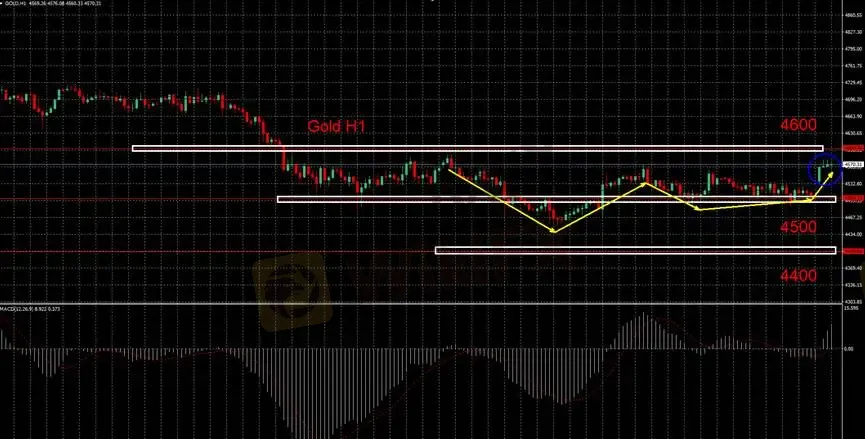
【Chart 2: Gold H1 Analysis】
Gold has rebounded above the 4,550 level, indicating that buying interest near 4,500 remains supportive. However, prices are now approaching the key resistance zone around 4,600, where sellers have recently been active.
MACD Analysis
The MACD histogram has turned positive and continues to expand, while the MACD and signal lines maintain a bullish crossover. This suggests improving short-term momentum and stronger market sentiment compared with recent sessions.
Nevertheless, the current move still appears to be a recovery rally rather than a confirmed trend reversal, meaning medium-term downside risks have not completely disappeared.
Analyst's View
The 4,600 level remains the key technical barrier. A successful breakout and sustained move above this level could pave the way for a test of 4,700.
On the downside, failure to break resistance may trigger another pullback toward the 4,500 support area.
Resistance: 4,600
Support: 4,500
Risk DisclaimerThe information provided above is for general market commentary only and does not constitute investment advice. Investors should assess risks independently and make trading decisions based on their own judgment. Please trade responsibly.
Disclaimer:
The views in this article only represent the author's personal views, and do not constitute investment advice on this platform. This platform does not guarantee the accuracy, completeness and timeliness of the information in the article, and will not be liable for any loss caused by the use of or reliance on the information in the article.
WikiFX Broker
Latest News
How Trading Costs Quietly Drain Your Account: Spreads, Swaps, and Pip Values
 WikiFX
Why MetaTrader 4 Remains the Top Choice for Testing Automated Trading Robots
WikiFXeFishery Founder Jailed Nine Years as KWAP Defends RM163 Million Loss
WikiFXGFS Review 2026: Withdrawal Complaints, MT5 Access, and Regulation Gaps
WikiFXLOYAL PRIMUS Review: FSCA-Regulated Broker Faces Mounting Withdrawal Complaints
WikiFXDollar Firms as Geopolitics Pressures Asian Currencies
WikiFXKASPER CAPITAL MARKETS Review 2026: Regulation, Safety, and User Feedback
WikiFXThings About HTFX Broker That You Don't Know About
WikiFXWhy Most Retail Traders Fail: What the Numbers Reveal
WikiFX22K Trader Review 2026: Ongoing User Allegations Raise Fresh Questions About Trust
WikiFX