HTFX Moves to Exit the UK as More Brokers Step Back From FCA Licences
HTFX’s withdrawal from the United Kingdom comes amid a broader wave of brokerage firms reassessing the value of maintaining FCA licences.
简体中文
繁體中文
English
Pусский
日本語
ภาษาไทย
Tiếng Việt
Bahasa Indonesia
Español
हिन्दी
Filippiiniläinen
Français
Deutsch
Português
Türkçe
한국어
العربية
Abstract:NZD/USD leads G10 gainers while snapping seven-day downtrend around 16-month low.
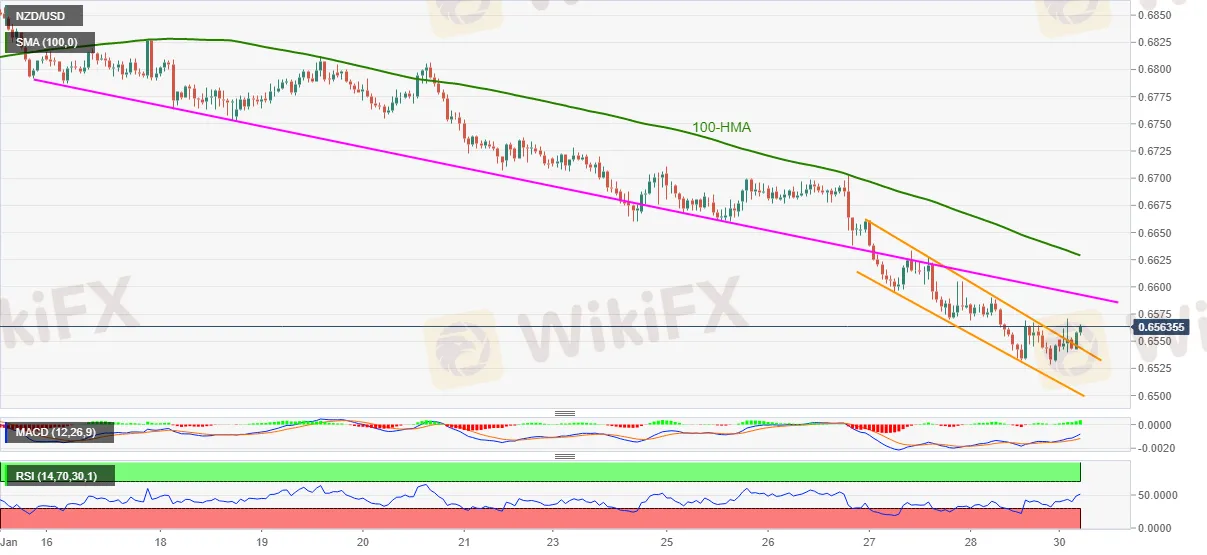
Bullish MACD signals back descending trend channel breakout to underpin corrective pullback.
Previous support line from mid-January, 100-HMA restricts nearby advances.
NZD/USD takes the bids to refresh intraday high around 0.6562, up 0.26% on a day while consolidating the recent losses around multi-day low during early Monday.
The pairs recent corrective pullback takes clues from a clear upside break of a three-day-old descending trend channel, as well as the firmer MACD signals.
Even so, the previous support line from January 14, around 0.6595, precedes the 100-HMA level of 0.6628, challenging the NZD/USD bulls.
On the contrary, pullback moves may initially aim for the stated channels upper line, near 0.6545, before eyeing the recent multi-day bottom of 0.6532.
Also likely to challenge the NZD/USD bears is the channels support line and the 50% Fibonacci retracement (Fibo.) of March 2020 to February 2021 upside, respectively around 0.6500 and 0.6465.
NZD/USD: Hourly chart

Disclaimer:
The views in this article only represent the author's personal views, and do not constitute investment advice on this platform. This platform does not guarantee the accuracy, completeness and timeliness of the information in the article, and will not be liable for any loss caused by the use of or reliance on the information in the article.


HTFX’s withdrawal from the United Kingdom comes amid a broader wave of brokerage firms reassessing the value of maintaining FCA licences.

Retail forex and CFDs broker GMI has brought its long-running brokerage business to an end, marking the close of roughly 16 years of operations.

When traders ask, "Is Pepperstone safe or a scam?" they are dealing with a basic problem in the trading world. On one side, Pepperstone is a well-known broker globally, with licenses from some of the strictest financial regulators. On the other side, ongoing user complaints raise serious questions about how reliable it is. Answering this question needs more than just a simple "yes" or "no." It requires a careful look at the evidence. This article works as an investigative report, designed to break down the puzzle of Pepperstone's reputation. We will go beyond marketing claims and look at objective, checkable data taken directly from WikiFX, a global broker regulation inquiry platform. By looking at its regulatory status, client protection measures, and most importantly, the patterns found within 29 documented user complaints, we aim to provide a clear view of Pepperstone's trustworthiness. Our goal is not to make a final judgment, but to give you the data needed to make your own inform

PINAKINE Liquidity has been in the news for alleged forex trading discrepancies recently. These include the lack of deposit credit into the platform and the poor response from the customer support official. All these have allegedly led to a fund scam. The overall report for the broker is not encouraging either. The broker manages a very poor trust score of 1.22 out of 10 from WikiFX, a leading forex broker regulation inquiry app. In this PINAKINE review article, we have investigated the company profile, trading conditions, user reports and more. Let’s read on!