

Broker Globale Piattaforma di Verifica Regolamentare
WikiFX
Italiano
简体中文
繁體中文
English
Pусский
日本語
ภาษาไทย
Tiếng Việt
Bahasa Indonesia
Español
हिन्दी
Filippiiniläinen
Français
Deutsch
Português
Türkçe
한국어
العربية
اردو


FXT Financial Focus (Asia-Pacific 08/20)AI Demand Boosts U.S. Clean Energy


Sommario:The U.S. clean energy market is seeing policy tightening and capacity expansion unfold at the same time. New clean energy installations in the United States are still expected to reach a record 45 gig
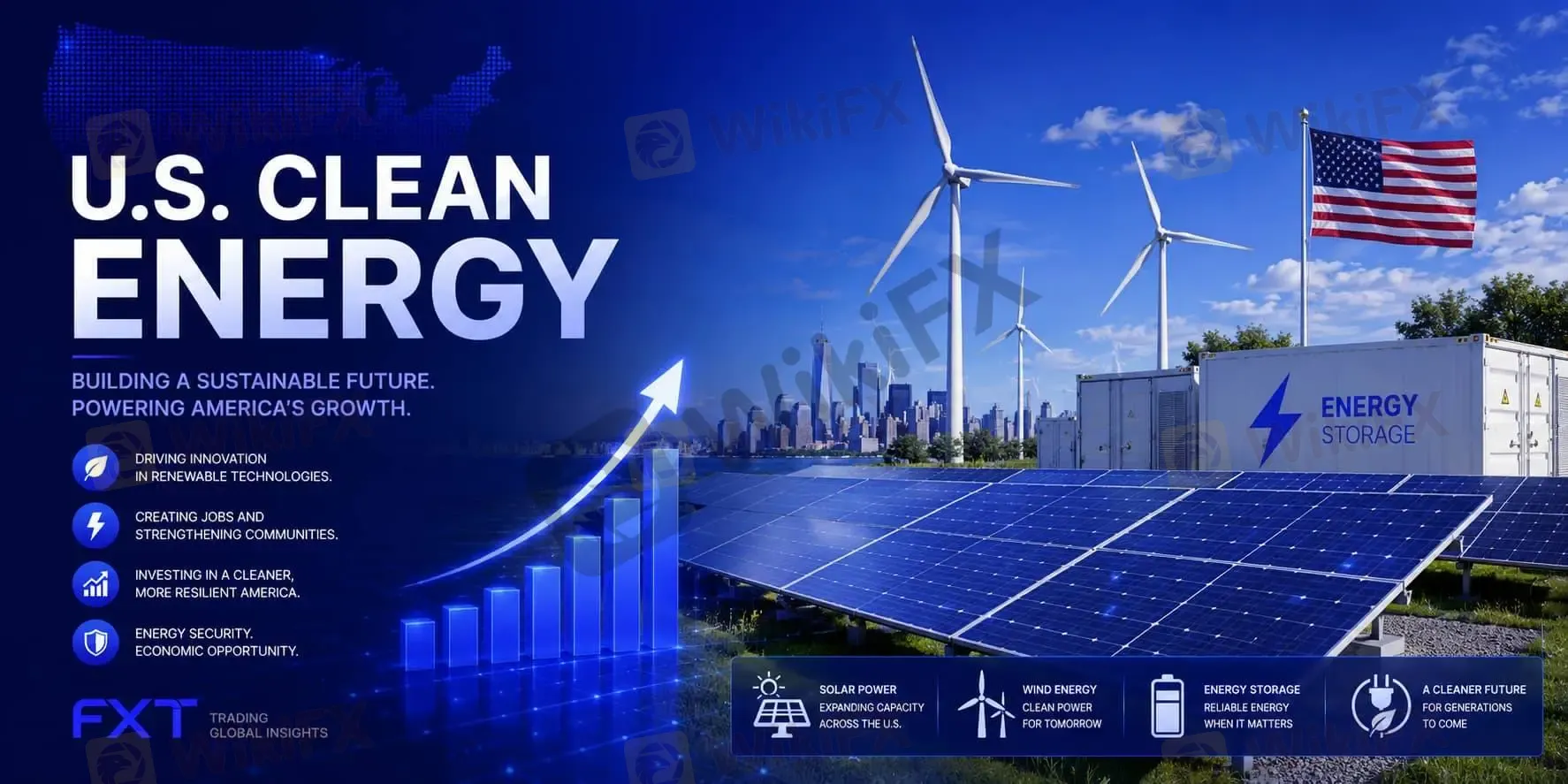
The U.S. clean energy market is seeing policy tightening and capacity expansion unfold at the same time. New clean energy installations in the United States are still expected to reach a record 45 gigawatts this year, around 25% above the previous record set in 2024. This suggests that beyond government policy, rapidly rising electricity demand is becoming an increasingly important driver of industry growth.
Artificial intelligence data centers are one of the main sources of new demand. ICF estimates that U.S. electricity consumption could increase by 39% by 2035, driven by data center expansion, transportation electrification, and higher household power consumption. As the electricity supply gap widens rapidly, solar and wind have the advantage of relatively short construction timelines, typically taking less than two years to complete, while natural gas projects often require at least three years. As a result, clean energy remains an important option for adding power supply capacity in the near term.
The Trump administration has already reduced some tax incentives for solar and wind projects, although transitional provisions continue to provide some projects with a window of opportunity. To meet construction-start and completion requirements before the incentives expire, companies are accelerating investment and project development. S&P Global expects new U.S. solar installations to increase by nearly one-third this year, while wind capacity additions could rise by around 50%, meaning tighter policies have instead triggered a noticeable short-term rush to install new capacity.
The levelized cost of electricity for newly built solar and wind projects currently stands at approximately $38 and $37 per megawatt-hour, respectively, below the roughly $48 per megawatt-hour cost of natural gas generation. Although these figures do not fully account for energy storage and grid upgrade costs, renewable energy still benefits from shorter construction timelines and relatively lower costs at a time when new electricity demand is growing rapidly. As the withdrawal of some subsidies could push electricity prices higher, developers may also gain some support for future profit margins.
Rising traditional energy prices have further reinforced this trend. After the Trump administration's actions against Iran pushed global energy prices higher, businesses and households began placing greater emphasis on energy costs and supply reliability. In the second quarter of 2026, U.S. household investment in residential solar, battery storage, and zero-emission vehicles increased by 45% quarter-on-quarter and 21% year-on-year. In states such as Florida, where extreme weather risks are relatively high, household demand for energy storage is also increasing, with clean energy increasingly being used not only to reduce costs but also to ensure reliable power supply.
However, policy obstacles have not disappeared. The Trump administration continues to restrict some wind and solar projects, although courts have constrained certain administrative measures, while developers are increasingly promoting project approvals from the perspectives of electricity supply, data center demand, and energy security. As the U.S. electricity supply gap widens, the government's approach to individual projects may become more pragmatic, particularly toward solar-plus-storage projects that can be brought online quickly.
From FXTRADING's perspective, the U.S. clean energy sector is likely to remain caught between policy tightening and expanding demand. Electricity demand driven by artificial intelligence, the longer construction timelines of conventional power generation, and volatility in energy prices will continue to support investment in solar, wind, energy storage, and power grids. If transmission networks and energy storage infrastructure fail to keep pace, however, electricity supply bottlenecks could still become a major constraint on the further expansion of data centers and other energy-intensive industries, even if new clean energy installations continue to reach record highs.

(For more insights into global macroeconomic trends and market developments, please follow FXTRADINGs official updates. This information is provided for reference only and does not constitute any form of investment advice.)
Disclaimer:
Le opinioni di questo articolo rappresentano solo le opinioni personali dell’autore e non costituiscono consulenza in materia di investimenti per questa piattaforma. La piattaforma non garantisce l’accuratezza, la completezza e la tempestività delle informazioni relative all’articolo, né è responsabile delle perdite causate dall’uso o dall’affidamento delle informazioni relative all’articolo.
WikiFX Trader
Exness
Sotto supervisione
FOREX.com
Supervisione del paese
vantage
Sotto supervisione
STARTRADER
Sotto supervisione
SBCFX
Sotto supervisione
GTCFX
Sotto supervisione
Exness
Sotto supervisione
FOREX.com
Supervisione del paese
vantage
Sotto supervisione
STARTRADER
Sotto supervisione
SBCFX
Sotto supervisione
GTCFX
Sotto supervisione
