

Broker Globale Piattaforma di Verifica Regolamentare
WikiFX
Italiano
简体中文
繁體中文
English
Pусский
日本語
ภาษาไทย
Tiếng Việt
Bahasa Indonesia
Español
हिन्दी
Filippiiniläinen
Français
Deutsch
Português
Türkçe
한국어
العربية
اردو
Is the U.S.–Iran Deal Real or Just Market Speculation?
Sommario:[Chart 1: Illustration of Donald Trump]Former President Donald Trump has claimed that U.S.–Iran negotiations are “close to reaching an agreement,” with core terms reportedly including Irans permanent
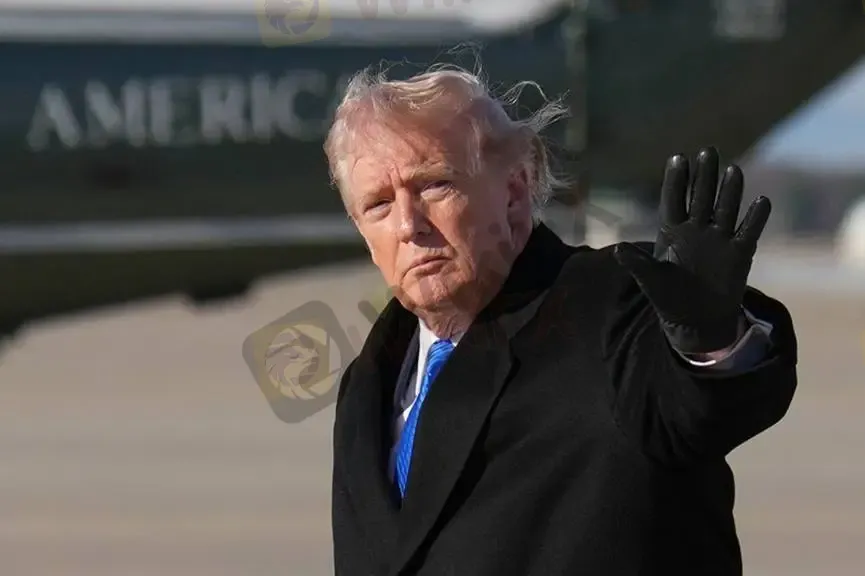
[Chart 1: Illustration of Donald Trump]
Former President Donald Trump has claimed that U.S.–Iran negotiations are “close to reaching an agreement,” with core terms reportedly including Irans permanent abandonment of nuclear weapons and domestic uranium enrichment. However, the proposed peace framework carries a distinctly transactional undertone. Reports suggest Washington has presented Gulf allies with a “war settlement bill,” seeking up to $2.5 trillion to offset military expenditures in exchange for de-escalation.
Meanwhile, approximately 3,000 troops from the 82nd Airborne Division remain deployed in the Middle East as a rapid-response force, reinforcing a strategy best described as “negotiating with a loaded weapon.”
Despite earlier official denials, recent reports confirm that Iran has begun imposing transit fees of up to $2 million per voyage on passing vessels, with some ships already complying. At the same time, QatarEnergy has declared force majeure on LNG deliveries to European and South Korean clients due to infrastructure damage. This marks a critical shift: Iran has effectively transformed control of the Strait into a monetized economic lever, forcing the global energy supply chain to absorb a geopolitical risk premium.
Market expectations for a March 31 ceasefire are rising sharply. Unusual insider positioning on Polymarket suggests capital is increasingly betting on a diplomatic breakthrough. However, internal Iranian concerns over a potential “negotiation trap,” combined with Israels commitment to “full-force” strikes, underscore the fragility of any short-term truce.
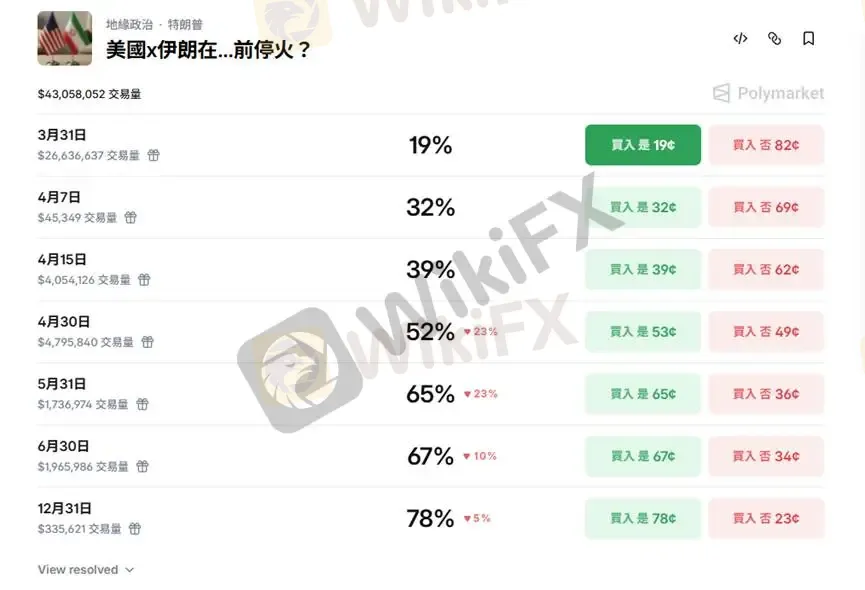
[Chart 2: Polymarket Prediction Chart]
This situation reflects a broader restructuring of the global energy order, driven by Trumps negotiation strategy and anchored in high-cost geopolitical guarantees. Should the $2.5 trillion funding package and a proposed 15-point agreement be finalized in Islamabad, markets may see a temporary stabilization. Conversely, a breakdown in negotiations could signal the entry of U.S. ground forces, escalating into a significantly larger-scale conflict.
Gold Analysis
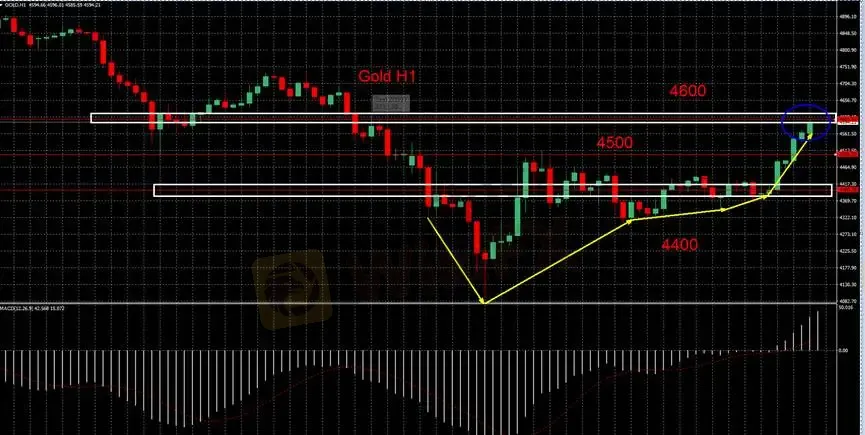
[Chart 3: Gold H1 (1-Hour) Chart]
From the H1 candlestick perspective, gold experienced a sharp sell-off on March 23, briefly touching the 4,130 level before staging a strong V-shaped recovery. Prices have since broken through the key psychological levels of 4,400 and 4,500, and are currently testing resistance near 4,600 as of early March 25.
The MACD indicator shows a clear bullish shift. The histogram has turned positive and continues to expand, while the DIF and DEA lines have formed a bullish crossover below the zero line and are accelerating upward. This suggests that bearish momentum has been fully exhausted, with bullish forces entering a strong expansion phase.
If the MACD lines successfully break above the zero axis, gold is likely to transition from a short-term rebound into a sustained uptrend, with 4,600 as the immediate resistance target.
Trading Strategy
A buy-on-dip approach is recommended, combined with profit-taking at higher levels:
Entry: Consider light long positions if price retraces to the 4,500–4,520 range, provided the MACD histogram remains strong
Stop-loss: Set below 4,440
Take-profit (TP1): 4,600
If price fails to break above 4,600 and the MACD shows a bearish crossover at elevated levels, or if confirmed news emerges that the U.S. and Iran have finalized the 15-point agreement, a short reversal strategy should be considered, targeting downside support near 4,350.
Risk Disclaimer
The above analysis, opinions, and market commentary are provided for general informational purposes only and do not represent the official position of this platform. All investors should conduct their own due diligence and assume full responsibility for any trading decisions. Trade cautiously.
Disclaimer:
Le opinioni di questo articolo rappresentano solo le opinioni personali dell’autore e non costituiscono consulenza in materia di investimenti per questa piattaforma. La piattaforma non garantisce l’accuratezza, la completezza e la tempestività delle informazioni relative all’articolo, né è responsabile delle perdite causate dall’uso o dall’affidamento delle informazioni relative all’articolo.
WikiFX Trader
FXTM
Sotto supervisione
JustMarkets
Sotto supervisione
FXCM
Sotto supervisione
HFM
Sotto supervisione
IC Markets Global
Sotto supervisione
Exness
Sotto supervisione
FXTM
Sotto supervisione
JustMarkets
Sotto supervisione
FXCM
Sotto supervisione
HFM
Sotto supervisione
IC Markets Global
Sotto supervisione
Exness
Sotto supervisione
WikiFX Trader
FXTM
Sotto supervisione
JustMarkets
Sotto supervisione
FXCM
Sotto supervisione
HFM
Sotto supervisione
IC Markets Global
Sotto supervisione
Exness
Sotto supervisione
FXTM
Sotto supervisione
JustMarkets
Sotto supervisione
FXCM
Sotto supervisione
HFM
Sotto supervisione
IC Markets Global
Sotto supervisione
Exness
Sotto supervisione
Rate Calc
USD

CNY
Tasso di cambio attuale:0
inserisci l'importo
USD
A disposizione
CNY
Calcolare 