

Applicazione di richiesta di informazioni sulla regolamentazione dei broker globali
WikiFX
English
简体中文
繁體中文
English
Pусский
日本語
ภาษาไทย
Tiếng Việt
Bahasa Indonesia
Español
हिन्दी
Filippiiniläinen
Français
Deutsch
Português
Türkçe
한국어
العربية
Iran’s New Supreme Leader Takes Power, Signaling a Hardline Stance
Sommario:[Figure 1: Illustration of Irans New Leadership]Iran has officially confirmed Mojtaba Khamenei as the countrys new Supreme Leader, and his first public statement signals an extremely hardline stance.

[Figure 1: Illustration of Irans New Leadership]
Iran has officially confirmed Mojtaba Khamenei as the countrys new Supreme Leader, and his first public statement signals an extremely hardline stance. At the same time, the U.S. aircraft carrier USS Gerald R. Ford, a core asset involved in regional operations, reportedly experienced an onboard fire. Combined with congressional leaks revealing that President Trumps war plan lacks clear strategic direction, the situation has pushed the conflict into both military and political turmoil.
Irans newly appointed Supreme Leader Mojtaba Khamenei released his first international statement following his appointment, effectively shattering market expectations that a leadership transition might create room for negotiations.
Key points from the statement include:
Continued blockade: Iran declared that the Strait of Hormuz will remain closed, with Iran maintaining full control over maritime access.
Ultimatum: All U.S. military bases in the Middle East must immediately shut down and withdraw. Failure to comply will result in sustained attacks.
New frontlines and advanced weaponry: Iran claimed it possesses a new generation of advanced missile systems not yet deployed, capable of sustaining high-intensity warfare for more than six months. Iran also confirmed a precision strike on the U.S. Fifth Fleet base in Bahrain.
Leaked intelligence briefings from the U.S. Congress have exposed the strategic weaknesses behind the Trump administration‘s rhetoric of “unlimited ammunition.” The military campaign appears to lack a defined end goal. It neither aims for the complete destruction of Iran’s nuclear infrastructure nor includes a comprehensive plan for regime change. This “strike first, plan later” approach risks pushing the conflict into a prolonged and inefficient war of attrition.
Meanwhile, vague guidance from the U.S. Treasury and Department of Energy regarding maritime escort timelines—reportedly extending toward the end of March—suggests that the global oil market may face at least two weeks of insurance coverage gaps for shipping routes. This development is likely to further intensify global inflationary pressure and strain supply chains.
Trumps trade threats toward European allies—particularly Spain and Italy—are also pushing NATO toward internal division, a geopolitical outcome that Iran and its potential allies would likely welcome.
Financial markets have now entered a phase of “asymmetric warfare pricing.”
Gold and the U.S. dollar: As ultimate hedges against the uncertainty surrounding Mojtabas leadership, safe-haven premiums are expected to expand further into late March.
Energy supply restructuring: With naval escorts in the Strait delayed, alternative shipping routes via the Red Sea from Saudi Arabia, along with potential G7 strategic reserve releases, may serve as the only short-term pressure valves for oil prices.
Defense technology: Market focus is shifting from heavy military hardware toward counter-drone systems and anti-interference communication technologies.
Mojtabas succession represents not only a shift in Irans internal power structure but also a direct challenge to the post-war international order. The Middle East now appears to be sliding rapidly into a geopolitical abyss with no predictable end. As of March 2026, global markets remain on edge, bracing for the next wave of escalation.
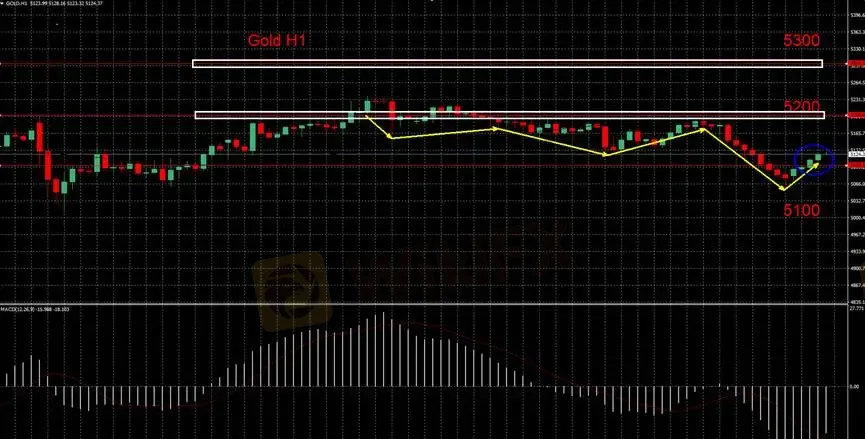
[Figure 2: Gold H1 Hourly Technical Chart]
Golds H1 (hourly) price action remains within a consolidation range, fluctuating between 5100 and 5200. After recently breaking below the 5150 level, prices declined to around 5100, where support emerged and triggered a technical rebound. Gold has since recovered toward the 5120–5130 range, suggesting that short-term buyers are beginning to accumulate positions at lower levels. However, the overall structure remains in the lower portion of the trading range.
Market participants should closely monitor the 5150–5200 resistance zone.
If the rebound fails to break above 5200, gold may retest the 5100 support level.
Conversely, if prices regain stability above 5150 and break through 5200, the market may initiate a broader rebound toward the 5230–5300 resistance zone.
Overall, unless gold decisively breaks above 5200, the short-term outlook remains range-bound with a slightly bearish bias.
Risk Disclaimer:
The views, analysis, research, price information, or other data presented above are provided for general market commentary only and do not represent the official position of this platform. Any individual who relies on this information assumes all associated risks. Please trade cautiously.
Disclaimer:
Le opinioni di questo articolo rappresentano solo le opinioni personali dell’autore e non costituiscono consulenza in materia di investimenti per questa piattaforma. La piattaforma non garantisce l’accuratezza, la completezza e la tempestività delle informazioni relative all’articolo, né è responsabile delle perdite causate dall’uso o dall’affidamento delle informazioni relative all’articolo.
WikiFX Trader
ZFX
Sotto supervisione
FXTM
Sotto supervisione
FOREX.com
Supervisione del paese
VT Markets
Sotto supervisione
HFM
Sotto supervisione
IC Markets Global
Sotto supervisione
ZFX
Sotto supervisione
FXTM
Sotto supervisione
FOREX.com
Supervisione del paese
VT Markets
Sotto supervisione
HFM
Sotto supervisione
IC Markets Global
Sotto supervisione
WikiFX Trader
ZFX
Sotto supervisione
FXTM
Sotto supervisione
FOREX.com
Supervisione del paese
VT Markets
Sotto supervisione
HFM
Sotto supervisione
IC Markets Global
Sotto supervisione
ZFX
Sotto supervisione
FXTM
Sotto supervisione
FOREX.com
Supervisione del paese
VT Markets
Sotto supervisione
HFM
Sotto supervisione
IC Markets Global
Sotto supervisione
Rate Calc
USD

CNY
Tasso di cambio attuale:0
inserisci l'importo
USD
A disposizione
CNY
Calcolare 