

عالمی بروکر ریگولیشن چیک کرنے والا ایپ
WikiFX
اردو
简体中文
繁體中文
English
Pусский
日本語
ภาษาไทย
Tiếng Việt
Bahasa Indonesia
Español
हिन्दी
Filippiiniläinen
Français
Deutsch
Português
Türkçe
한국어
العربية
اردو


When Spreads Explode: A Beginner's Guide to Liquidity Shocks

WikiFX
|


خلاصہ۔:A liquidity shock can turn a carefully placed stop-loss into a much costlier exit. This beginner guide explains spread, slippage and gaps with a simple EURUSD example, so readers can see where the extra risk really comes from.

 فہرست
فہرستWhat a Liquidity Shock Actually Is
The foreign exchange (forex) market is known for being deep and open around the clock. New traders often imagine a smooth flow of buy and sell prices, with orders filled instantly. That picture is incomplete. Liquidity measures how easily a market can absorb orders without moving price by a lot. A liquidity shock happens when many participants stop quoting tradable prices at the same time, often after a surprise news event, a central bank announcement, or pressure in another market. The waiting orders thin out quickly.
A liquidity shock is not the same as volatility. Volatility measures how much price moves; liquidity measures how cheaply it moves. In a shock, price can jump a large distance with very few trades in between. Every order a trader sends must be matched with a willing counterparty, meaning another trader or institution ready to take the other side. When counterparties disappear, execution becomes expensive.
Spread, Slippage, and Gaps: the Three Execution Costs
In forex, the spread is the difference between the bid price, at which a dealer is willing to buy, and the ask price, at which a dealer is willing to sell. It is the first cost of entering or exiting a trade. In calm conditions, the spread on a major pair is often less than one pip. A pip is the standard small price move in most currency pairs, usually the fourth decimal place. During a liquidity shock, dealers protect themselves by widening the spread, sometimes by dozens of pips.
Slippage is the difference between the price a trader expects to receive and the price the order actually gets. A stop-loss is an instruction a trader can attach to a position so that it closes automatically if price reaches a level set in advance. In practice, a stop-loss order becomes a market order once price reaches that level. A market order is an order to buy or sell at the next available price, not at a price chosen in advance. In a normal market, the next available trade is usually close to the stop price. In a liquidity shock, it can be far away. A gap is the empty price space between the last traded price and the next price at which trading resumes.
- Spread grows, so the cost of entering and exiting becomes harder to predict.
- Slippage can appear, because a stop triggers at a level where no one is willing to trade.
- Gaps can skip over protective levels, so the actual fill can be worse than the stop price.
- Margin pressure builds, because losses can be larger than planned. Margin is the funds set aside to keep a position open. If losses reduce the account, a margin call can occur when those funds fall below the required level.
In a shock, the usual chain runs through four stages: dealers pull quotes, spreads widen, stops trigger late, and margin pressure builds.
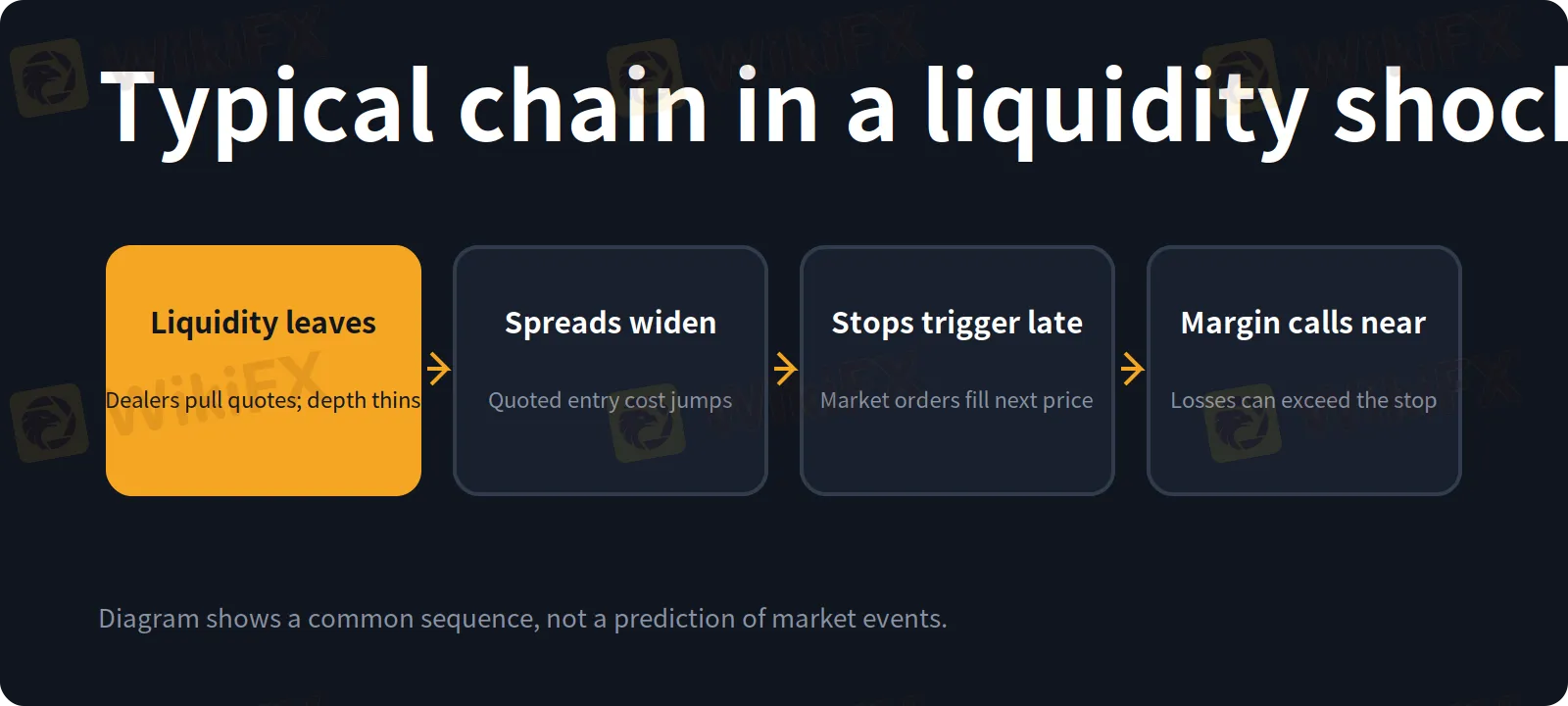
A typical chain of events in a liquidity shock.
A Hypothetical Calculation With EURUSD
Let us make the chain concrete with an explicitly hypothetical teaching example. Suppose EURUSD is trading at 1.1593 in calm conditions, and a trader places a stop-loss at 1.1543 on one standard lot. One standard lot in forex is usually a contract of 100,000 units of the base currency, the first currency in the pair. Because the pair is EURUSD, a 0.0001 move equals $10 on one lot.
If price falls normally to 1.1543, the stop is filled near that level. The loss is (1.1593 - 1.1543) x 100,000 = $500. That is the amount the trader planned to risk. Now suppose an overnight event leaves almost no liquidity and price gaps down to 1.1513 before trading resumes. The stop is now a market order, and the first available trade is near 1.1513. The actual loss is (1.1593 - 1.1513) x 100,000 = $800.
This is a classroom calculation, not advice to open any trade, enter at 1.1593, or place a stop at 1.1543. The point is general: when a gap takes price beyond the stop, the extra $300 is not a broker trick. It is market reality: no buyer or seller was available at the price the trader wanted.
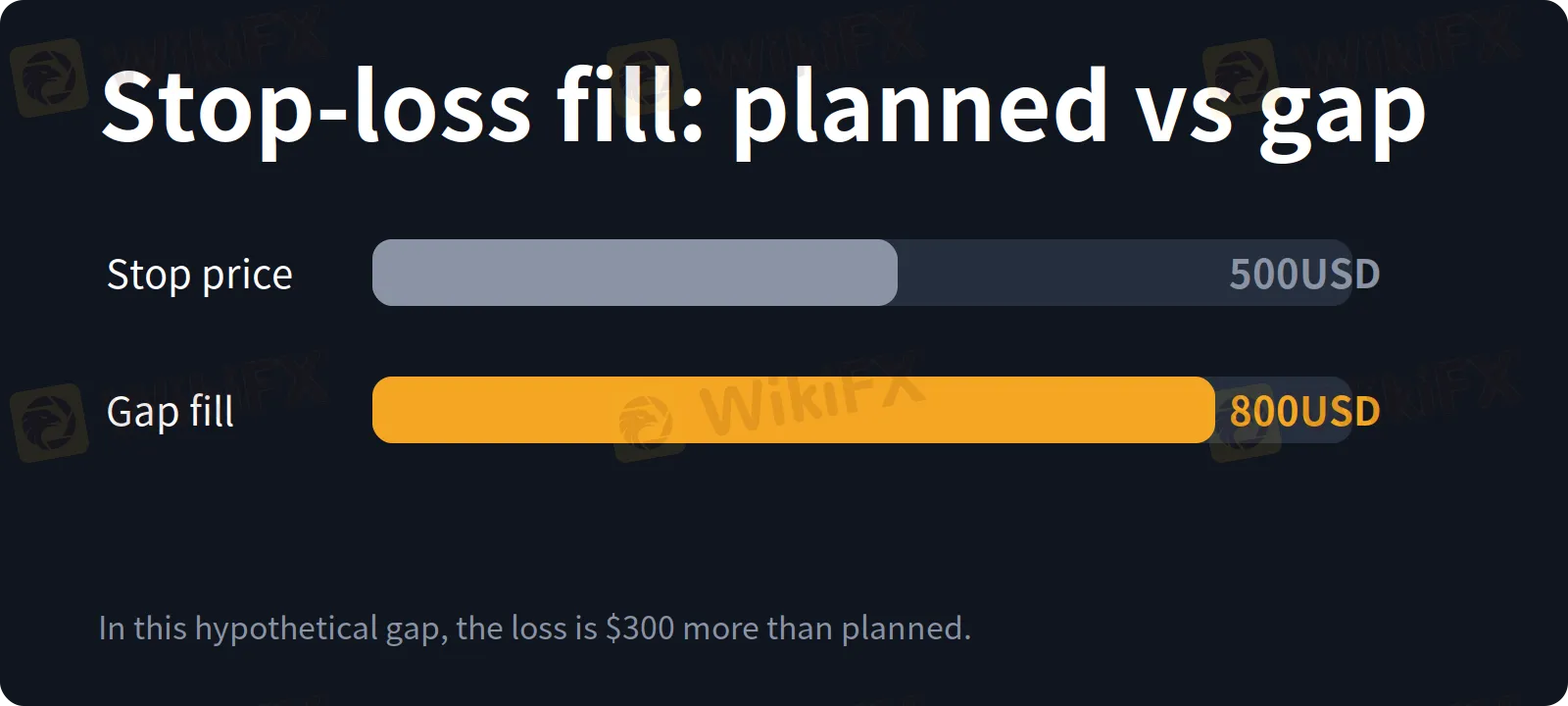
Hypothetical comparison: loss at stop level vs loss after a gap.
What These Costs Mean for a Risk Plan
The example changes how to think about stop-losses. A stop-loss is an instruction, not a promise. It can limit risk in normal conditions, but liquidity shocks can add unexpected slippage on top. The exact stop distance is only part of the picture.
- A sharply widening spread is a warning that execution has become uncertain.
- A margin cushion matters even when price is far from the stop, because unexpected slippage can reduce account equity. Equity means the current value of the account, including open positions valued at market price.
- Pair choice can affect execution risk. Major pairs like EURUSD usually have deeper liquidity, while currencies with lower trading volumes, including many African currency pairs, can show wider gaps and larger spread jumps more often. That is not a reason to avoid them; it is a reason to expect higher execution risk in those moments.
- Some traders decide before a news event whether they will reduce size or stand aside. Removing last-minute pressure is a personal choice, not a rule.
Liquidity risk is not a direction signal. It does not tell a trader whether price will rise or fall. It tells a trader how much a trade may cost between the moment of intending to enter and the moment the order is actually filled. Understanding that cost is a core part of forex education. A trader who sees execution as part of the plan is usually better prepared when shocks occur.
ڈس کلیمر:
یہ مضمون صرف مصنف کی ذاتی رائے پر مبنی ہے، یہ پلیٹ فارم کی سرمایہ کاری کی مشورہ نہیں ہے۔ پلیٹ فارم مضمون کی معلومات کی درستگی، مکملیت اور بروقت ہونے کی کوئی ضمانت نہیں دیتا، اور مضمون کی معلومات پر اعتماد یا استعمال سے ہونے والے کسی بھی نقصان کی ذمہ داری قبول نہیں کرتا۔
