

عالمی بروکر ریگولیشن چیک کرنے والا ایپ
WikiFX
اردو
简体中文
繁體中文
English
Pусский
日本語
ภาษาไทย
Tiếng Việt
Bahasa Indonesia
Español
हिन्दी
Filippiiniläinen
Français
Deutsch
Português
Türkçe
한국어
العربية
اردو


Why You Can't Accept a Forex Loss: The Sunk Cost Trap

WikiFX
|


خلاصہ۔:A beginner-friendly psychology article about why traders hold losing positions out of a break-even obsession. Learn what sunk costs are, see a hypothetical EUR/USD example, and find ways to observe your own emotional loop.
It starts with a small loss. You open a trade, the market moves against you, and you decide to wait until the price returns to your entry. The wait becomes longer, the loss becomes wider, and somewhere along the way you stop evaluating the trade and start defending a memory.
A sunk cost is money or effort already spent that you cannot get back. In forex, the global market where currencies are traded, it also includes the hours of watching charts and the emotional energy you put into a position. None of that can be recovered by waiting.
Many beginners make one quiet mistake: they treat their entry price, the price at which they opened the trade, as a promise from the market. They believe the price must return to their break-even point before they are allowed to leave. Break-even means the price returns to the entry level, so the trade shows neither profit nor loss. The market has no such memory, and it owes nothing to your entry. This article is educational. It explains the trap and gives you ways to observe it, but it will not tell you to hold or to close any trade.
 فہرست
فہرستThe Break-Even Illusion
As soon as a trade shows a loss, two questions start competing. The market question asks what is likely to happen next. The emotional question asks how to avoid the pain of admitting that the original idea was wrong. Most of the time, the emotional question wins.
Imagine a purely hypothetical trade. For this teaching illustration, assume a reference rate for EUR/USD, the euro against the US dollar currency pair, near 1.1593, and round it to 1.1600 for clarity. You decide to enter there, and the price falls 50 pips to 1.1550. A pip is a common unit of price movement in forex, usually the fourth decimal place. This example is for teaching only; it is not a recommendation to trade that pair at that level.
If you close now, the account records a loss. If you wait, the price may return to 1.1600, but it may also move further away. The painful part is that even if the price climbs to 1.1599, nothing says it will reach 1.1600. Break-even is a mental bookmark, not a market signal.
An unrealised loss is a loss on paper for a position that is still open. A position is another word for an open trade. This loss is not imaginary. Your account equity, meaning the current value of your account if you closed all open positions, has already changed by the time the market moves against the position. Closing the trade makes that change visible, but the market already did the damage. Waiting to avoid a loss does not avoid the loss; it often only changes when you have to face it.
Why the Trap Feels So Strong
The urge to wait for break-even is not a personal weakness. It comes from three normal mental shortcuts.
- Loss aversion: the pain of a loss is often stronger than the pleasure of an equal gain. Letting go feels unbearable, so the brain avoids it.
- Identity protection: losing a trade feels like losing face. Holding on seems to protect your reputation with yourself.
- Status quo bias: doing nothing feels safer than taking action. In reality, leaving a position unchanged is also a decision, and it is one you make every second you stay in it.
These shortcuts developed in a world where most threats were immediate. They are not built for markets, where the only thing flowing backwards is your equity.
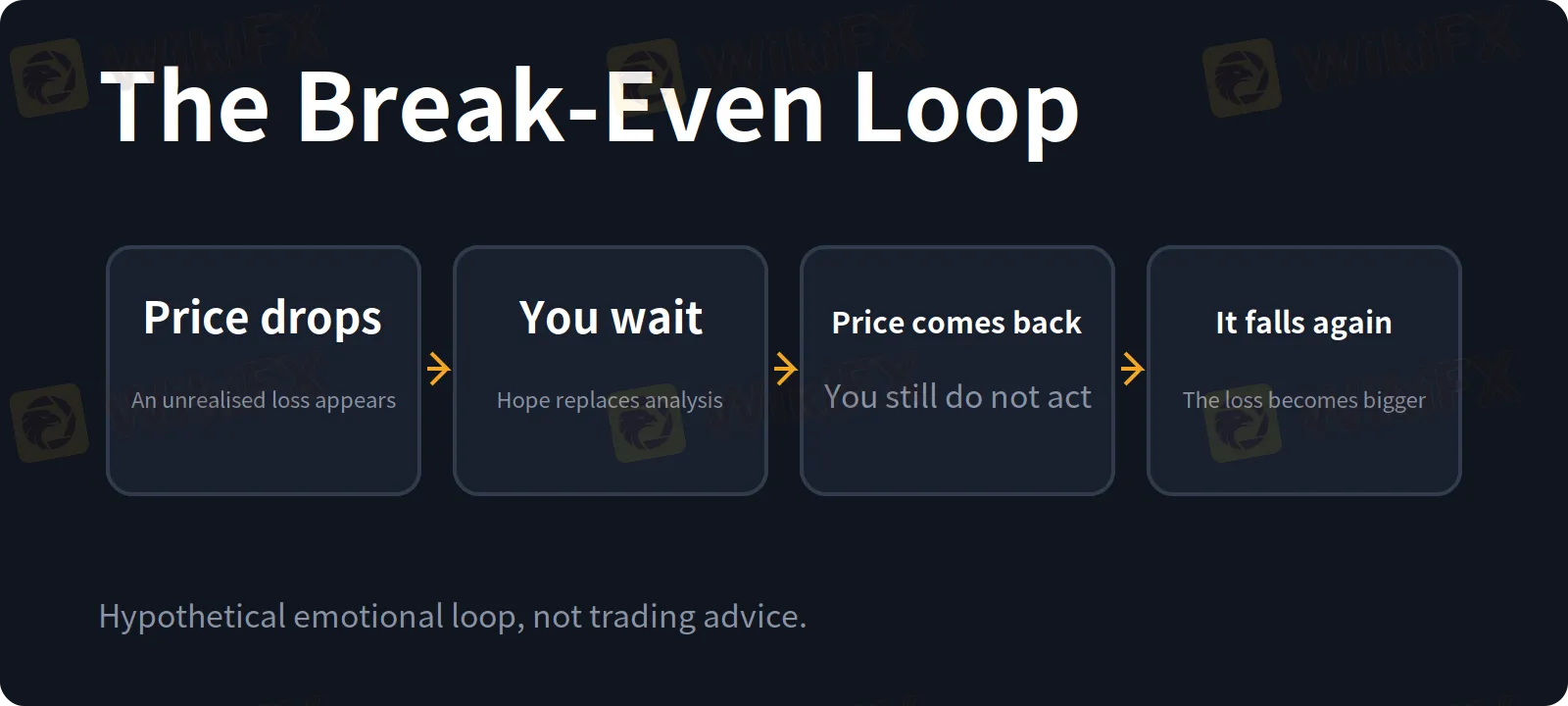
The loop repeats because every temporary recovery looks like proof that break-even is near.
Watching Yourself Instead of the Market
Instead of demanding that the price cooperate, you can catch the moment when a preference turns into a need. The ideas below are self-observation tools, not trading rules.
- Say the reason out loud: 'I am holding because I want my money back.' If this is the only reason you can find, you are describing a memory, not a market opportunity.
- Ask a future-only question: 'If I did not have this position, would I open it at the current price?' The answer is a mirror, not a signal.
- Keep a short journal. Write down your entry, the size of the loss, what you felt, and what facts supported your decision. Reread the pages after several trades and look for repeats.
- Test yourself on a demo account. A demo account is a practice account that uses play money rather than real cash. Treat it with the same seriousness as real money and observe whether the same wait-for-break-even pattern appears with play money. Seeing the pattern is the point.
What Accepting a Loss Really Means
Accepting a loss means accepting that a past price is no longer the centre of the map. You are not being asked to enjoy the red numbers on your screen, only to stop treating them as a personal verdict.
A loss is information. It tells you that your view did not match the market at that moment. It does not ask you to wait for an apology, and it never promises a second chance at the same price.
Every serious risk framework, or set of rules for how much you are willing to lose and how you will react before entering a trade, includes the idea that losses are normal. Whether any particular open position should be kept or closed depends on the plan you built before entering the trade, not on the hope you built after losing.
In the end, the cost you already paid is gone. The only question worth asking is what you want to do with your attention next. That shift, from defence to observation, is where many balanced trading habits begin.
ڈس کلیمر:
یہ مضمون صرف مصنف کی ذاتی رائے پر مبنی ہے، یہ پلیٹ فارم کی سرمایہ کاری کی مشورہ نہیں ہے۔ پلیٹ فارم مضمون کی معلومات کی درستگی، مکملیت اور بروقت ہونے کی کوئی ضمانت نہیں دیتا، اور مضمون کی معلومات پر اعتماد یا استعمال سے ہونے والے کسی بھی نقصان کی ذمہ داری قبول نہیں کرتا۔
