

عالمی بروکر ریگولیشن چیک کرنے والا ایپ
WikiFX
اردو
简体中文
繁體中文
English
Pусский
日本語
ภาษาไทย
Tiếng Việt
Bahasa Indonesia
Español
हिन्दी
Filippiiniläinen
Français
Deutsch
Português
Türkçe
한국어
العربية
اردو


Why FOMO Makes Forex Traders Chase Prices

WikiFX
|


خلاصہ۔:FOMO in forex is not about a missed opportunity; it is about a rushed decision. This beginner guide explains the psychology behind fear of missing out, uses a clearly hypothetical example, and shares self-observation methods for better decision quality.
Fear of missing out sounds like a social event problem, but in forex it shows up as a decision problem. FOMO is the uneasy feeling that everyone else is making money while you stand aside. For a beginner, that feeling can arrive within seconds after a price move appears on the chart. It makes a normal market moment feel like an emergency.
 فہرست
فہرستWhat FOMO Feels Like
Imagine a new trader watching a currency pair climb steadily. Each new bar on the chart seems to say the same thing: you are not in this move. The mind starts asking whether a quick entry can still catch the next part of the trend. That tension between standing still and acting quickly is not a market signal; it is the feeling of being left behind.
FOMO does not usually arrive as a loud alarm; it feels like gentle pressure that excuses small mistakes. A trader who would normally wait for a clear setup may suddenly think that one minute of delay will cost money. A stop-loss, which is the order you set to close a trade automatically if the market moves against you, may get moved farther away. Position size, the amount of money committed to one trade, may quietly grow.
Let's make this concrete with a pretend case. A trader decides in advance to risk only an amount they can afford to lose, but later the urge to join a sharp rise pushes that limit aside and the trader enters without a clear stop-loss. The move reverses and the loss is bigger than the original limit. This is only a hypothetical example to show a pattern, not a prediction or recommendation.
The Mental Shortcut FOMO Activates
Forex is built for quick comparisons. You see prices moving in real time, watch lines on your chart, and often hear about other traders' results. That environment turns on a mental shortcut called social proof: we assume that if many people are doing something, it must be right. FOMO borrows that shortcut and replaces analysis with reaction.
When you are in FOMO mode, your attention narrows. You watch the price that is moving and ignore the levels that show where the move could stop. You compare your empty account with the imagined profit of everyone else. In that state, the question changes from “does this trade fit my plan?” to “what if I miss the rest?”
Loss aversion plays a part too. People feel the pain of losing more strongly than the pleasure of gaining. FOMO turns an opportunity cost, the profit you could have made if you had taken another path, into a feeling of loss. The market moving without you starts to feel like money you have already lost, even though no trade was made.
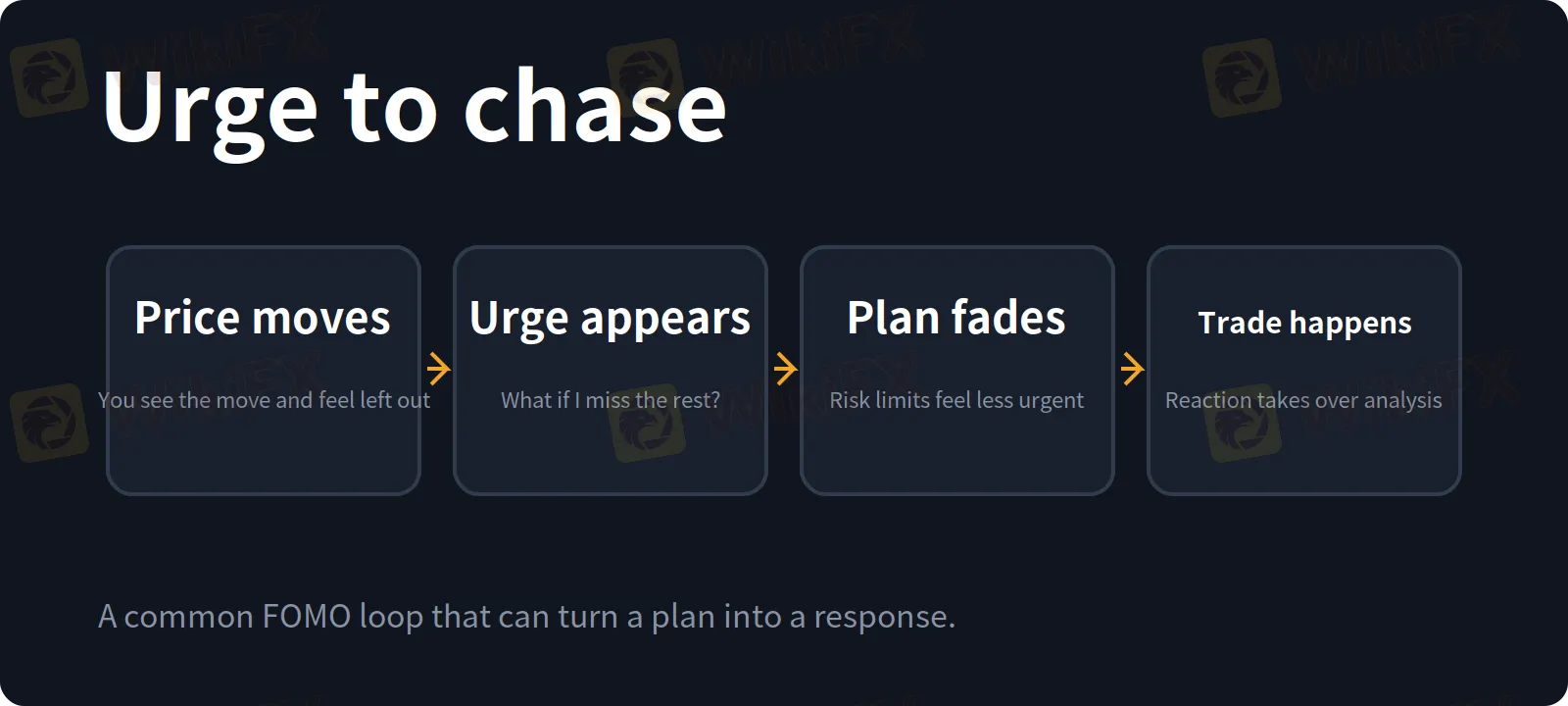
How FOMO can speed up a decision.
Raising the Quality of Your Decision
FOMO cannot be switched off completely, but you can learn to notice it before it becomes an order. The most useful habit is to keep a simple record of the moments when you feel the urge to enter. You do not need a complicated system; a few lines in a notebook can reveal a pattern.
- Write down the time of day, the currency pair, and what you saw right before the urge appeared.
- Write the reason the market might continue, not the reason you want it to continue.
- Write how much this trade could lose if the move reverses, using a number that is easy to understand.
If these questions are hard to answer, that is a useful signal in itself. A plan does not have to be perfect, but it should be clear enough to defend. The goal is not to predict the market; it is to know what you are reacting to.
Another exercise is a paper simulation. Choose a chart you are already watching and write what you would do if you entered. Then watch what happens without placing a real order. This is not a real trade, so it carries no profit or loss, but it trains you to observe the gap between impulse and outcome.
Common FOMO signs include refreshing the chart many times in one minute, feeling irritated when you read about a price move, or moving a stop-loss because the trade is not going your way. These signs are not failures. They are data points. Journaling them helps separate a market idea from an emotional reaction.
Decision quality is not about picking a winner. It is about how clearly you can see the reason for the trade. FOMO makes that reason blurry.
You cannot stop the market from moving without you. You can only choose how much attention your fear gets. The next time you feel that pull, you may not need a new strategy. You may just need to ask whether the decision comes from a plan or from the discomfort of standing aside.
ڈس کلیمر:
یہ مضمون صرف مصنف کی ذاتی رائے پر مبنی ہے، یہ پلیٹ فارم کی سرمایہ کاری کی مشورہ نہیں ہے۔ پلیٹ فارم مضمون کی معلومات کی درستگی، مکملیت اور بروقت ہونے کی کوئی ضمانت نہیں دیتا، اور مضمون کی معلومات پر اعتماد یا استعمال سے ہونے والے کسی بھی نقصان کی ذمہ داری قبول نہیں کرتا۔
