

عالمی بروکر ریگولیشن چیک کرنے والا ایپ
WikiFX
اردو
简体中文
繁體中文
English
Pусский
日本語
ภาษาไทย
Tiếng Việt
Bahasa Indonesia
Español
हिन्दी
Filippiiniläinen
Français
Deutsch
Português
Türkçe
한국어
العربية
اردو


Diversify into 4 strategies? Why risk can still double

WikiFX
|


خلاصہ۔:Diversification does not make risk disappear. This article shows how hidden correlation between strategies can push a 'safe' portfolio back toward the risk of a single bet.

 فہرست
فہرستThe beginner illusion: many buckets, less risk
When someone opens a demo account and splits capital across four currency strategies, the first relief is that the account line looks smoother. That feeling is normal, but it can be misleading. The strategies may be losing on different days, so the grey line hides how much each bet actually moves. The beginner assumption is usually simple: more strategies, lower risk. The more accurate statement is: more strategies, lower risk only if their moves do not arrive together.
Risk is the likelihood that your account suffers losses larger than expected, and one common proxy is volatility. Volatility measures how widely a set of returns swings around its average; in formulas it is written as σ. Diversification lowers volatility when the strategies are not perfectly correlated. But it does not erase the underlying chance of losing money, because the strategies may still share the same engine.
Correlation: the link that decides everything
Correlation, written as ρ, is a number from -1 to +1 that describes how two strategies move relative to each other. A +1 means they rise and fall in lockstep, 0 means no consistent relation, and -1 means one tends to rise when the other falls. Most real strategy pairs sit somewhere between 0 and 1, and the number changes over time.
Here is the arithmetic for two strategies. If you put weight w1 in strategy 1 and w2 in strategy 2, with volatilities σ1 and σ2 and correlation ρ, the combined variance is:
Portfolio variance = w1²σ1² + w2²σ2² + 2 × w1 × w2 × ρ × σ1 × σ2
Portfolio volatility is the square root of that number. The correlation term is the piece that can break the promise of diversification, and it is the part that beginners often forget.
Correlation is also not static. In calm markets, different forex strategies may look independent, with a correlation near zero. In a global risk-off event, when nervous investors sell risky assets and move into safer ones, many currencies move together. The correlation that mattered during normal weeks is not the correlation that matters during a crisis.
A hypothetical four-strategy portfolio
Here is a purely hypothetical calculation, not advice and not a forecast. Suppose a trader tests four strategies: Strategy A follows trends in EUR/USD, Strategy B trades the yen-dollar pair on longer swings, Strategy C trades breakouts in GBP/USD, and Strategy D fades short-term moves in AUD/USD. For this example, each strategy has an annual volatility of 12%.
If the trader assumes all four are completely independent, with correlation 0 between every pair, equal weights give:
Portfolio volatility = 12% / √4 = 6%
That looks excellent. Now assume the truth is messier: all four are driven by the same global risk-appetite factor, and each pair has correlation 0.8. The portfolio volatility becomes roughly 11.1%, not 6%. The risk the trader thought had disappeared did not vanish; it was still sitting inside the hidden correlation. The difference between 6% and 11.1% is almost double, which is exactly why many strategies alone is not a safety guarantee.
The exact number depends on the correlation estimate. If correlation is 1, the portfolio volatility is 12%, no better than holding one strategy. If correlation is 0, it is 6%. Real portfolios sit between those cases, and no one knows the future value of ρ.
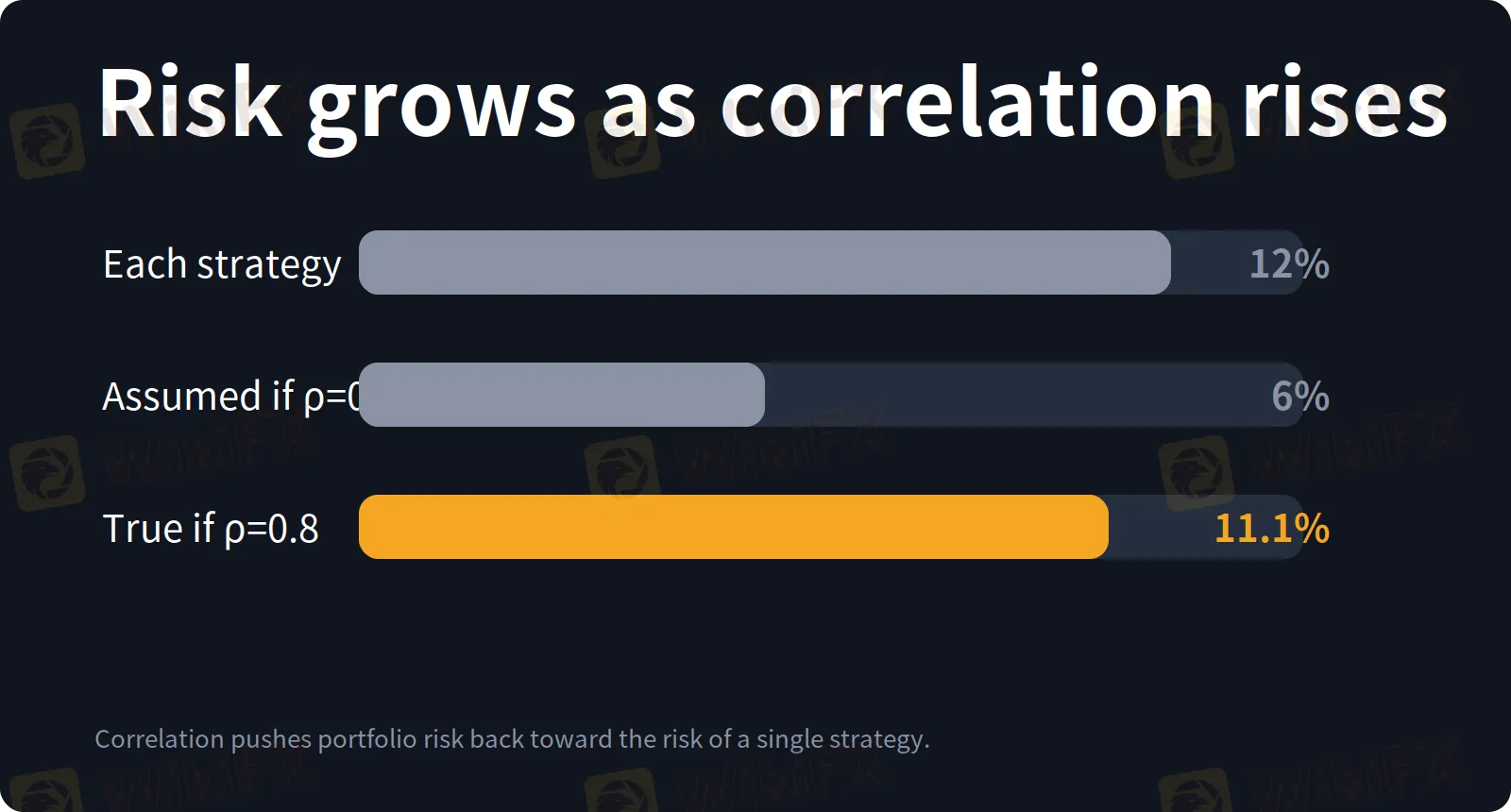
Hypothetical annual volatility values used in the example.
What diversification can and cannot do
Diversification lowers the average daily swing when correlations are low. It does not eliminate the worst-case loss, because extreme markets tend to push correlations upward.
Common beginner mistakes include:
- Confusing low realised correlation with a permanent relationship. A pair of strategies that was uncorrelated for years can become highly correlated when the market environment changes.
- Judging diversification by the number of strategies rather than by the number of independent drivers. Four strategies all betting on the direction of the US dollar are one bet in disguise.
- Treating a portfolio's smooth historical line as proof of safety. Historical correlation is only a starting point, not a promise.
Diversification is a tool for changing the shape of risk, not a spell that removes it. When you hear the claim that a portfolio is diversified, the useful question is: diversified against what, and what would make all of these strategies lose at the same time?
ڈس کلیمر:
یہ مضمون صرف مصنف کی ذاتی رائے پر مبنی ہے، یہ پلیٹ فارم کی سرمایہ کاری کی مشورہ نہیں ہے۔ پلیٹ فارم مضمون کی معلومات کی درستگی، مکملیت اور بروقت ہونے کی کوئی ضمانت نہیں دیتا، اور مضمون کی معلومات پر اعتماد یا استعمال سے ہونے والے کسی بھی نقصان کی ذمہ داری قبول نہیں کرتا۔
