

عالمی بروکر ریگولیشن چیک کرنے والا ایپ
WikiFX
اردو
简体中文
繁體中文
English
Pусский
日本語
ภาษาไทย
Tiếng Việt
Bahasa Indonesia
Español
हिन्दी
Filippiiniläinen
Français
Deutsch
Português
Türkçe
한국어
العربية
اردو


Pocket Option Review: Complaints, Regulation Gaps, and Account-Blocking Risks

WikiFX
|


خلاصہ:Pocket Option shows a high-risk profile on the supplied WikiFX data: a 1.74 score, no verified financial regulation listed, one Securities Commission Malaysia investor-alert disclosure, and heavy recent complaint volume. Some users praise the platform and low-entry trading, but the repeated reports of blocked accounts, delayed withdrawals, KYC disputes, and fund withholding make this broker unsuitable for traders who cannot absorb account-access or withdrawal risk.
Executive Summary (TL;DR): Pocket Option has been operating since 2018 and has strong online visibility, but the available WikiFX data points to serious safety concerns. The broker has a WikiFX Score of 1.74, no verified financial regulator listed, one regulator disclosure from Malaysia, and 31 user complaints received by WikiFX in the past three months.
Before you find a broker and deposit real money, the first question is not whether the app looks smooth. It is whether you have a realistic path to recover funds if something goes wrong. In this review, Pocket Option presents a mixed picture: popular platform features and many user comments, but a weak safety profile for anyone trading Forex, crypto, stocks, or quick-trading products.
WikiFX identifies Pocket Option as a Costa Rica-based broker established in 2018. Its influence rating is listed as AAA, with visibility across markets including the United Arab Emirates, Armenia, Angola, Argentina, Austria, Australia, Azerbaijan, Bosnia and Herzegovina, Bangladesh, and Belgium. That reach may explain why the broker is frequently searched, but visibility is not the same as investor protection.
 فہرست
فہرستRegulation and Safety
The central issue is regulation. According to the supplied WikiFX safety data, Pocket Option has no related financial institution regulation found. The profile lists no regulator country and no active regulator details for the broker itself. That means the regulation status shown in the available data does not provide the kind of formal oversight you would expect from a strongly supervised Forex or CFD broker.
There is also a regulator disclosure. WikiFX records one disclosure from the Securities Commission Malaysia, under an investor alert list. The category is “Unauthorized,” with the reason given as “conducting unregulated activities.” The disclosure content says the list includes unauthorized websites, investment products, companies, and individuals carrying out or claiming to carry out regulated activities without permission from the Securities Commission, including securities dealing, derivatives dealing, fund management, investment advice, and related services. Pocket Option / Pocket Option Malaysia is referenced with the website https://pocketoption.com/en/ and the reason “conducting unregulated activities.”
For you as a trader, the practical problem is simple: if a broker has no verified regulator in the available data and has appeared in an investor alert, your protection may be limited. Disputes over withdrawals, KYC, pricing, or account closures may become much harder to resolve through an official compensation or complaint channel.
WikiFX Score and Visible Risk Signals
Pocket Options WikiFX Score is 1.74. Treat that as a live data point rather than a permanent judgment, but it is low enough to deserve attention before funding an account. WikiFX also notes several disadvantages: no regulation by any regulator, multiple exposure records, negative regulatory disclosure, and a high number of customer complaints.
The profile states that WikiFX received 31 user complaints about Pocket Option in the past three months. That complaint volume matters because the cases are not all about minor platform preferences. Several involve account blocking, failed withdrawals, deposit-credit issues, alleged slippage or time manipulation, and extended fund retention.
Platform and Account Access
Pocket Option uses a proprietary trading platform. The WikiFX software information says it supports mobile use and describes the experience as smooth. The listed downloads are Android apps including Pocket Broker, Pocket Analytics, Pocket Strategies, Pocket Option, Pocket Signals, and Pocket AI. The summary says iOS, Windows, MacOS, Web, and other application support are not available in the reviewed profile.
The software review also says the proprietary platform is highly customizable, supports multiple languages, offers good search functions, and provides clear fee reports. Those are useful features. The more important security detail is that the profile says the platform lacks two-step login and biometric authentication for safer login protection. If you use any Pocket Option account-access page, verify the official website before entering credentials and avoid reusing passwords across trading, email, and crypto-wallet services.
A proprietary platform is not automatically unsafe, but under weak or unclear regulation it can create extra trust issues. You depend heavily on the operators internal systems for pricing, execution records, balance history, and dispute evidence.
Trading Conditions and User Feedback
The structured WikiFX data does not provide official spreads, leverage, commissions, or account-type details. That limits how far this review can go on trading costs. The user cases, however, repeatedly mention quick trading, Forex, stocks, crypto, copy trading, demo accounts, low deposit requirements, and payout percentages that vary by asset.
Some users describe positive experiences: smooth withdrawals, easy onboarding, a simple demo account, educational articles, quick-trading tools, and useful platform guides. Others complain that payout rates can be low on certain assets, stock selection may be limited, crypto payouts may vary, and support can be inconsistent. For Forex traders, the key point is that attractive payout percentages or low entry requirements should not distract from withdrawal reliability and regulation risk.
Trader Complaints and Exposure Cases
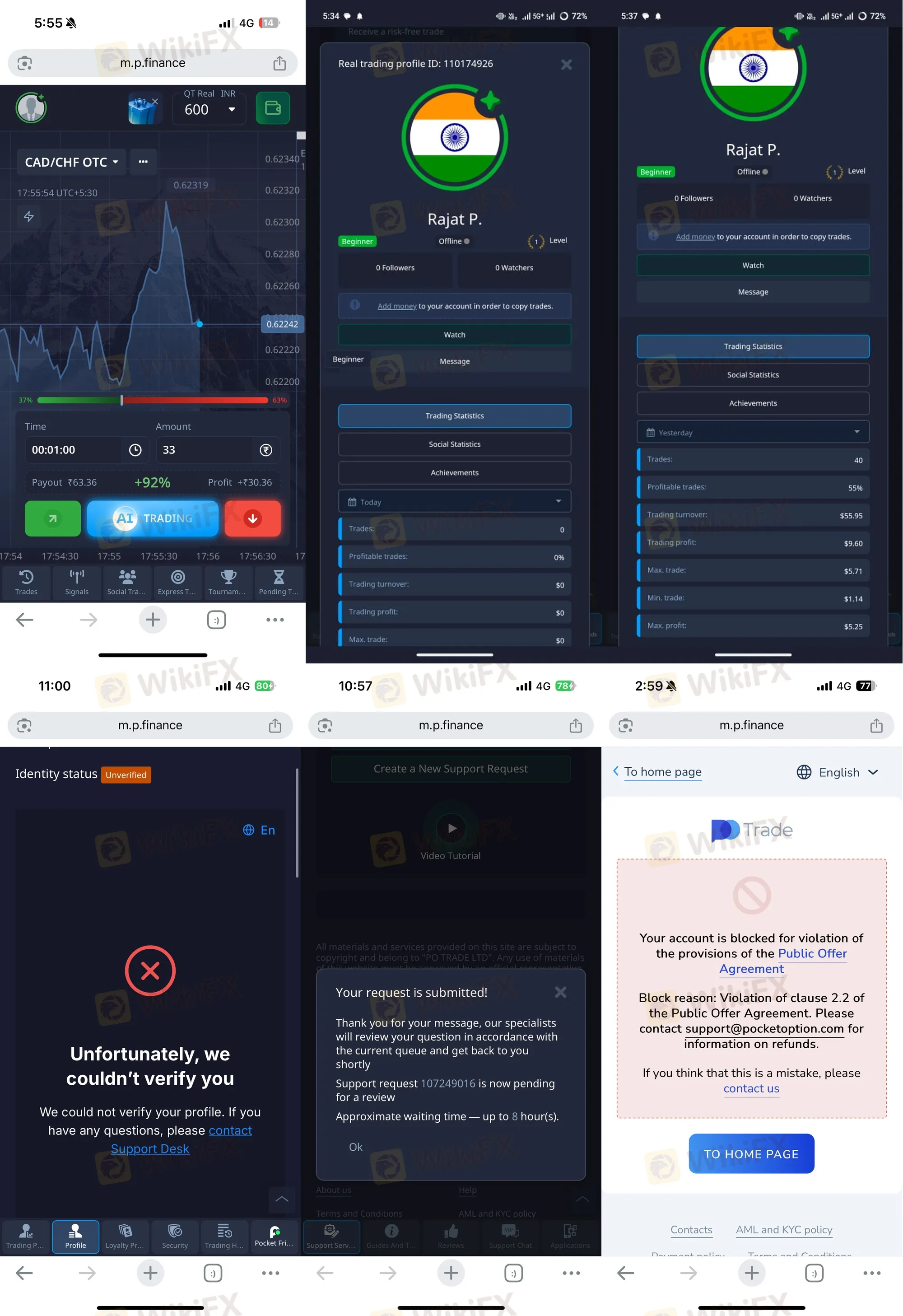
The complaint pattern is the strongest risk signal in the supplied cases. One Cyprus user said their account was blocked without payment after they had made money. A China-based user said they deposited 600, grew the balance to 1,400, then faced KYC rejection, delayed support, and account blocking under a public-offer clause when trying to withdraw. A similar case from Malaysia described the same deposit, profit, KYC rejection, and account-blocking sequence.
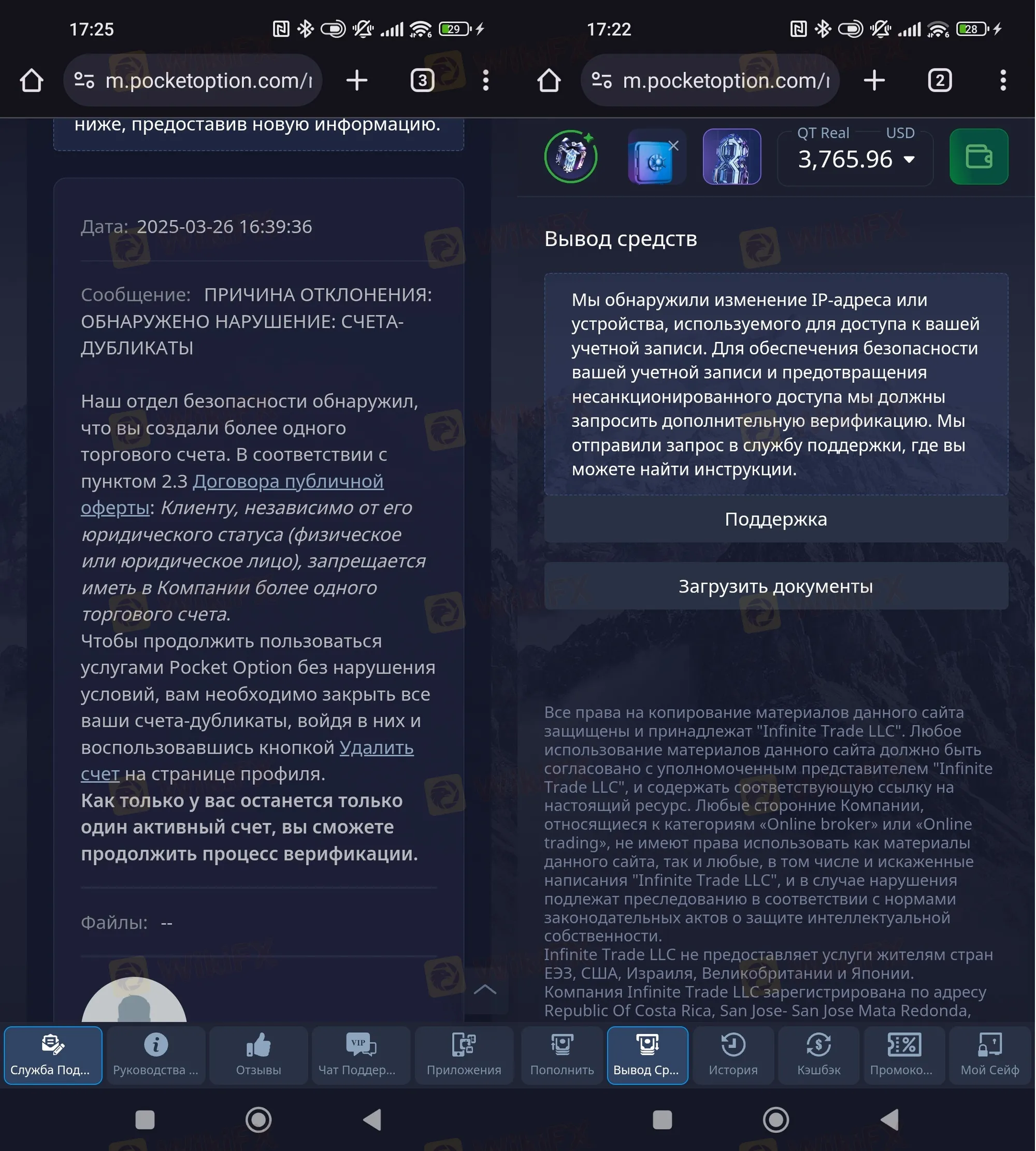
Larger fund disputes are also reported. A Venezuela user claimed Pocket Option withheld 12,000 USDT through Tether TRC-20 beyond the stated three-day processing time and provided automated responses. A Kazakhstan user reported depositing about 40,000 through several card payments, after which the account was blocked; the user said around 14,000 was recovered through chargebacks, while significant losses remained. An Israel user said a withdrawal of 3,765.96 USDT was frozen after KYC, with the broker citing a duplicate account issue.
There are also older cases alleging long-term retention. A Brazil user said 6,767 USD in profit remained unpaid for 293 days, and later described the dispute as lasting 406 days with the account blocked. A Honduras user reported a 2,000 withdrawal being repeatedly rejected with new excuses. Nigerian users reported failed withdrawals after verification, positions closing unexpectedly, and balance losses.
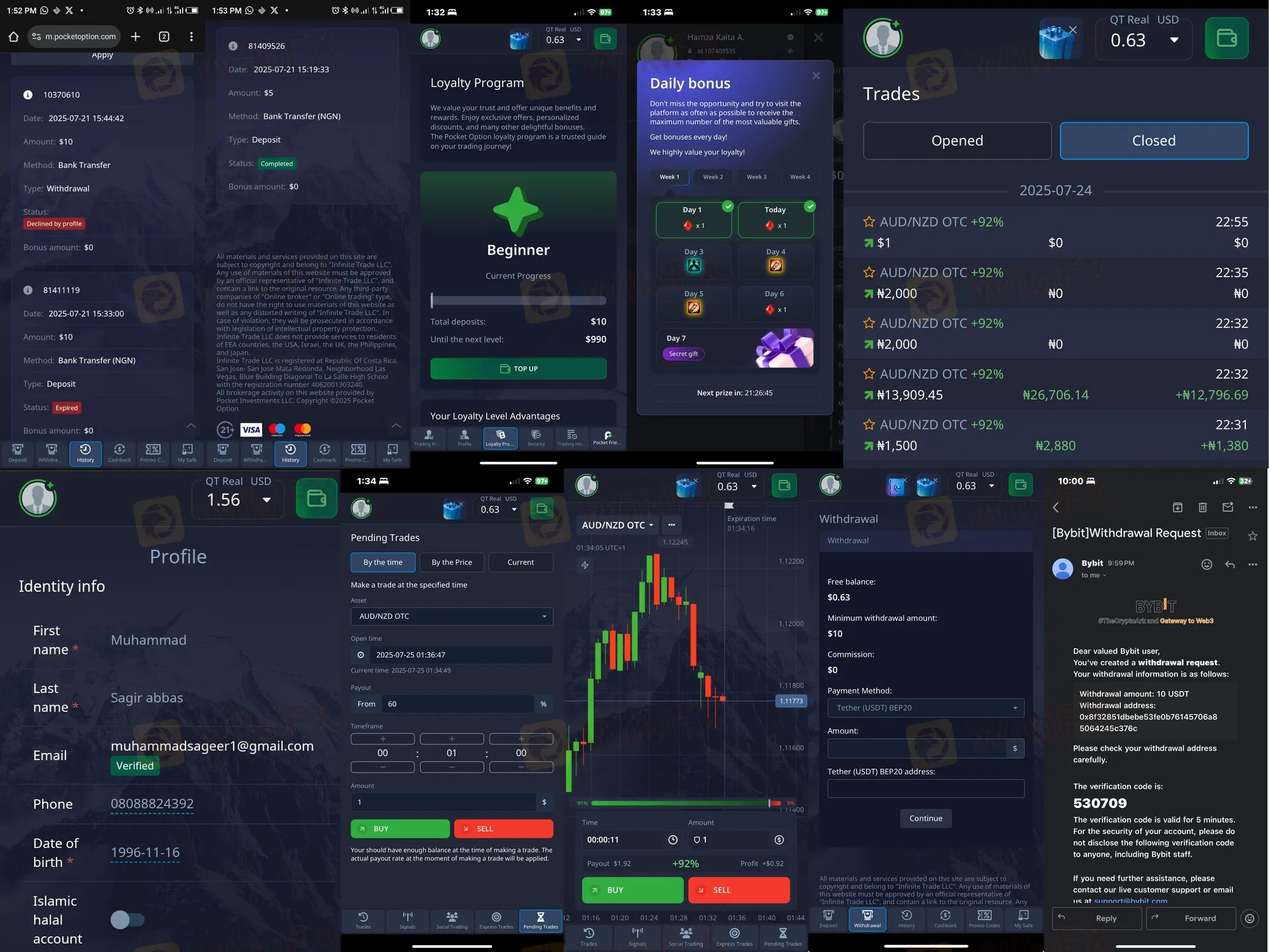
Not every case is negative. Some users from Oman, the Philippines, Thailand, Brazil, and the United Arab Emirates reported smooth withdrawals, useful education, responsive support, or a comfortable platform. Still, the negative cases are serious enough that you should test withdrawals early, keep screenshots of deposits, trades, KYC submissions, and support tickets, and avoid leaving large balances on the platform.
Deposits, Withdrawals, and Support
WikiFX lists English customer support through X, Facebook, phone, email, Instagram, and YouTube, including support@pocketoption.com and +44 20 8123 4499. The profile says support can answer most relevant questions, but waiting times may be long.
That aligns with mixed user feedback. Some users praised quick support; others described evasive or bot-like responses, slow ticket handling, frozen deposits, failed card funding, delayed withdrawals, and unresolved complaints. For a broker with low regulation confidence, support quality becomes more than convenience. It becomes part of the risk control process.
Final Verdict: Should I open an account?
Based only on the supplied WikiFX data and user cases, Pocket Option is a high-risk broker. The main concerns are the 1.74 WikiFX Score, no verified financial regulation listed, the Securities Commission Malaysia unauthorized-activity disclosure, and repeated exposure cases involving account blocking, KYC disputes, withdrawal delays, and alleged fund withholding.
If you still choose to test it, use a small amount, verify account requirements before trading, try a withdrawal early, and document everything. The available data is not strong enough to support a confident safety verdict, especially for larger deposits or serious Forex trading capital.
Status changes daily. Before depositing, check the WikiFX App for the latest real-time certificate.

ڈس کلیمر:
یہ مضمون صرف مصنف کی ذاتی رائے پر مبنی ہے، یہ پلیٹ فارم کی سرمایہ کاری کی مشورہ نہیں ہے۔ پلیٹ فارم مضمون کی معلومات کی درستگی، مکملیت اور بروقت ہونے کی کوئی ضمانت نہیں دیتا، اور مضمون کی معلومات پر اعتماد یا استعمال سے ہونے والے کسی بھی نقصان کی ذمہ داری قبول نہیں کرتا۔
